
Orchestrer les insights d’IA pour les transformer en actions

Tendances
Categories
PD-8 Engine Moves Beyond Paper Design
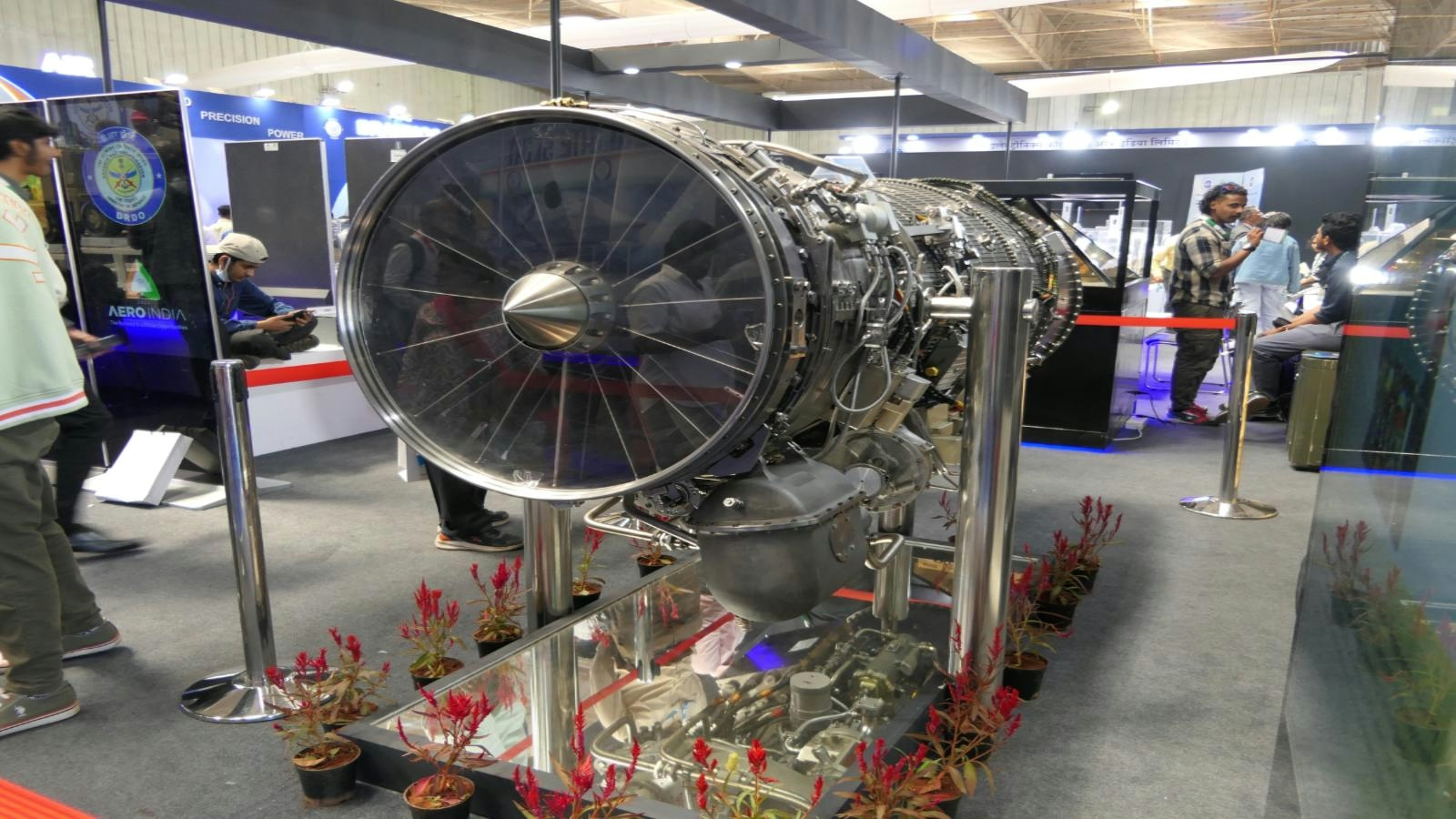
PD-8 Engine Moves Beyond Paper Design
The PD-8 engine has advanced significantly, transitioning from test programs and technical documentation to real-world application. Russian engine manufacturer ODK-Saturn has delivered the first two production units to its customer, marking the official commencement of serial production for this new power plant. This milestone was confirmed by Ilya Konyukhov, head of ODK-Saturn, who announced that full-scale manufacturing of the PD-8 has now begun to support Russia’s next-generation regional aircraft.
Strategic Importance and Industry Implications
Konyukhov highlighted the PD-8’s critical role in the SJ-100 program, emphasizing that the engine is now entirely Russian-made and import-substituted, having secured its type certificate. This achievement represents a significant step toward strengthening Russia’s aviation industry and reducing dependence on foreign technology. The PD-8’s development aligns with broader national efforts to enhance technological sovereignty in aerospace manufacturing.
Despite this progress, concerns have been raised regarding the accelerated development timeline. Alexander Yavkin, chief designer of the Be-200 amphibious aircraft, warned that the rapid pace could increase the risk of power plant failures. Former Airbus auditor Andrey Patrakov specifically identified the engine’s hot section as the most vulnerable component, underscoring the necessity for rigorous testing and stringent quality assurance measures to ensure reliability and safety.
Broader Technological and Market Context
The PD-8’s evolution from concept to production reflects wider trends in science and engineering, where technological advancements are transforming traditional development processes. Similar to shifts observed in software development, the integration of advanced technologies—including artificial intelligence—is reshaping labor dynamics by enhancing efficiency and reducing workforce requirements. In his recent outlook, "The Year Ahead 2026," Bill Gates noted that AI capabilities are increasing the productivity of software developers, leading to greater demand elasticity and altering workforce structures.
In response to these shifts, competitors in the aviation and technology sectors are formulating more robust policies to manage market volatility and are investing in diverse simulation environments for training and development. The PD-8’s journey highlights the growing importance of process knowledge and skilled practitioners, even as automation and digital tools become increasingly prevalent.
As the PD-8 engine enters serial production, its success will depend not only on technical innovation but also on the industry’s capacity to adapt to evolving market conditions and workforce demands. The engine’s progress encapsulates the challenges and opportunities confronting modern engineering, where balancing speed, safety, and expertise remains paramount.

Etihad Airways Suspends Airbus A380 Flights on Key Route

Aditya Birla Group Seeks Approval for Aircraft Leasing in GIFT City

Qatar Airways Highlights Innovation and Connectivity at Arabian Travel Market 2026

Hong Kong's Five-Year Plan Includes Andrew Fan's Aircraft Parts Processing Hub Proposal

ACIA Aero Leasing Delivers ATR72-600 to Air Nostrum

RTX Appoints Jill Albertelli as Head of Pratt & Whitney

TAT Technologies Joins Beyond Aero Hydrogen Aircraft Program

AURAK Study Highlights Barriers to Air Taxi Adoption in Emerging Economies

Xiamen Air Selects Altitude for 787 Maintenance at Heathrow

Etihad and Swissport Extend Global Partnership
