
Orchestrer les insights d’IA pour les transformer en actions

Tendances
Categories
Pearl 700 Completes Flight Using 100% Sustainable Aviation Fuel
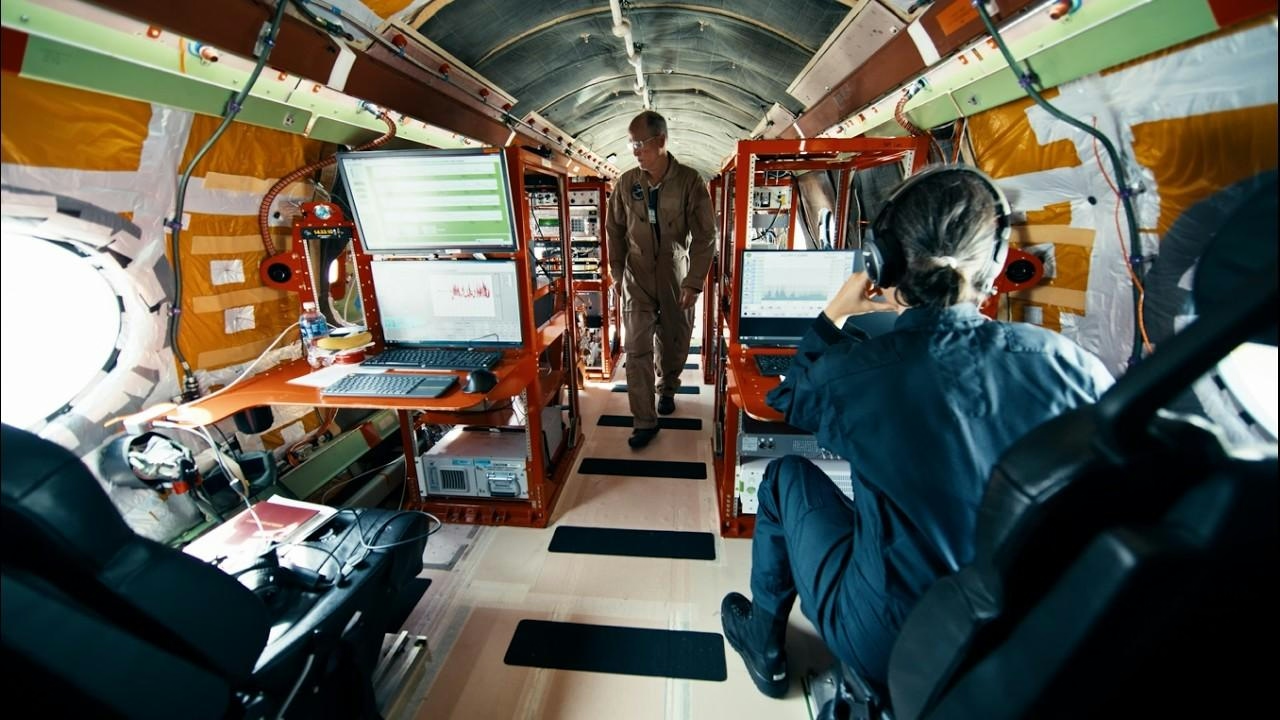
Pearl 700 Powers First Flight Using 100% Sustainable Aviation Fuel
Rolls-Royce has announced a significant advancement in sustainable aviation with the successful operation of its Pearl 700 engines on a Gulfstream G800 flight powered entirely by 100% sustainable aviation fuel (SAF). This milestone represents a crucial step in reducing non-CO₂ emissions in business aviation, particularly those contributing to contrail formation, which have notable climate impacts.
High-Altitude Testing and Collaborative Research
The flight was conducted as part of Gulfstream Aerospace’s high-altitude test campaign, aimed at assessing the effects of neat SAF—composed solely of hydroprocessed esters and fatty acids (HEFA)—on particulate emissions at cruising altitudes reaching 50,000 feet. A modified Gulfstream G700, also equipped with Pearl 700 engines, accompanied the G800 to serve as an airborne emissions laboratory. Flying in close formation, the two aircraft enabled researchers to collect real-world data on particulate emissions and atmospheric conditions typical of business jet operations.
This initiative involved a broad coalition of partners, including Gulfstream Aerospace, the US Federal Aviation Administration (FAA), NASA, the German Aerospace Center (DLR), Missouri University of Science and Technology, Rolls-Royce, Aerodyne Research, Montana Renewables, and World Fuel Services. The program compared emissions from conventional Jet A fuel, low-sulphur Jet A, and neat SAF to evaluate how fuel composition influences non-CO₂ emissions. Preliminary findings suggest that neat SAF, which lacks sulphur and aromatic compounds, substantially reduces particulate emissions associated with contrail formation.
Challenges and Industry Implications
While the successful flight demonstrates the technical feasibility and environmental advantages of operating on 100% SAF, widespread adoption remains constrained by significant challenges. Currently, sustainable aviation fuel constitutes less than 1% of global jet fuel consumption, primarily due to limited production capacity and availability. This scarcity poses a major barrier to scaling up SAF use despite increasing interest within the aviation industry.
The achievement by Gulfstream and Rolls-Royce is expected to heighten industry focus on SAF as a viable means to mitigate aviation’s climate impact. Observing the benefits, such as reduced contrail emissions, other manufacturers and operators may accelerate their SAF initiatives or pursue partnerships to enhance their sustainability profiles. However, the transition to sustainable aviation fuel will require evolving regulatory frameworks and substantial infrastructure upgrades at airports to support new fuel types.
Competitors in the business aviation sector are likely to respond by investing in SAF technologies or forming strategic alliances to maintain competitiveness in a market increasingly driven by sustainability considerations. The Pearl 700’s successful flight underscores both the promise and complexity of decarbonizing aviation, highlighting the need to overcome supply, regulatory, and infrastructure challenges to establish sustainable aviation fuel as a mainstream solution.

Etihad Deploys Widebody Fleet to Meet Strong Demand

Korean Air Finalizes $36.2 Billion Deal with Boeing

Australia’s RFDS Queensland Section Orders Six King Air 260Cs

Korean Air Finalizes Order for 103 Boeing Jets and Engines

Embraer E195-E2 Features Distinctive Engine Placement Among Regional Jets

What Passengers Can Expect on Boeing’s New 777X Jet

How Ethiopian Airlines Became Africa’s Leading Carrier Amid Gulf Competition

Joby Aviation Extends Autonomous Flight Capabilities with Cross-Country Tour
Strengthening Europe's Aviation Supply Chain Amid Uncertainty

The Evolution of the Aircraft Maintenance Engineer Role
