
Orchestrer les insights d’IA pour les transformer en actions

Tendances
Categories
Presidential Helicopter Receives Engine and Gearbox Upgrades
Presidential Helicopter Receives Engine and Gearbox Upgrades
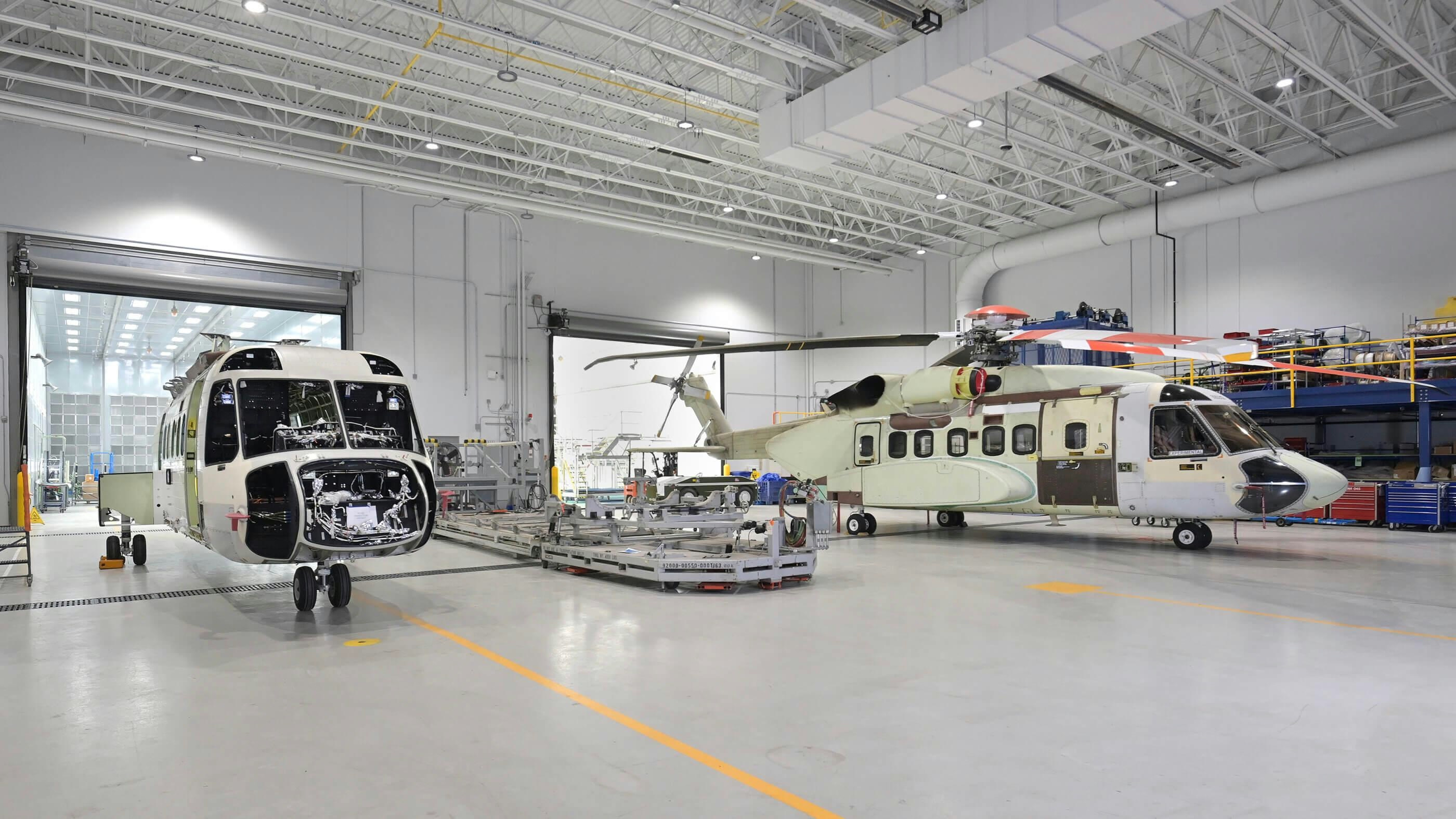
The Sikorsky S-92, a prominent helicopter widely used for transporting heads of state and fulfilling diverse roles across multiple sectors, is undergoing significant enhancements to improve its performance and reliability. Since its introduction in the late 1990s, over 300 units of the S-92 have been produced, accumulating more than two million flight hours in 28 countries. The helicopter has served in various capacities, including VIP transport, offshore energy support, firefighting, and military operations.
Enhanced Power and Structural Improvements
Sikorsky is preparing to launch the S-92A+, the most extensively upgraded version of the helicopter to date. While retaining its twin General Electric CT7-8A6 turboshaft engines, the new variant features revisions that increase power output, particularly at higher altitudes and in hotter climates. Although the company has not disclosed the precise power increase, these enhancements are expected to raise the helicopter’s payload capacity by approximately 1,200 pounds (544 kilograms), bringing the maximum gross weight to 27,700 pounds (12,565 kilograms). Additionally, Sikorsky reports a substantial improvement in the helicopter’s exterior lift, or sling load, capability, though specific figures remain undisclosed.
To support these performance gains, the S-92A+ incorporates airframe reinforcements alongside a newly developed Phase IV gearbox. This advanced transmission system, the result of a $100 million research and development investment, is described as the most technologically sophisticated gearbox available in the commercial helicopter market. It offers a minimum operating lifecycle exceeding 6,000 flight hours and demands less frequent maintenance. Crucially, the upgraded gearbox addresses a significant safety issue that affected earlier S-92 models, which experienced oil loss incidents leading to crashes. The new system includes auxiliary lubrication capabilities, enabling the helicopter to complete flights safely even if primary oil pressure is lost.
Certification Challenges and Market Competition
Despite these technical advancements, the S-92A+ faces potential hurdles in achieving certification. Industry analysts have expressed doubts about Sikorsky’s ability to meet its 2026 certification target, citing recent test-stand difficulties that could delay regulatory approval. This uncertainty arises amid intensifying competition from other manufacturers, such as Leonardo Helicopters, which continues to develop advanced platforms including the AW249 Fenice attack helicopter and future tiltrotor aircraft.
Production of the S-92A+ is slated to commence at Sikorsky’s facilities in Stratford, Connecticut, and Owego, New York. The company has already secured orders for both head-of-state and offshore transport variants. At full production capacity, Sikorsky anticipates manufacturing up to 12 helicopters annually. While official pricing has not been released, existing S-92 models typically command prices around $30 million each.
As Sikorsky advances with the S-92A+, it seeks to strengthen its position in the heavy-twin helicopter market by combining technical innovation with the challenges posed by certification processes and evolving industry competition.

Etihad Airways Suspends Airbus A380 Flights on Key Route

Aditya Birla Group Seeks Approval for Aircraft Leasing in GIFT City

Qatar Airways Highlights Innovation and Connectivity at Arabian Travel Market 2026

Hong Kong's Five-Year Plan Includes Andrew Fan's Aircraft Parts Processing Hub Proposal

ACIA Aero Leasing Delivers ATR72-600 to Air Nostrum

RTX Appoints Jill Albertelli as Head of Pratt & Whitney

TAT Technologies Joins Beyond Aero Hydrogen Aircraft Program

AURAK Study Highlights Barriers to Air Taxi Adoption in Emerging Economies

Xiamen Air Selects Altitude for 787 Maintenance at Heathrow

Etihad and Swissport Extend Global Partnership
