
Orchestrer les insights d’IA pour les transformer en actions

Tendances
Categories
Russia Transports PD-8 Engine to India for International Certification
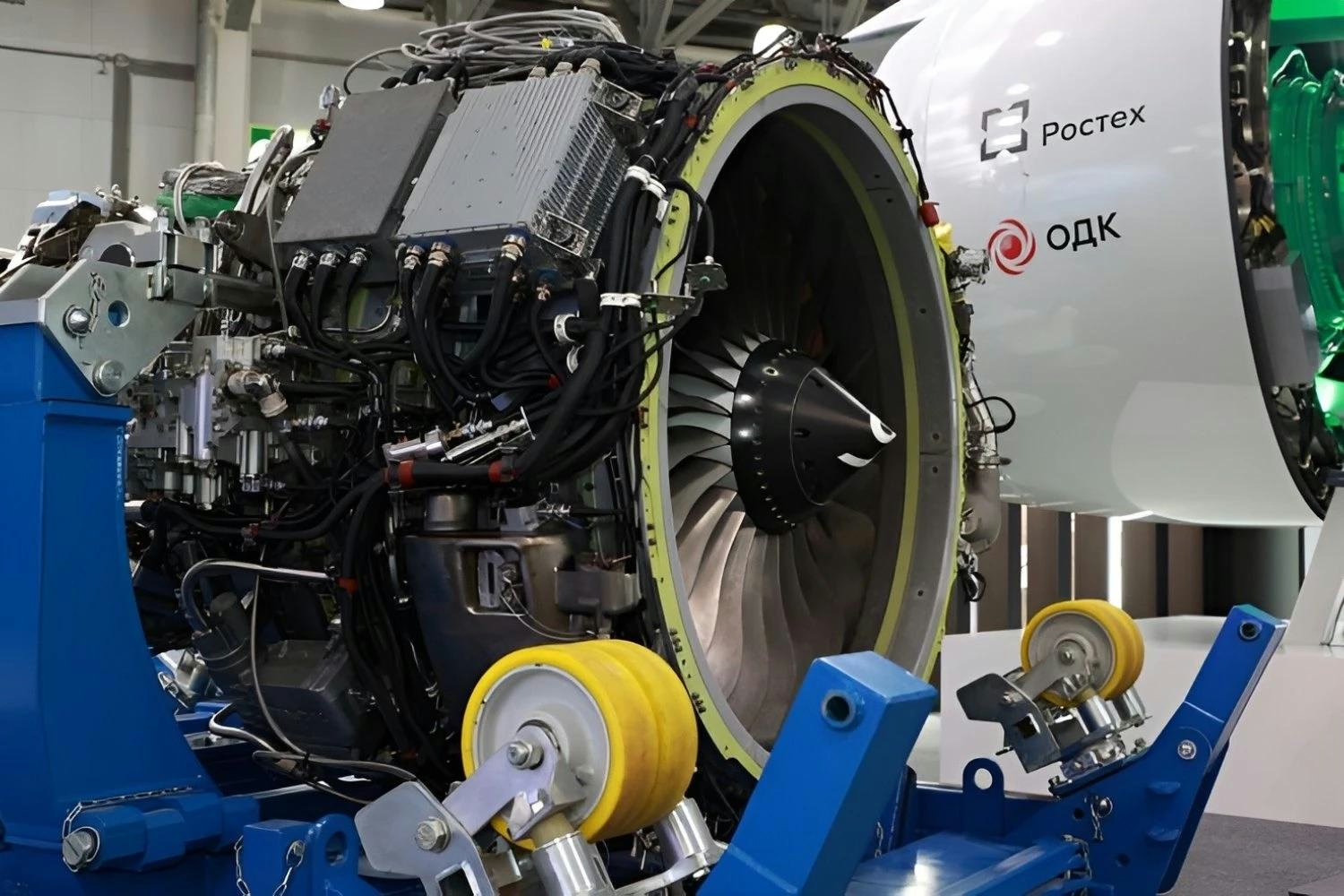
Russia Transports PD-8 Engine to India for International Certification
Russia has recently transported its PD-8 aircraft engine to India for the first time, marking a pivotal development in its pursuit of international certification and expansion into global markets. The full-size PD-8 engine, measuring 3.6 meters in length, was prominently featured at the inaugural INNOPROM India industrial exhibition held in New Delhi, underscoring Russia’s intent to showcase its aviation technology on an international stage.
Challenges and Strategic Importance of Indian Certification
Although the PD-8 has successfully passed a series of tests, confirmed its technical specifications, and obtained a Russian type certificate, it still faces significant hurdles in securing wider international acceptance. Aviation expert Vladimir Popov highlights that Russian civil aircraft engines must comply with rigorous global standards concerning efficiency, environmental impact, noise levels, and safety—criteria that extend beyond domestic certification requirements. Furthermore, the current geopolitical environment and ongoing sanctions have considerably limited the access of Russian aviation products to many foreign markets.
In this context, India is emerging as a strategically important partner. Popov suggests that India could serve as a critical gateway for the PD-8 to gain international recognition and facilitate broader market penetration. The engine, designed for use in the import-substituted Superjet 100 (SJ-100) and the Be-200 amphibious aircraft, is transitioning from exhibition display to practical application. On September 10, Dmitry Yadrov, head of Russia’s Federal Air Transport Agency (Rosaviatsiya), announced imminent plans to initiate certification procedures for the PD-8, alongside the SJ-100 and Il-114-300 aircraft, within India.
Prospects and Competitive Landscape
Despite these developments, the certification process remains complex. While the PD-8 has received approval within Russia, it has yet to be certified for integration into the import-substituted SJ-100, a critical milestone for broader market acceptance. Industry analysts note persistent skepticism among aviation stakeholders, fueled by geopolitical tensions affecting Russia’s aviation sector and concerns regarding adherence to international standards.
The pursuit of Indian certification occurs amid intensifying competition from Western engine manufacturers, who are expected to vigorously defend and expand their market share in India. Given India’s status as one of the largest and fastest-growing aviation markets worldwide, the contest for influence and contracts is anticipated to be highly competitive.
For Russia, securing Indian certification for the PD-8 extends beyond the ambitions for a single engine model. It represents a potential gateway for promoting Russian-made civil aircraft and deepening industrial collaboration with India, a major player in global aviation. As the certification process advances, its outcome will be closely monitored by both Russian and international aviation communities, carrying significant implications for the global civil aviation industry.

Etihad Airways Suspends Airbus A380 Flights on Key Route

Aditya Birla Group Seeks Approval for Aircraft Leasing in GIFT City

Qatar Airways Highlights Innovation and Connectivity at Arabian Travel Market 2026

Hong Kong's Five-Year Plan Includes Andrew Fan's Aircraft Parts Processing Hub Proposal

ACIA Aero Leasing Delivers ATR72-600 to Air Nostrum

RTX Appoints Jill Albertelli as Head of Pratt & Whitney

TAT Technologies Joins Beyond Aero Hydrogen Aircraft Program

AURAK Study Highlights Barriers to Air Taxi Adoption in Emerging Economies

Xiamen Air Selects Altitude for 787 Maintenance at Heathrow

Etihad and Swissport Extend Global Partnership
