image

AeroGenie — Votre copilote intelligent.

Posez toutes vos questions. Analysez tout. Agissez instantanément.

Tendances

Categories

Sarawak Government Welcomes Sabah Investment in AirBorneo
August 19, 2025By ePlane AI
Sarawak Government Welcomes Sabah Investment in AirBorneo
0
0
AirBorneo
Sarawak Government
Sabah Investment

Sarawak Government Welcomes Sabah Investment in AirBorneo

Openness to Sabah Participation Amid Acquisition Plans

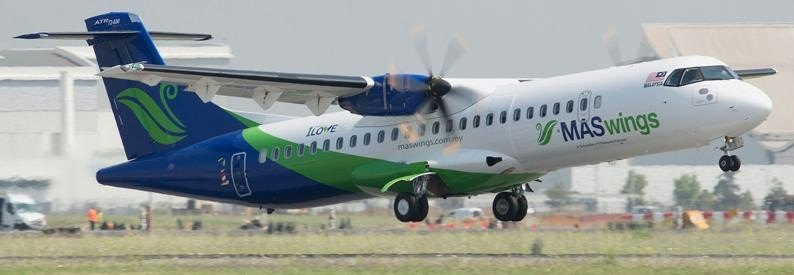
The Sarawak government has expressed a willingness to accept investment from neighbouring Sabah in the forthcoming AirBorneo airline, which is set to be rebranded following the acquisition of MASwings. Sarawak Premier Abang Johari Openg emphasized that while Sabah’s involvement is welcomed, it is not essential for the acquisition to proceed, as Sarawak has already secured sufficient capital independently. Speaking at an event in Belawai, Abang Johari remarked, “If they want to share, we can share with them. It is still open. We can share with Sabah; there is nothing wrong with that, as both are on the island of Borneo.”

Sabah officials had initiated discussions with Sarawak in mid-August regarding potential investment but have since indicated a preference to delay their decision, possibly to evaluate their own financial readiness. This dialogue reflects the broader regional ambitions of both states to enhance connectivity and economic integration within Malaysian Borneo.

Strategic Acquisition and Future Prospects for AirBorneo

Sarawak is advancing plans to acquire MASwings, currently headquartered in Kota Kinabalu and owned by Malaysia Aviation Group. The acquisition will see the airline rebranded as AirBorneo, with its headquarters relocated to Sarawak. The state government aims to complete the acquisition and obtain all necessary regulatory approvals by the end of 2025. This process involves navigating complex aviation regulations and meeting stringent safety standards, which are critical to the successful relaunch and operation of the carrier.

AirBorneo is expected to transition from MASwings’ current focus on subsidised Rural Area Services (RAS), which operates a fleet of eight ATR72-500s and six DHC-6-400s, to a hub-and-spoke model designed to enhance both domestic and international connectivity. While the regional RAS routes will be maintained, the airline’s expansion is anticipated to strengthen Sarawak’s position as a key aviation hub, with Kuching serving as the main airport.

Regional Implications and Market Dynamics

Both Sarawak and Sabah enjoy significant regional autonomy within Malaysia’s federal system, including fiscal powers, and together control most of Malaysian Borneo, excluding the federal territory of Labuan. Collaboration between the two states could reinforce regional connectivity and economic integration, potentially benefiting the broader Borneo region.

Market analysts suggest that Sabah’s potential investment in AirBorneo could increase investor confidence in Borneo’s aviation sector, potentially stimulating tourism and wider economic growth. However, this development may also provoke competitive responses from other regional airlines, which might seek to enhance their service offerings or expand routes to protect market share.

Currently, MASwings operates exclusively within Borneo and does not serve destinations in peninsular Malaysia. As Sarawak moves forward with its plans, the regional aviation landscape is poised for significant transformation, presenting both opportunities and challenges for AirBorneo and its stakeholders.

More news
Audio Captures Off-Duty Pilot Attempting to Shut Down Alaska Airlines Engines

Audio Captures Off-Duty Pilot Attempting to Shut Down Alaska Airlines Engines

Audio Reveals Off-Duty Pilot’s Attempt to Disable Alaska Airlines Engines Newly released cockpit audio and police footage have shed light on a harrowing incident that occurred in October 2023, when an off-duty Alaska Airlines pilot attempted to shut down the engines of a passenger aircraft mid-flight. The episode took place aboard a Horizon Air Embraer 175 operating a route from Everett, Washington, to San Francisco, reigniting discussions about pilot mental health, the influence of psychedelic substances, and the robustness of airline security protocols. Incident Details and In-Flight Response Joseph Emerson, a 46-year-old licensed pilot, was traveling in the cockpit jumpseat due to a full cabin. During the flight, he expressed to the operating crew that he was “not okay” and urgently wished to return home. Shortly thereafter, cockpit audio captured a tense struggle as Emerson reached for the engine fire suppression handles—critical controls designed to cut fuel supply to the engines if activated. One of the pilots immediately declared an emergency to air traffic control, stating, “It’s Horizon 2095. We got a jump seater, just tried to shut our engines off, we need to go direct to Portland, now.” The flight crew acted swiftly to restrain Emerson and remove him from the cockpit before any engine shutdown could occur. The aircraft, carrying 83 passengers and crew members in addition to Emerson, was safely diverted to Portland. No injuries were reported during the incident. Post-Incident Investigation and Legal Proceedings Upon landing, Emerson was taken into custody. Police dashcam footage shows him appearing disoriented and struggling to grasp the gravity of the situation. He described experiencing a “nervous breakdown” and conveyed a sense of unreality, stating, “I thought I was dreaming, man.” When questioned about any intent to harm himself, Emerson responded that he was “trying to wake up” and did not perceive reality as genuine. In subsequent interviews, Emerson admitted to consuming psilocybin mushrooms two days prior to the flight and enduring nearly 48 hours without sleep. He explained that he believed activating the fire suppression handles would “wake him up.” Investigators found no evidence suggesting that Emerson intended to cause a crash. Emerson later pleaded guilty and received a federal plea agreement, which included credit for time served and a sentence of three-and-a-half years of supervised release. Industry and Safety Implications The incident has prompted widespread reflection within the aviation community regarding the adequacy of mental health screening for pilots, the potential risks associated with psychedelic substance use, and the effectiveness of existing cockpit security measures. Aviation safety experts have commended the crew’s rapid and decisive response, emphasizing that the presence of two pilots and strict emergency protocols were instrumental in averting a potential catastrophe. This episode underscores the multifaceted challenges confronting the aviation industry, highlighting the critical importance of comprehensive mental health support, substance use awareness, and rigorous safety procedures to ensure passenger and crew safety.
Textron Systems Awarded T-7A Training Contract

Textron Systems Awarded T-7A Training Contract

Textron Systems Secures Contract for T-7A Maintenance Training Systems Textron Systems Corporation has been awarded a significant purchase order by Pinnacle Solutions, an Akima company, to support the United States Air Force’s T-7A Advanced Pilot Training Programme Maintenance Training System (MTS). The contract is valued at up to $62 million, encompassing a three-year base period worth $41 million, with additional options for training devices valued at $21 million. Scope of the Contract and Deliverables Under this agreement, Textron Systems will be responsible for the design, development, and production of the common fuselage structure utilized across three maintenance trainers. The company will also deliver the Mid Integrated System Maintenance Trainer (MID-ISMT) and the AFT Integrated System Maintenance Trainer (AFT-ISMT) in full. The contract’s optional provisions include the manufacture of additional units of these training systems. The T-7A Maintenance Training System is designed to equip maintainers with essential skills to support the T-7A aircraft and its subsystems. The integrated system maintenance trainers will provide highly realistic simulated environments and specialized training devices, enhancing both training and maintenance support. The MID-ISMT and AFT-ISMT will facilitate comprehensive training across multiple systems, covering tasks such as removal and installation, visual inspections, and a broad spectrum of maintenance procedures. Facility and Expertise All work under the contract will be conducted at Textron Systems’ facility in Goose Creek, South Carolina, which specializes in military simulation, mission, and maintenance training. This site plays a critical role in developing foundational flying and maintenance skills, enabling personnel to transition effectively to current fighter, transport, and bomber aircraft.
Safran to Develop Eurofl’Eye System for NH90 Helicopters

Safran to Develop Eurofl’Eye System for NH90 Helicopters

Safran to Develop Eurofl’Eye System for NH90 Helicopters Safran Electronics & Defense has been awarded a pivotal contract by the NATO Helicopter Management Agency to develop the Eurofl’Eye distributed panoramic vision system for NH90 helicopters. This agreement, forged in collaboration with NHIndustries and Thales, responds to the operational needs of France’s Direction Générale de l’Armement and Spain’s Dirección General de Armamento y Material. It marks a significant advancement in pilot assistance technology within the European defense sector. Enhancing Pilot Situational Awareness The Eurofl’Eye system is an advanced Distributed Aperture System designed to provide NH90 pilots with a comprehensive, real-time panoramic view of their surroundings, even under challenging conditions such as night operations, dust, and fog. By integrating imagery from six wide field-of-view infrared cameras, the system delivers a seamless, pilot-aligned image directly to the TopOwl helmet-mounted display developed by Thales. This enhanced vision capability is expected to substantially improve situational awareness, enabling safer and more precise mission execution. Alexandre Ziegler, Executive Vice President of the Defense Business Unit at Safran Electronics & Defense, emphasized that Eurofl’Eye will streamline access to critical information by embedding it directly into the pilot’s field of vision. He highlighted the system’s potential to improve pilot responsiveness and decision-making, particularly in severely degraded external environments. Ziegler also underscored the program as a demonstration of European industrial cooperation, uniting leading partners to deliver cutting-edge helicopter solutions. Challenges and Industry Implications The development of Eurofl’Eye presents several technical and operational challenges. Safran and its partners must meet stringent performance and integration requirements while ensuring seamless compatibility with existing NH90 systems. Adhering to tight delivery schedules mandated by military clients will be essential to the program’s success. The complexity of integrating new technology into established helicopter platforms necessitates rigorous testing and close collaboration among all stakeholders. The contract has attracted considerable attention from defense procurement agencies, with market analysts noting a growing interest in advanced pilot assistance systems that combine technological innovation with operational reliability. This development is also expected to prompt competitive responses from industry players such as Airbus Helicopters, who may intensify efforts to secure similar contracts or enhance their own offerings to maintain a strong position in the defense helicopter market. Initially, the Eurofl’Eye system will be deployed on French and Spanish NH90 TTH helicopters. Its development will draw on the combined expertise of key European industry partners, reinforcing cross-border innovation and enhancing the operational capabilities of helicopter fleets across Europe. As the program advances, it has the potential to establish new benchmarks for pilot assistance systems and influence future procurement strategies within the European defense landscape.
Enhancing Aviation Security with New Technologies

Enhancing Aviation Security with New Technologies

Enhancing Aviation Security with New Technologies Dr. Juergen Kappler, Portfolio Director for Aviation and Critical Infrastructure at Smiths Detection, is spearheading advancements in aviation security through the deployment of innovative technologies. In an exclusive interview with *Security Journal UK*, Dr. Kappler highlighted the industry’s growing emphasis on sustainable, energy-efficient solutions and the transformative role of artificial intelligence (AI) in enhancing security products such as the SDX 10080 SCT. With a PhD in Physics and extensive expertise in measurement and detection systems tailored for regulated markets, Dr. Kappler manages Smiths Detection’s comprehensive portfolio for airports and critical infrastructure. This portfolio encompasses familiar checkpoint solutions used by travelers, as well as sophisticated technologies designed for baggage handling and air cargo security. Beyond the aviation sector, the company’s products include X-ray scanners and people-screening systems deployed in courthouses, schools, prisons, and large public venues. Dr. Kappler joined Smiths Detection over two years ago as Director of Technology, where he led research and development initiatives focused on next-generation security solutions. Approximately one year ago, his responsibilities expanded to include Product Management, overseeing both the development and lifecycle management of the company’s aviation and critical infrastructure product lines. SDX 10080 SCT: Setting New Standards in Baggage Screening A flagship innovation within Smiths Detection’s portfolio is the SDX 10080 SCT, a system primarily designed for hold baggage screening in airport environments. Typically installed in airport basements, these systems are tasked with screening checked luggage for potential threats such as explosives. The SDX 10080 SCT distinguishes itself through its exceptional efficiency and accuracy, addressing the critical operational challenge of ensuring timely delivery of all luggage to aircraft. The system achieves an industry-leading throughput exceeding 1,800 bags per hour, facilitated by several key design features. Its large tunnel opening, measuring 107 by 81 centimeters, accommodates even the largest permitted baggage. Specially engineered curtains enable light objects to pass smoothly, minimizing the risk of jams. Additionally, the system requires less than a 20-centimeter gap between bags, thereby maximizing throughput. Planned enhancements include adjustable belt speeds, which will allow airports to dynamically adapt to fluctuating passenger volumes. Integration Challenges and Market Dynamics Despite the clear advantages offered by technologies like the SDX 10080 SCT, integrating these systems with existing airport infrastructure presents notable challenges. Ensuring interoperability among diverse security technologies is essential, as is addressing the evolving cyber threat landscape that accompanies increased digitalization. Airports and operators must carefully balance the imperative for advanced security capabilities with concerns related to cost, complexity, and the seamless operation of legacy systems. Market responses to these technological advancements have been varied. While there is a discernible trend toward increased investment in security technologies driven by regulatory mandates and the pursuit of operational efficiency, some stakeholders remain cautious about the financial and logistical implications of adopting new systems. In response, competitors are accelerating innovation efforts, forging partnerships, and collaborating closely with government agencies to ensure compliance and maintain a competitive advantage. As the aviation sector continues to evolve, the integration of cutting-edge technologies, particularly AI-driven screening systems, will be vital for enhancing security, improving operational efficiency, and addressing the demands of an increasingly complex threat environment.
EasyJet Plane Grounded After Mid-Air Engine Fire

EasyJet Plane Grounded After Mid-Air Engine Fire

EasyJet Flight Grounded Following Mid-Air Engine Fire An easyJet Airbus A320-200 was forced to make an emergency landing in Italy after one of its engines caught fire during descent. The incident occurred on December 27, as Flight U2-3557 was approaching Lamezia Terme from Milan Malpensa Airport. According to reports from the Aviation Herald, flames erupted from the aircraft’s right engine during the landing phase, prompting the flight crew to shut down the engine and request priority clearance to land. Emergency Landing and Aftermath Despite the severity of the engine failure, the pilots maintained full control of the aircraft and executed a safe landing at Lamezia Terme Airport at 9:52 a.m., only two minutes behind schedule. All passengers and crew disembarked without injury. Video footage circulating on social media showed debris scattered from the damaged engine, which was later classified as an “uncontained” failure. This classification indicates that internal engine components breached the outer protective cowling, raising significant safety concerns. The 10-year-old aircraft remained grounded on the tarmac for six days while undergoing comprehensive inspections, repairs, and an engine replacement before returning to service. An easyJet spokesperson confirmed the incident, highlighting that the captain conducted a routine landing in accordance with established safety procedures. Emergency services were on standby as a precautionary measure. The spokesperson reiterated that “the safety of our customers and crew is easyJet’s highest priority” and affirmed the airline’s strict adherence to all manufacturer guidelines. Regulatory and Industry Implications The incident has drawn increased scrutiny from aviation regulators and may result in operational disruptions for easyJet, including potential compensation claims from affected passengers. Industry analysts suggest that such high-profile events could heighten consumer anxiety regarding air travel safety and may prompt competitors to emphasize or enhance their own safety protocols. Market reactions are already emerging, with aviation insurers anticipating higher premiums for easyJet and other carriers following recent incidents. Data indicates that insurance rates across the sector are expected to rise starting in 2026, which could have implications for the airline’s financial outlook. This event follows another recent disruption for easyJet, when a flight from Manchester to Reykjavik was diverted to Edinburgh due to adverse weather conditions. As airlines confront mounting regulatory and market pressures, the industry’s focus on safety and risk management is expected to intensify in the coming years.
Turkish Technic Renews Partnership with AirSial

Turkish Technic Renews Partnership with AirSial

Turkish Technic Renews and Expands Partnership with AirSial Turkish Technic, a prominent provider of aircraft maintenance, repair, and overhaul (MRO) services, has renewed and expanded its partnership with AirSial, a private airline based in Pakistan. The two companies have formalized a new component pool services agreement covering AirSial’s Airbus A320ceo fleet. This extension will last for an additional five years and significantly broadens the scope of services offered under their collaboration. Strengthening Operational Support and Fleet Availability Building on a relationship that began in 2020, Turkish Technic will continue to provide comprehensive component support and pooling solutions for AirSial’s entire fleet. The company will utilize its extensive global inventory of components and spare parts, alongside its network of specialized workshops and warehouses worldwide, to enhance AirSial’s operational reliability and fleet availability. This expanded support aims to ensure that AirSial maintains high standards of service continuity and efficiency. Mikail Akbulut, CEO and Board Member of Turkish Technic, emphasized the significance of the renewed partnership, describing it as a key advancement that reflects the shared ambitions of both companies. He stated, “Supported by our world-class team of technicians and engineers, Turkish Technic remains committed to delivering comprehensive services to customers worldwide. We look forward to exploring new opportunities with AirSial in the years ahead.” Navigating a Competitive MRO Landscape The expanded partnership unfolds amid a highly competitive MRO industry environment. Turkish Technic faces the ongoing challenge of maintaining the reliability and quality of its maintenance services for AirSial, as aviation regulators and market observers closely scrutinize the operational efficiencies and market positions of both companies. Industry analysts suggest that this renewed agreement may prompt rival MRO providers to intensify efforts to attract AirSial or similar clients, potentially leading to more aggressive pricing strategies and enhanced service offerings across the sector. The success of the Turkish Technic-AirSial collaboration could also influence other airlines in the region as they reassess their own MRO arrangements, thereby increasing competition for Turkish Technic. Moving forward, both companies will need to carefully navigate these industry dynamics while preserving the trust and operational synergy that have defined their partnership to date. The expanded agreement is expected to further solidify the relationship between Turkish Technic and AirSial, positioning both firms to respond effectively to evolving market demands and regulatory expectations.
Airbus Appoints New CEO for Commercial Aircraft Amid Supply Chain Challenges

Airbus Appoints New CEO for Commercial Aircraft Amid Supply Chain Challenges

Airbus Appoints Lars Wagner as CEO of Commercial Aircraft Division Airbus has announced the appointment of Lars Wagner as the new president and chief executive officer of its Commercial Aircraft division, effective from the beginning of 2026. Wagner succeeds Christian Scherer, who retired on December 31 after a lengthy tenure but will remain with the company for six months to facilitate a smooth leadership transition. Wagner, who joined Airbus in November to commence the handover process, brings a wealth of industry experience, having previously served as CEO of MTU Aero Engines AG and held earlier roles within Airbus. Navigating Supply Chain Challenges and Strategic Decisions Wagner assumes leadership at a critical moment as Airbus contends with ongoing supply chain disruptions that have impacted the aerospace sector globally. Similar to its competitor Boeing and other major manufacturers, Airbus faces significant challenges in scaling up production. The company has set ambitious targets to increase output, aiming for 75 aircraft per month of its A320 family by 2027, 12 A220 units monthly this year, 12 A350 aircraft per month by 2028, and five A330s per month by 2029. However, persistent supply chain pressures, compounded by quality control issues such as recently revealed defects in A320 fuselage panels, have compelled Airbus to revise downward its delivery forecast for 2025. These difficulties are emblematic of broader industry-wide strains. Suppliers to both Airbus and Boeing are expected to intensify production efforts starting in 2026, a surge that analysts predict could lead to the steepest net price increases since 2023. In response to similar challenges, Boeing recently acquired Spirit AeroSystems for $4.7 billion, a strategic move aimed at enhancing production quality and supply chain resilience, potentially altering competitive dynamics within the sector. Despite these operational hurdles, the aviation industry remains robust. The International Air Transport Association (IATA) forecasts that global airlines will achieve a record net profit of $41 billion next year, reflecting strong demand. Boeing has also demonstrated improved performance amid ongoing supply chain issues, underscoring the competitive environment that Wagner now faces. Looking forward, Wagner will be tasked with critical strategic decisions that could shape Airbus’s future product portfolio. Key considerations include whether to develop a stretched version of the A220-300 to rival the size of the A320neo and whether to select the GE/Safran CFM International RISE Open Fan engine for the eventual A320 replacement. Airbus Group CEO Guillaume Faury indicated at last year’s Paris Air Show that an engine decision is anticipated by 2027 or 2028, with a program launch targeted for 2030. Notably, a RISE demonstrator engine is scheduled for flight testing on an A380 next year. Wagner inherits not only the operational challenges facing Airbus but also pivotal strategic choices. His predecessor, Scherer, was a strong proponent of both the A220 stretch and the adoption of next-generation propulsion technologies, advocating for Airbus to lead rather than follow market trends. As Wagner takes the helm, his leadership will be instrumental in determining Airbus’s competitive position in the coming decade.
Delta Flight DL2883 Diverts to Kansas City Following Engine Failure; No Injuries Reported

Delta Flight DL2883 Diverts to Kansas City Following Engine Failure; No Injuries Reported

Delta Flight DL2883 Diverts to Kansas City Following Engine Failure On January 3, Delta Air Lines Flight DL2883, en route from Denver to Detroit, was forced to make an emergency landing at Kansas City International Airport after a mechanical failure was detected in one of its engines. The flight, operated by an Airbus A321-211 (registration N349DX), departed Denver International Airport shortly before midday. Approximately one hour into the journey, the flight crew identified a critical issue with the right-side engine and promptly declared an emergency with air traffic control. Adhering to established safety protocols, the pilots shut down the malfunctioning engine and diverted the aircraft to Kansas City. The plane landed safely without further incident, with emergency response teams on standby as a precaution. The aircraft was able to taxi to the gate under its own power. All 169 passengers and six crew members disembarked without injury. Later that evening, Delta arranged a recovery flight to transport passengers to Detroit, which proceeded without complications. The airline emphasized that the crew’s swift and measured response reflected rigorous training and adherence to safety procedures designed to manage in-flight technical failures. The aircraft remained in Kansas City for a thorough inspection by Delta maintenance personnel, with oversight from the Federal Aviation Administration (FAA) as part of an ongoing investigation into the engine malfunction. Context and Industry Implications This incident occurs amid increased scrutiny of engine safety within the U.S. aviation sector. Just days prior, United Airlines Flight 803 experienced an engine failure during takeoff from Dulles International Airport, where the engine cover separated and ignited a brush fire on the ground. That Boeing 777 also returned safely, prompting an FAA investigation. Although the Delta incident involved a different aircraft model, both events underscore the persistent challenges airlines face in maintaining public confidence and regulatory compliance in the wake of technical failures. Industry experts suggest that such occurrences may lead airlines to reinforce safety protocols and enhance transparency to reassure passengers. Delta has since resumed service on the Denver–Detroit route using a substitute aircraft, with only minor schedule adjustments reported for subsequent DL2883 flights as operations returned to normal. The FAA and Delta maintenance teams continue their investigation into the cause of the engine failure on Flight DL2883. While no injuries were reported in either the Delta or United incidents, both highlight the essential role of crew training and emergency preparedness in safeguarding passenger safety.
How AI Is Transforming Air Travel and Combat

How AI Is Transforming Air Travel and Combat

How AI Is Transforming Air Travel and Combat Artificial intelligence is rapidly reshaping the aviation sector, extending well beyond its initial applications as a flight aid. This evolution was highlighted during an October 2023 panel on the Future of Army Aviation in Washington, D.C., where military leaders and industry executives examined the profound changes AI is driving in both civilian and military aviation. Just a year after the launch of ChatGPT, AI has become a pivotal topic across industries, and its influence on aviation is now unmistakable. Advancements in Civilian Air Travel In the realm of civilian aviation, AI is significantly enhancing the passenger experience and streamlining airport operations. Automated identification systems powered by AI have accelerated security procedures, in some cases reducing boarding times to under a minute. Air traffic controllers increasingly rely on AI-driven data analytics to optimize flight paths, manage airspace congestion, and respond promptly to shifting weather conditions. These improvements not only boost operational efficiency but also contribute to safer and more reliable air travel. Aircraft manufacturing and maintenance are also undergoing transformation through AI. The development of digital twins—virtual replicas of aircraft—enables manufacturers to analyze performance metrics, detect potential flaws, and predict maintenance requirements with greater accuracy. This proactive approach enhances safety standards, expedites diagnostics, and reduces operational costs. While fully autonomous passenger flights remain a future prospect, AI is already assisting pilots by providing real-time data interpretation, dynamic rerouting, and hazard detection. Companies such as Wisk Aero and eHang are pioneering autonomous, short-range air taxis, signaling a future where urban air mobility could become a routine aspect of transportation. AI in Air Combat: Innovations and Ethical Considerations The military aviation sector is experiencing equally transformative changes driven by AI. The United States and China are leading the development of AI-controlled aircraft. The U.S. has conducted its first dogfight between an AI-piloted F-16 and a human pilot, while China is converting older J-6 jets into autonomous, armed drones. These developments suggest a future in which human-machine collaboration will be central to air combat strategies. However, the integration of AI into military aviation raises significant ethical and regulatory challenges. The emergence of autonomous weapon systems has ignited international debate, prompting calls for stricter oversight and clearer rules of engagement. Defense companies emphasize AI’s role in enhancing situational awareness and supporting human decision-making, while committing to compliance with international laws and norms. Market Dynamics and Industry Competition The swift adoption of AI in aviation has intensified competition among technology firms. Companies are racing to develop AI-powered flight management systems that are both reliable and transparent, aiming to gain consumer trust and secure regulatory approval. Despite these efforts, challenges remain. Regulatory bodies are scrutinizing AI’s implications for privacy and safety, and public skepticism persists, particularly concerning data security and the prospect of autonomous flight. In response, industry players are investing in technologies that prioritize transparency and reliability, seeking to address regulatory concerns and alleviate public apprehension. The Path Forward AI stands poised to revolutionize both civilian and military aviation by delivering unprecedented efficiency, safety, and capabilities. As the industry advances, it must carefully navigate complex regulatory, ethical, and societal challenges. The future of flight will depend not only on technological innovation but also on the aviation sector’s ability to foster trust and ensure the responsible integration of artificial intelligence.
IAF Chief Stresses Timely Delivery of Indigenous Aviation Projects

IAF Chief Stresses Timely Delivery of Indigenous Aviation Projects

IAF Chief Emphasizes Timely Delivery of Indigenous Aviation Projects Amid Sector Challenges Air Chief Marshal A. P. Singh, Chief of the Air Staff, has urged the Aeronautical Development Agency (ADA) to adhere strictly to delivery schedules for critical indigenous aviation projects. Speaking at the inauguration of the two-day national seminar ‘Aeronautics 2047’ in Bengaluru, which commemorated 25 years of the Light Combat Aircraft (LCA) Tejas flight program, he warned that delays could jeopardize the Indian Air Force’s (IAF) operational readiness in an increasingly complex security environment. Milestones and Strategic Imperatives While congratulating the ADA and the Indian aerospace sector on the significant milestone achieved by the Tejas program, Air Chief Marshal Singh underscored the importance of timely induction of platforms such as the LCA Tejas Mk-1A. He highlighted that addressing squadron strength gaps depends not only on successful design but also on reliable and punctual delivery. “Operational readiness depends not only on design success but also on reliable and punctual delivery,” he stated, emphasizing the risks posed by delays amid current geopolitical tensions. The seminar, organized by ADA at the Centre for Airborne Systems (CABS), convened experts from industry, academia, and government to deliberate on next-generation aircraft manufacturing, digital twin technologies, advances in aerodynamics and propulsion, AI-enabled design, and certification challenges. A key focus was the evolution of the LCA Tejas from concept to frontline service, which has completed over 5,600 successful sorties with support from more than 100 government laboratories, academic institutions, and industries. The Tejas, incorporating advanced composites, fly-by-wire controls, and digital systems, currently operates in two IAF squadrons, with 38 aircraft inducted to date. Looking forward, the Tejas Mk-1A is expected to fulfill IAF operational requirements with upgraded avionics and mission systems, while development continues on the Mk-2 and Naval variants to enhance capabilities across air and maritime domains. The seminar also featured exhibitions showcasing indigenously developed airborne systems from Defence Public Sector Undertakings (DPSUs), private industry, and Micro, Small and Medium Enterprises (MSMEs), reflecting India’s growing sophistication in aerospace manufacturing. Challenges and the Path Ahead Dr. Samir V. Kamat, Secretary of the Department of Defence R&D and Chairman of the Defence Research and Development Organisation (DRDO), emphasized the imperative of advancing indigenous technologies to reduce import dependency. He linked defence innovation to the national vision of Viksit Bharat@2047 and called for strengthened collaboration among government, industry, and academia. Despite these ambitions, the sector faces significant challenges. Limited options for utility aircraft, as noted by industry figures such as Derek Nice of Rise Air—who pointed out that ATR remains the sole Western producer of large civilian turboprops—highlight the critical need for robust domestic production capabilities. Globally, major defence and aerospace companies like Boeing and Lockheed Martin are under intense scrutiny regarding delivery timelines, with production updates influencing market dynamics. Competitors are accelerating procurement and production efforts, exemplified by the Pentagon’s adoption of AI-enabled acquisition processes. Domestically, recent operational disruptions at IndiGo have underscored the necessity for operational stability and stringent regulatory compliance across the aviation sector. Air Chief Marshal Singh’s call for disciplined execution reflects a strategic imperative: the development of indigenous capabilities must be matched by timely and reliable delivery. As India aspires to aerospace leadership by 2047, the integration of visionary leadership, innovation, and industry collaboration showcased at Aeronautics 2047 will be crucial in ensuring the IAF sustains a decisive operational advantage.
Ask AeroGenie










