
Orchestrer les insights d’IA pour les transformer en actions

Tendances
Categories
Seven Airlines That Previously Operated the McDonnell Douglas MD-11
Seven Airlines That Previously Operated the McDonnell Douglas MD-11
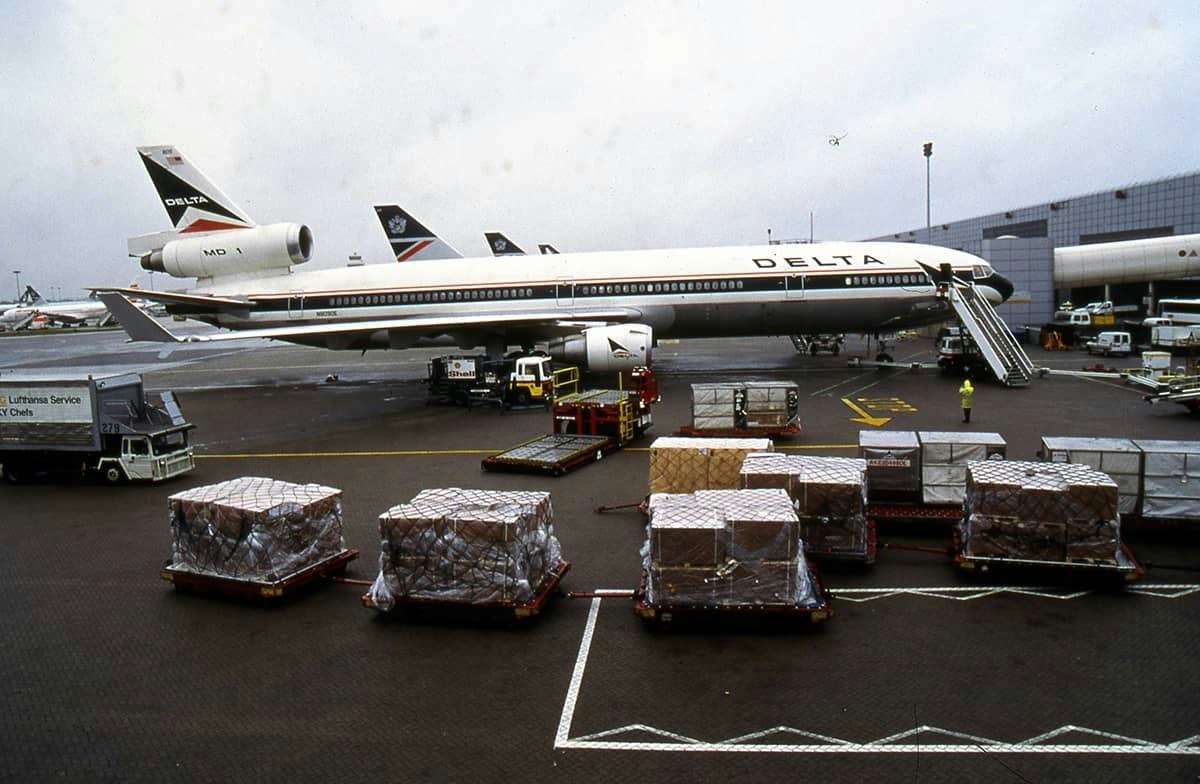
The McDonnell Douglas MD-11 represents the final chapter in the era of three-engine commercial airliners. Introduced during the late Cold War period, the aircraft was conceived as a modern successor to the DC-10, featuring a stretched fuselage, winglets, updated avionics, and a two-pilot cockpit. On paper, the MD-11 promised enhanced range and improved fuel efficiency compared to earlier widebody aircraft, while retaining the cargo capacity and runway performance that made it attractive for long-haul operations.
In practice, however, the MD-11 became a transitional model. The 1990s saw a shift in airline economics favoring more efficient, long-range twin-engine jets, which gradually eroded the MD-11’s appeal. Many major carriers initially adopted the type to bridge fleet renewal and growth cycles, but most retired it earlier than anticipated as ETOPS-certified twins such as the Boeing 777 and Airbus A330/A340 demonstrated superior cost-effectiveness. Rising fuel prices and the industry’s drive toward fleet simplification accelerated the MD-11’s withdrawal from passenger service. Nevertheless, its robust payload capacity and structural durability ensured a prolonged second life in cargo operations, where it remained valued long after passenger airlines had moved on.
The following seven airlines, spanning North America, Europe, and Asia, illustrate the MD-11’s operational trajectory—from early enthusiasm to eventual retirement amid broader industry transformations. Their experiences also highlight the significant financial and operational challenges involved in phasing out the MD-11, including substantial write-downs and market adjustments. For instance, UPS Airlines recorded a $137 million after-tax charge upon retiring its MD-11 fleet, underscoring the financial impact of such transitions. As these airlines replaced the MD-11 with newer Boeing and Airbus models, competitors often capitalized on the opportunity to offer alternative services or aircraft, intensifying market competition. Additionally, safety concerns and subsequent groundings of the MD-11 prompted a wider industry reassessment of the operational viability of aging aircraft.
American Airlines
American Airlines operated the MD-11 as a high-capacity, long-range workhorse throughout the 1990s, filling a niche for international routes that required more lift than a Boeing 767 but less than a 747. The MD-11 introduced cockpit commonality and strong cargo capabilities, making it well-suited for trunk routes and peak schedules. However, as fuel costs increased and twin-engine jets advanced, the economics of operating tri-jets became unsustainable. American Airlines retired its MD-11 fleet in 2001, reflecting the broader industry shift toward more flexible and cost-efficient twin-engine aircraft.
China Airlines
For China Airlines, the MD-11 was a targeted solution rather than a core fleet component. Operated through its subsidiary Mandarin Airlines, the MD-11 supported long-haul expansion by adding capacity where necessary, balancing passenger volume with belly cargo potential. The airline retired its MD-11s in 2002 amid growing concerns over fleet complexity and capital allocation during a period of rapid market change.
The operational history of the MD-11 across these seven airlines underscores the evolving technological and economic landscape of commercial aviation. It also highlights the complex strategic decisions airlines face when retiring legacy aircraft. As the industry continues to evolve, the MD-11 remains a significant case study in adaptation, transition, and the enduring influence of fleet strategy on airline performance.

Etihad Airways Suspends Airbus A380 Flights on Key Route

Aditya Birla Group Seeks Approval for Aircraft Leasing in GIFT City

Qatar Airways Highlights Innovation and Connectivity at Arabian Travel Market 2026

Hong Kong's Five-Year Plan Includes Andrew Fan's Aircraft Parts Processing Hub Proposal

ACIA Aero Leasing Delivers ATR72-600 to Air Nostrum

RTX Appoints Jill Albertelli as Head of Pratt & Whitney

TAT Technologies Joins Beyond Aero Hydrogen Aircraft Program

AURAK Study Highlights Barriers to Air Taxi Adoption in Emerging Economies

Xiamen Air Selects Altitude for 787 Maintenance at Heathrow

Etihad and Swissport Extend Global Partnership
