
Orchestrer les insights d’IA pour les transformer en actions

Tendances
Categories
UC Davis Advances Development of Air Taxi Technology
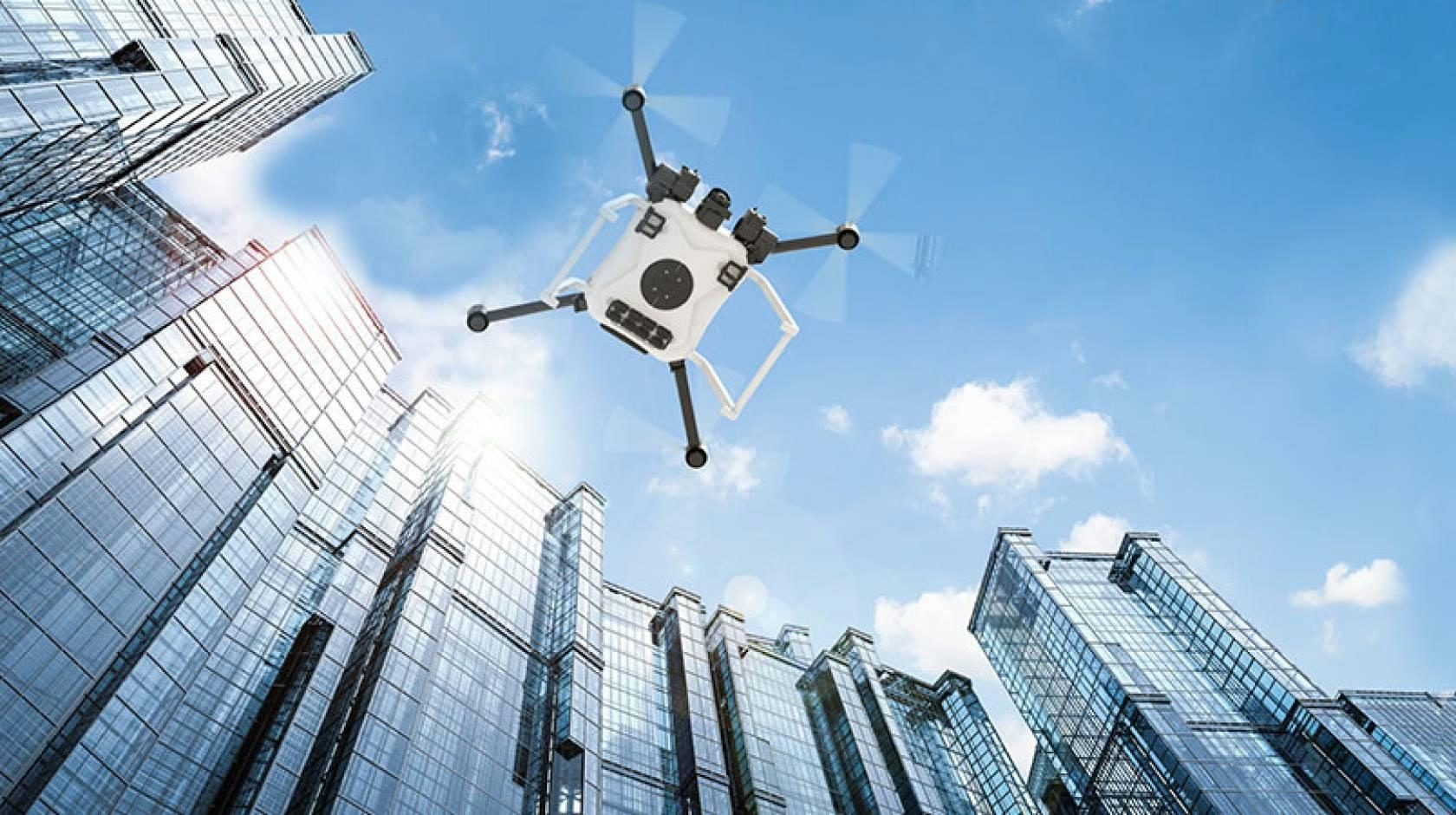
UC Davis Advances Development of Air Taxi Technology
The concept of flying cars has long been relegated to the realm of science fiction, yet the emergence of urban air mobility (UAM) suggests that this futuristic vision may soon become a practical reality. At the forefront of this technological evolution is Seongkyu Lee, a professor of mechanical and aerospace engineering at the University of California, Davis. Lee is actively engaged in advancing electric vertical takeoff and landing aircraft (eVTOLs) with the goal of integrating them into everyday urban transportation.
Lee anticipates that air taxis could enter commercial use within the next few years. As eVTOL technology nears readiness for widespread deployment, researchers are addressing critical challenges, particularly in the field of aeroacoustics—the study of noise generated by moving air—to ensure these vehicles operate efficiently while meeting public expectations for noise levels.
The Sound of Progress
eVTOLs present several advantages over conventional helicopters. Powered by batteries, they produce zero greenhouse gas emissions and combine vertical takeoff and landing capabilities with airplane-like cruising, making them well-suited for congested urban environments. A key benefit is their significantly reduced noise footprint, achieved through the use of multiple small rotors rather than a single large one.
However, Lee emphasizes that “quieter than a helicopter does not mean silence.” For instance, Joby Aviation, founded by UC Davis alumnus JoeBen Bevirt, conducted NASA tests on its S4 prototype in 2022. The aircraft registered approximately 45.2 decibels when flying overhead at 500 meters—comparable to the ambient noise of a refrigerator or moderate rainfall. During takeoff and landing, noise levels remained below 65 decibels, akin to normal conversation or a running vacuum cleaner. By comparison, helicopters typically generate noise levels between 78 and 87 decibels at similar altitudes.
Lee’s research employs computational fluid dynamics to examine the interactions between tiltrotors, wings, and airflow, with the objective of further reducing noise emissions without compromising performance. He notes that the public is likely to accept eVTOLs more readily than helicopters due to their quieter operation, but stresses the importance of balancing noise reduction with vehicle efficiency.
Industry Challenges and Competitive Landscape
Despite significant technological advancements, the widespread adoption of air taxis faces considerable hurdles. Regulatory uncertainty remains a major obstacle, as aviation authorities in the United States and Europe have yet to establish definitive certification standards for eVTOL operations. Some companies’ intentions to launch air taxi services in regions such as the Middle East prior to securing these certifications have sparked criticism, raising concerns about safety and regulatory oversight.
The competitive landscape is also evolving rapidly. Beta Technologies recently experienced a surge in its stock price following a substantial agreement with Eve Air Mobility, while Joby Aviation’s lawsuit against Archer Aviation highlights the intense rivalry within the sector. Additionally, Hopscotch Air’s plans for a mini-IPO underscore the financial and operational challenges confronting new entrants.
As UC Davis and its collaborators continue to refine air taxi technologies, the future of urban air mobility will depend not only on engineering innovations but also on successfully navigating regulatory frameworks, market dynamics, and competitive pressures. For now, the prospect of quiet, efficient urban air travel is steadily transitioning from science fiction to tangible reality.

Etihad Airways Suspends Airbus A380 Flights on Key Route

Aditya Birla Group Seeks Approval for Aircraft Leasing in GIFT City

Qatar Airways Highlights Innovation and Connectivity at Arabian Travel Market 2026

Hong Kong's Five-Year Plan Includes Andrew Fan's Aircraft Parts Processing Hub Proposal

ACIA Aero Leasing Delivers ATR72-600 to Air Nostrum

RTX Appoints Jill Albertelli as Head of Pratt & Whitney

TAT Technologies Joins Beyond Aero Hydrogen Aircraft Program

AURAK Study Highlights Barriers to Air Taxi Adoption in Emerging Economies

Xiamen Air Selects Altitude for 787 Maintenance at Heathrow

Etihad and Swissport Extend Global Partnership
