Image

Orchestrer les insights d’IA pour les transformer en actions

Inscrivez-vous dès aujourd’hui sur la liste d’attente d’AeroGenie !

Tendances

Categories

United Introduces Polaris Studio Suites on Domestic Flights
March 28, 2026By ePlane AI
United Introduces Polaris Studio Suites on Domestic Flights
0
0
United Airlines
Polaris Studio Suites
Premium Cabin Interiors

United Introduces Polaris Studio Suites on Domestic Flights

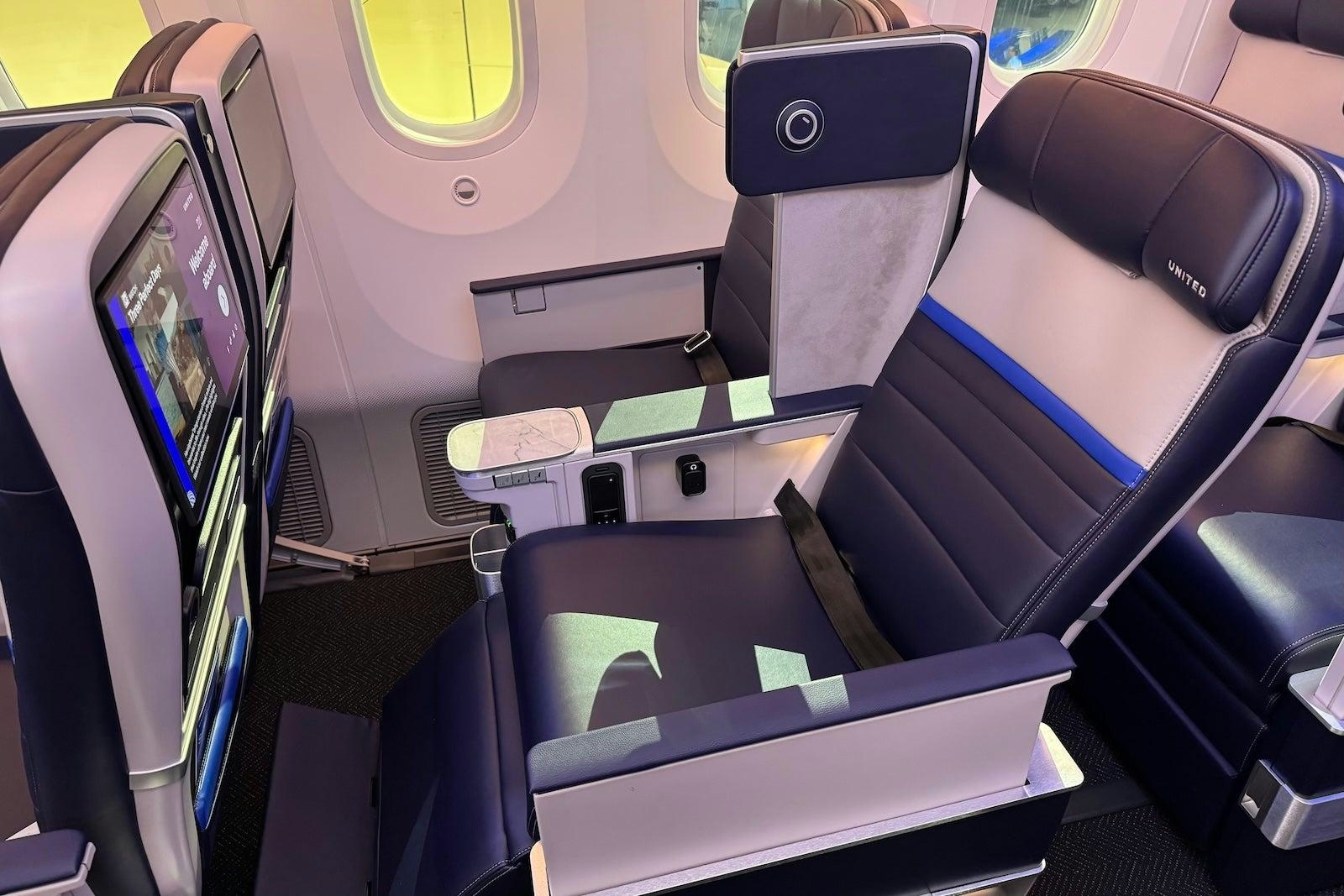
United Airlines is enhancing the domestic travel experience with the introduction of its Polaris Studio Suites, providing U.S. passengers early access to the airline’s next-generation premium cabin ahead of a wider international launch scheduled for April 2026. This initiative represents a strategic effort by United to attract business travelers by setting a new standard for comfort and privacy on domestic routes.

A New Standard in Domestic Business Travel

First revealed in 2024 as part of United’s “Elevated” interior design for its newly delivered Boeing 787-9 aircraft, the Polaris Studio Suites offer a significant upgrade over the existing Polaris business-class seats. Each suite is approximately 25 percent larger and features a sliding privacy door, an expanded side console, and an ottoman that can serve as a buddy seat. The suites are equipped with fully closing doors, large 27-inch 4K screens, Bluetooth connectivity, and wireless charging capabilities, all intended to create a more residential and comfortable environment suitable for work, dining, or rest.

United has begun deploying these upgraded 787-9 aircraft on select domestic hub-to-hub routes. This phased introduction allows flight crews to become familiar with the new cabin layout and systems before the aircraft transition to long-haul international service. Such a strategy is common in the industry when rolling out major cabin enhancements, enabling the airline to refine onboard service and operational procedures in a controlled setting.

Passenger Experience and Market Implications

For travelers, the immediate advantage lies in the ability to book Polaris Studio Suites on certain domestic flights—an option traditionally reserved for international travel. The refitted aircraft feature 99 premium seats, including a limited number of Polaris Studio Suites, a larger section of refreshed Polaris suites, and an expanded Premium Plus cabin. While the Studio Suites do not constitute a separate class, they are marketed as a distinct sub-section within the business cabin during seat selection, offering a noticeably more spacious and private experience at the front of the aircraft.

Industry experts recognize these suites as among the most premium business-class products currently offered by a U.S. airline. The design prioritizes privacy, productivity, and comfort, with increased storage, multiple power outlets, and refined seat controls. The larger personal surface area and warmer finishes further distinguish the suites from standard business-class seats.

United’s introduction of Polaris Studio Suites on domestic routes is widely viewed as a move to capture a larger share of the lucrative business travel market. The enhanced comfort and privacy are expected to appeal to corporate travelers seeking a superior onboard experience. Analysts predict that competitors may respond with similar upgrades to maintain their market positions, while consumer reactions are likely to vary from enthusiasm for the improved amenities to scrutiny over potential fare increases.

As United prepares for the full international rollout in 2026, domestic passengers now have the unique opportunity to experience the airline’s most advanced premium seating, setting a new benchmark for business-class travel within the United States.

More news
Ink Innovation Implements CUPPS Platform at Suriname Airport

Ink Innovation Implements CUPPS Platform at Suriname Airport

Ink Innovation Implements CUPPS Platform at Suriname Airport Modernizing Passenger Processing at Johan Adolf Pengel International Airport Ink Innovation has introduced its Common Use Passenger Processing System (CUPPS) at Johan Adolf Pengel International Airport (JAPIA) in Para, Suriname, representing a pivotal advancement in the airport’s ongoing modernization. This deployment, executed in collaboration with Wintel N.V., Ink’s exclusive local partner, establishes a shared infrastructure that seamlessly integrates with airline Departure Control Systems (DCS) across the recently renovated terminal. As the sole operator of JAPIA, Airport Management Ltd. has emphasized aligning the airport’s operations with international standards while preparing for anticipated passenger growth. The implementation of Ink CUPPS is central to this digital transformation, streamlining check-in and boarding procedures and providing a scalable platform to support future passenger services. Enhancing Efficiency and Flexibility Through Technology Delivered via a subscription-based model, Ink CUPPS minimizes upfront capital expenditure and reduces ongoing operational costs for both the airport and its airline partners. By consolidating check-in and boarding functions onto a unified platform, JAPIA can optimize resource allocation and offer airlines a simplified certification process. The system’s compatibility with both modern and legacy DCS environments ensures broad accessibility for all carriers operating at the airport. The platform also supports mobile passenger processing through the Ink Touch app on Apple iPhone devices, enabling airlines to extend check-in and boarding services beyond fixed counters. This capability enhances operational flexibility, allowing the airport to better manage demand surges and maintain continuity during outages or system disruptions. Challenges and Market Response Despite the clear benefits, Ink Innovation faces several challenges in the CUPPS implementation at JAPIA. These include navigating regulatory compliance, ensuring seamless integration with existing airport systems, and addressing potential resistance from stakeholders accustomed to traditional processes. Market reactions have been mixed; while some investors express optimism about the innovative approach and its potential to improve operational efficiency, others remain cautious regarding initial costs and the timeline for realizing long-term returns. Competitors may respond by adopting similar technologies or developing alternative strategies to maintain their market positions. Progress and Industry Impact The rollout is already in progress, with Sky High Dominicana having migrated to the CUPPS platform and FlyAllWays completing certification and becoming fully operational. Additional carriers, including GOL, Copa Airlines, Caribbean Airlines, KLM, and Surinam Airways, are currently undergoing certification. Once certified, these airlines will benefit from full interoperability with all CUPPS-compliant software at JAPIA, as well as access to supplementary services such as Ancillary Payments. Natasha Abdulhak, Chief Commercial Officer of FlyAllWays, remarked on the transition: “Integrating with the Ink CUPPS platform was straightforward and well-supported. Our agents were up and running quickly, and the shared-counter flexibility has made a real difference in our day-to-day operations at Suriname Airport.” This deployment marks a significant milestone in the strategic partnership between Ink Innovation and Wintel N.V., a well-established ICT company with over 25 years of experience in Suriname’s hospitality, banking, and retail sectors. Wintel N.V. is responsible for implementation, on-site support, and ongoing operations as Ink’s exclusive in-country partner.
Rolls-Royce Provides Real-Time Engine Data for Bombardier Jets

Rolls-Royce Provides Real-Time Engine Data for Bombardier Jets

Rolls-Royce Introduces Real-Time Engine Data for Bombardier Global Jets Rolls-Royce has launched an advanced aircraft and engine health monitoring program tailored for Bombardier’s Global 5500 and Global 6500 business jets. This initiative integrates Rolls-Royce’s Pearl engine Vibration & Health Monitoring Unit (EVHMU) with Bombardier’s Smart Link Plus system, enabling operators enrolled in Rolls-Royce CorporateCare® Enhanced to receive real-time, automatic transmission of engine performance and health data. The system facilitates predictive maintenance, accelerates troubleshooting processes, and enhances overall aircraft availability. Enhancing Maintenance and Operational Efficiency The monitoring solution tracks up to 10,000 engine health parameters, delivering actionable insights to both operators and Rolls-Royce. These insights support optimized maintenance scheduling and help maximize operational uptime. This development forms part of Rolls-Royce’s broader commitment to digital innovation, emphasizing predictive maintenance and superior customer support within the business aviation sector. Industry Challenges and Competitive Landscape The introduction of real-time engine data solutions occurs amid ongoing industry challenges. Rolls-Royce’s reliance on exclusivity agreements has attracted scrutiny, particularly in light of recent disputes such as those involving United Airlines and concerns over engine shortages. These issues have intensified focus on the company’s supply chain resilience and its ability to meet increasing demand for advanced monitoring technologies. Competitors are also responding to the evolving market. General Electric, which dominates the Boeing 787 engine segment, is expected to capitalize on its scale to offer competitive engine monitoring solutions. Meanwhile, Rolls-Royce’s success in delivering fuel efficiency improvements with its XWB-84 EP engine strengthens its position against rivals. Nevertheless, supply constraints and the imperative to maintain customer confidence remain significant challenges as Rolls-Royce navigates a highly competitive and rapidly changing environment. As Rolls-Royce expands its digital capabilities in business aviation, the industry will closely observe its capacity to provide reliable real-time data and maintain robust customer support.
Vietnam Airlines Plans to Acquire Up to 30 Wide-Body Aircraft

Vietnam Airlines Plans to Acquire Up to 30 Wide-Body Aircraft

Vietnam Airlines Plans Major Fleet Expansion with Up to 30 Wide-Body Aircraft Vietnam Airlines has announced plans to acquire up to 30 new wide-body aircraft as part of a comprehensive fleet modernization and expansion strategy. Chairman Dang Ngoc Hoa revealed that the airline is currently preparing an investment proposal for submission to regulatory authorities and is engaged in discussions with Boeing, Airbus, and international aircraft lessors. The acquisition strategy is expected to involve a combination of purchases and leases to meet future capacity requirements. This planned wide-body expansion complements an existing order for 50 next-generation Boeing narrow-body jets, which are scheduled for delivery between 2030 and 2032. To address more immediate capacity needs, Vietnam Airlines also intends to lease approximately 20 narrow-body aircraft during 2027 and 2028. The airline’s current fleet comprises around 105 aircraft, including 31 wide-body jets. Strategic Rationale and Industry Context Chairman Hoa emphasized that the global aviation industry continues to face aircraft shortages in the aftermath of the COVID-19 pandemic, making early negotiations with manufacturers and lessors essential to securing future capacity. The planned fleet upgrades aim to modernize Vietnam Airlines’ aircraft, improve fuel efficiency, reduce emissions, and strengthen the carrier’s competitiveness on international routes. Despite these ambitions, the expansion faces significant challenges, particularly in securing adequate financing. Recently, Vietnam Airlines obtained a $2.9 billion loan from the Export-Import Bank of the United States to support its Boeing 737 Max 8 orders, highlighting the substantial investment required for fleet renewal. The airline’s expansion plans also come amid intensifying competition, with global carriers such as American Airlines considering wide-body orders to keep pace with rivals like Delta and United. Regionally, competitors including Sun PhuQuoc Airways are expanding their fleets and networks to capitalize on growing leisure travel demand, potentially increasing market pressures. Network Growth and Market Focus Chief Executive Le Hong Ha highlighted the airline’s recent network expansion, noting new or announced routes to Amsterdam, Phuket, and Colombo in the first half of the year. Additionally, Vietnam Airlines has increased frequencies to destinations such as Singapore, Manila, Moscow, Kaohsiung, Melbourne, and Sydney. The airline plans to prioritize long-haul markets in Europe and Australia while continuing to expand services across Northeast Asia, Southeast Asia, India, and China. Ha reported strong demand on European routes, with seat occupancy rates reaching approximately 91 percent, partly due to service suspensions by some Middle Eastern carriers amid regional conflicts. Vietnam Airlines intends to maintain its focus on business travelers, international passengers, and frequent flyers. Meanwhile, its subsidiaries Pacific Airlines and VASCO will continue to serve more price-sensitive market segments. As Vietnam Airlines advances its fleet expansion, the carrier seeks to secure the capacity necessary for sustained growth while navigating financial constraints and heightened competition in a rapidly evolving global aviation environment.
Wheels Up Becomes Launch Customer for Surf Air’s Palantir-Integrated Charter Broking Software

Wheels Up Becomes Launch Customer for Surf Air’s Palantir-Integrated Charter Broking Software

Wheels Up Becomes Launch Customer for Surf Air’s Palantir-Integrated Charter Broking Software Wheels Up has entered into a landmark agreement to become the launch customer for Surf Air Mobility’s new Enterprise BrokerOS, an AI-powered charter broker platform developed in collaboration with Palantir Technologies. The contract, initially spanning two years with an option to extend for a third, is valued at up to $12 million in subscription fees and includes standard software service guarantees. Modernizing Private Aviation Charter Operations This partnership represents a pivotal moment in Wheels Up’s strategic transformation, as the company seeks to modernize its charter workflow by adopting Surf Air Mobility’s BrokerOS. The platform leverages Palantir’s advanced AI and data integration capabilities to streamline the private aviation charter process. By consolidating critical data sources, BrokerOS enables faster, more informed decision-making, enhancing operational efficiency and customer experience. George Mattson, CEO of Wheels Up, highlighted the strategic significance of the collaboration, stating, “By combining Wheels Up’s scale, brand, and aviation expertise with Surf Air Mobility’s transformative aviation software and Palantir’s leadership in AI, we are setting a new standard for how private aviation is sold, operated, and experienced. This is technology as a competitive advantage in the marketplace, not a back-office function.” BrokerOS is set to replace multiple legacy software platforms currently in use at Wheels Up, thereby freeing engineering and operational resources to focus on higher-value initiatives. The deployment is anticipated to yield both cost savings and productivity gains, while also driving growth in charter operations. Key benefits include streamlined aircraft sourcing, quote generation, booking, and customer relationship management. The platform consolidates supply across Wheels Up’s owned fleet and third-party operator network, automates manual workflows to enable brokers to manage higher transaction volumes, and provides real-time business intelligence for actionable insights. Industry Implications and Future Outlook Liam Fayed, co-founder of Surf Air Mobility, remarked on the platform’s tailored design for private aviation complexities, noting that the success of their own On Demand private charter business has reinforced confidence in BrokerOS’s capabilities. He described Wheels Up as an ideal enterprise launch customer, given its mission to be the most technologically advanced private aviation company and its potential to demonstrate BrokerOS’s impact at scale. Ted Mabrey, Global Head of Commercial at Palantir, emphasized the technical challenge Surf Air has overcome in codifying operator expertise into scalable technology. He affirmed that Wheels Up’s adoption of SurfOS validates Surf Air’s operational insights and that Palantir’s ontology and technological backbone ensure enterprise-grade security, governance, and access to cutting-edge AI. As Wheels Up integrates BrokerOS into its operations, the company may encounter challenges related to merging the new platform with existing systems. This development is expected to attract attention from other business aviation firms, potentially accelerating the adoption of AI-driven charter management solutions across the industry. Competitors may respond by expediting their own technology upgrades to maintain market competitiveness. Additionally, regulatory authorities are likely to scrutinize the software to ensure compliance with aviation standards as the sector adapts to increasingly sophisticated digital tools.
How AI Is Transforming Industries Worldwide

How AI Is Transforming Industries Worldwide

How AI Is Transforming Industries Worldwide Artificial intelligence is rapidly reshaping industries across the globe, generating both optimism and concern. Its growing prevalence is influencing sectors ranging from business aviation and hospitality to finance and technology, prompting companies to rethink strategies and operations in profound ways. The Changing Landscape of Business Aviation and Corporate Travel In the realm of business aviation, AI is streamlining administrative processes, enabling operators to concentrate more on customer service. While manufacturers have long employed AI to enhance aircraft reliability, new AI-driven innovations are emerging, promising further advancements. Despite these technological gains, the value of personal relationships and the discreet nature of business aviation continue to serve as key differentiators. Contrary to earlier predictions that digital tools would reduce the need for in-person meetings, industry leaders now observe the opposite trend. Kerstin Mumenthaler, CEO of Axis Aviation, notes that increased automation is actually driving a greater demand for face-to-face interactions. Shawn Holstein, CEO of Holstein Aviation, adds that as AI blurs the distinction between real and artificial experiences, personal meetings are poised to regain prominence, potentially increasing business travel in a post-pandemic world. AI’s Impact on Finance, Hospitality, and Technology The financial sector is undergoing a significant transformation as retail investors increasingly adopt AI-powered trading bots. These tools offer enhanced efficiency and help mitigate emotional biases in decision-making, thereby amplifying the influence of AI-driven systems in global markets. Meanwhile, the hospitality industry is adapting to a new reality where AI-generated recommendations have become a primary means for travelers to discover hotels. This shift has made visibility in AI responses a critical competitive factor, compelling hotels and travel companies to revise their distribution strategies accordingly. Within the broader technology sector, the AI investment cycle is evolving from infrastructure development to application deployment. This transition is prompting companies to reevaluate their partnerships and platforms. Established software and technology service providers face significant challenges as enterprises seek vendors capable of fully harnessing AI’s transformative potential to improve operations and decision-making processes. Economic and Policy Implications of the AI Revolution The global race to capitalize on AI carries substantial risks. Nations that fail to secure a foothold in the AI supply chain may confront widespread job losses and shrinking tax revenues, potentially giving rise to a permanent economic underclass. Policymakers face the urgent task of ensuring their economies remain competitive and inclusive as AI continues to reshape the global economic order. AI companies themselves are becoming increasingly important consumers of business services. Rapidly growing firms such as Anthropic, which reported $4.8 billion in first-quarter sales and is approaching profitability, are driving demand for services including aviation. Reflecting evolving corporate travel preferences, some of these companies may favor fractional ownership or charter solutions over outright aircraft ownership. As AI continues to transform industries worldwide, success will depend on the ability to adapt swiftly—embracing technological innovation while maintaining the human connections that remain central to business.
WSA Delivers Second B737-400SF to Skyway Airlines

WSA Delivers Second B737-400SF to Skyway Airlines

WSA Delivers Second Boeing 737-400SF to Skyway Airlines World Star Aviation (WSA) has completed the delivery of a second Boeing 737-400SF freighter to Skyway Airlines, a move that significantly bolsters the Philippines-based carrier’s cargo operations throughout the Asia-Pacific region. This latest acquisition follows the successful handover of the first aircraft and is expected to enhance Skyway’s capacity in one of the world’s fastest-growing air freight markets. André Abreu, Vice President of Marketing and Sales at WSA, emphasized the strength of the partnership between the two companies. He noted that the second delivery reflects the solid relationship established since Skyway’s launch as a cargo carrier. Abreu expressed gratitude for Skyway’s continued confidence in WSA’s team and highlighted the company’s commitment to providing cost-effective freighter solutions. He also expressed optimism about further collaboration in the years ahead. José Peralta, Chief Executive Officer of Skyway Airlines Inc., welcomed the fleet expansion with enthusiasm. He described the arrival of the third aircraft—and second from WSA—as a significant milestone that will reinforce the airline’s network across the Asia-Pacific region. Peralta praised WSA for its professionalism and dedication throughout the delivery process, underscoring the importance of this partnership to Skyway’s growth ambitions. Navigating a Shifting Aviation Landscape The delivery of the new freighter occurs amid considerable transformation within the global aviation industry. European carriers are undergoing consolidation in response to persistent challenges, creating a more competitive and evolving market environment. Concurrently, a recent surge in fuel prices in the United States has exacerbated disparities between stronger and weaker airlines, influencing operational costs and strategic decision-making worldwide. In the secondhand aircraft market, industry figures such as Michael O’Leary have observed that the return of jets from carriers like Spirit Airlines is unlikely to significantly ease market pressures. This highlights the complexities airlines face when attempting to expand or modernize their fleets in the current climate. Against this backdrop, Skyway Airlines’ continued investment in its cargo fleet signals both resilience and ambition. As the airline contends with rising costs and intensifying competition, its partnership with WSA and the integration of the Boeing 737-400SF freighter are set to play a pivotal role in advancing its growth strategy across the Asia-Pacific region.
Airbus Faces Challenges with A220 in China

Airbus Faces Challenges with A220 in China

Airbus Faces Challenges with A220 in China Limited Market Penetration Despite Industrial Presence Airbus is intensifying efforts to promote its A220 aircraft in China, a market where the model’s footprint remains minimal. Currently, the A220’s involvement in China is confined to the Shenyang facility, which produces fuselage sections that are then shipped to Mirabel, Quebec, for final assembly. This limited presence contrasts sharply with Airbus’s broader industrial engagement in China, which includes an A320neo family assembly line in Tianjin, an A330 finishing center, and an extensive supplier network. Despite China’s position as one of the world’s largest aviation markets and its substantial orders for other Airbus models, the A220 has yet to secure a single order from Chinese airlines or leasing companies. Political and Commercial Barriers The absence of A220 orders in China stems from a combination of political sensitivities and commercial challenges. The Shenyang plant has been involved with the program since its origins as Bombardier’s C Series, but Bombardier itself was unable to attract Chinese customers before selling the program to Airbus in 2017. Airbus executives acknowledge that lingering resentment in Beijing over the failed acquisition attempt continues to affect the aircraft’s prospects. Christian Kley, head of single-aisle market development at Airbus, noted during a media briefing at the company’s Mirabel headquarters that “the Chinese were involved in the bidding contest at the time when Airbus ended up taking over the former C Series, so there's certainly some resentment there. That's ten years ago. They have long memories.” Commercially, the A220 faces skepticism from leasing companies and potential customers who debate the aircraft’s range and performance capabilities. The program itself remains unprofitable and has recently lost orders to Brazilian competitor Embraer, further complicating Airbus’s efforts to gain traction in the region. Operational Concerns and Future Prospects In response to market feedback, Airbus is exploring a “simple” stretch of the A220 to better meet customer demands, though the timeline for this development remains uncertain. Some key customers, including Air France-KLM, have expressed concerns that a stretched variant may arrive too late to influence their fleet planning. Operational issues have also emerged, exemplified by Swiss International Air Lines’ recent retirement of two A220-100 aircraft to support its larger A220-300 fleet amid ongoing engine reliability problems. These challenges highlight the operational hurdles Airbus must address to position the A220 as a competitive option in China’s demanding aviation market. Despite Airbus’s established industrial partnerships and success with other aircraft families in China, the company faces a complex interplay of political, commercial, and operational obstacles as it seeks to establish the A220 in this critical market.
MIAT Technics Completes First Heavy Maintenance on B787-9

MIAT Technics Completes First Heavy Maintenance on B787-9

MIAT Technics Completes First Heavy Maintenance on Boeing 787-9 MIAT Technics, the maintenance division of MIAT – Mongolian Airlines, has successfully completed its inaugural heavy maintenance check on a Boeing 787-9 aircraft. This milestone marks a significant advancement for Mongolia’s aviation industry, as it is the first time a widebody aircraft has undergone such comprehensive servicing within the country. Previously, MIAT’s fleet maintenance was conducted exclusively abroad. A New Chapter for Mongolia’s Aviation Sector The aircraft in question, a seven-year-old Boeing 787-9 registered as EI-MGL and owned by AerCap, joined MIAT’s fleet in 2023. The completion of this heavy maintenance at MIAT Technics’ facility signals a new era in the airline’s technical capabilities. Executive Director Telmen Tunsag emphasized the importance of this achievement, stating that it demonstrates the international competitiveness of MIAT’s workforce and management. He highlighted the potential for MIAT Technics to generate revenue not only through flight operations but also by offering maintenance services to foreign airlines, reflecting the company’s growing ambitions. Industry Context and Competitive Landscape This development occurs amid a challenging global aerospace maintenance, repair, and overhaul (MRO) market, which is currently under increased scrutiny and competition. Recent industry events, including the investigation into the Air India 787 incident and concerns related to Boeing’s Starliner program, have heightened the focus on safety and regulatory compliance for maintenance providers worldwide. As MIAT Technics expands into widebody aircraft maintenance, it will be required to maintain stringent standards to satisfy both airline customers and regulatory authorities. Regional competitors, many of whom are well-established MRO providers, may respond by intensifying efforts to secure contracts with major carriers, leveraging their extensive experience and reputations. Additionally, the recent approval by the U.S. Federal Aviation Administration (FAA) for Boeing to commence testing of the 777X is expected to influence market dynamics, potentially affecting demand for maintenance services as airlines reassess their fleet strategies. Expanding Service Capabilities Historically, MIAT – Mongolian Airlines has depended on external MRO partners such as HNA Technic in Haikou for heavy maintenance tasks. MIAT Technics currently collaborates with several international airlines, including Jeju Air, Jin Air, AL!-KE-o, and t’way Air, as it seeks to broaden its service offerings beyond its own fleet. This strategic expansion underscores MIAT Technics’ commitment to becoming a competitive player in the regional MRO market. MIAT has not yet responded to requests for comment regarding this development.
Two Lufthansa Boeing 747s Make Overweight Landings on US Routes Within 24 Hours

Two Lufthansa Boeing 747s Make Overweight Landings on US Routes Within 24 Hours

Two Lufthansa Boeing 747s Make Overweight Landings on US Routes Within 24 Hours Emergency Returns and Overweight Landings Within a 24-hour period from June 26 to 27, two Lufthansa Boeing 747-8 aircraft operating flights from Frankfurt International Airport (FRA) to the US East Coast were compelled to return shortly after departure, resulting in overweight landings with nearly full fuel tanks. The affected flights, LH418 bound for Washington Dulles International Airport (IAD) and LH402 destined for Newark Liberty International Airport (EWR), were both cancelled following emergency responses on the ground. Flight LH418 diverted to Cologne Bonn Airport (CGN) on June 26 after a medical emergency involving an infant passenger arose shortly after takeoff. Passengers reported on social media that the crew elected to return immediately without dumping fuel, prioritizing the infant’s health over standard fuel jettison procedures. This decision led to a heavy landing, necessitating a thorough inspection of the aircraft’s landing gear due to the increased stress. Emergency services were present upon arrival to ensure safety. The subsequent day, flight LH402 returned to Frankfurt after the crew detected a burning brake odor approximately 20 minutes into the flight. Given the potential risk of an in-flight fire and the considerable time required to safely jettison fuel from a fully loaded 747—typically 20 to 30 minutes—the crew opted to land overweight rather than risk further escalation. Video footage circulated by aviation enthusiasts showed the aircraft surrounded by fire trucks as a precautionary measure against overheated brakes. Operational Challenges and Industry Implications These back-to-back incidents underscore the critical and time-sensitive decisions flight crews must make during emergencies. Although the Boeing 747-8 is equipped with an efficient fuel jettison system, the process is not always feasible in urgent situations where immediate landing is necessary to safeguard passengers and crew. Overweight landings, while uncommon, remain a vital safety protocol under such circumstances. The consecutive overweight landings on prominent US routes have attracted attention from aviation regulators and industry analysts. Such events may prompt increased regulatory scrutiny, potentially resulting in fines, mandatory inspections, and heightened compliance costs for Lufthansa. Competitors may also leverage these incidents to highlight their own safety records and operational reliability. In the immediate term, Lufthansa faces reputational challenges as these incidents circulate within industry circles and public forums. Nevertheless, the airline’s ongoing efforts to consolidate operations and invest in sustainable aviation initiatives may help alleviate long-term reputational damage. Lufthansa’s transparent communication and prioritization of passenger safety during these emergencies will be closely monitored by both regulators and the flying public. As investigations proceed, Lufthansa is expected to review its emergency protocols and operational procedures to address any findings, reaffirming its commitment to safety and regulatory compliance.
Phionx Signs Vendor Agreement with U.S.-Based KMC

Phionx Signs Vendor Agreement with U.S.-Based KMC

Phionx Enters Strategic Vendor Agreement with U.S.-Based KMC to Expand in Global Aviation MRO Market Phionx announced on June 29 that it has formalized a Strategic Vendor Agreement (SVA) with Kansas Modification Center (KMC), a U.S.-based specialist in aircraft freighter conversion (P2F) and Maintenance, Repair, and Overhaul (MRO) services. This partnership is designed to accelerate Phionx’s entry into the global aviation MRO sector, establishing the company as KMC’s primary supplier for a broad range of products and services. These include aircraft parts, structural modification materials, painting and insulation supplies, as well as technical support. Focus on South Korea and Large-Scale Projects The agreement emphasizes a strategic collaboration centered on projects and operations within South Korea. Under the terms, KMC will designate Phionx as its preferred partner for upcoming aircraft conversion and MRO initiatives. In turn, Phionx will customize its product supply and technical assistance to meet KMC’s specific operational needs. While the overarching framework is set, detailed supply terms will be negotiated through individual contracts for each project. This collaboration follows KMC’s recent signing of an investment Memorandum of Understanding (MOU) with Jeollanam-do province, valued at approximately 348 billion won. KMC intends to establish P2F and MRO facilities in the Jeonnam region, providing Phionx with a strategic foothold to participate in these significant developments. KMC is widely recognized for its advanced freighter conversion technology, particularly for Boeing 777-300ER and Boeing 787-9 aircraft, addressing the growing global demand for cargo aircraft. Industry estimates place the market for B777-300ER freighter conversions at around 600 units, valued at approximately 3 trillion won, while the B787-9 segment is projected at 1,200 units with a similar market value. Combined, these markets represent an estimated 6 trillion won opportunity. Strategic Expansion and Challenges Ahead Through this agreement, Phionx has secured a critical entry point into a substantial and growing market. Originally operating as a licensed cannabis business in the United States, Phionx has been diversifying its portfolio to include aerospace alongside its bio and healthcare operations. The company views this partnership as a springboard for broader expansion into the global aviation MRO and aerospace industries. Nonetheless, the venture presents several challenges. Phionx must navigate complex regulatory compliance requirements across U.S. and international jurisdictions, manage intricate supply chain logistics, and compete against well-established players in the healthcare and aerospace supply sectors. Market analysts suggest that investors will closely evaluate the strategic alignment and potential synergies of this diversification, while competitors may respond by reinforcing their own vendor agreements to safeguard market share. A Phionx representative stated, “This strategic vendor agreement is not just a simple supply contract, but the starting point of a strategic partnership for entering the global aviation MRO market. We will actively participate in various global projects, including KMC’s initiatives in Korea, to secure new growth engines.” As Phionx embarks on this new chapter, its ability to overcome operational and market challenges will be closely monitored by industry stakeholders and investors alike.
line









