
Orchestrer les insights d’IA pour les transformer en actions

Tendances
Categories
Urban Air Taxis Edge Closer to Reality as FAA Issues Final Airworthiness Standards for eVTOL Fleet
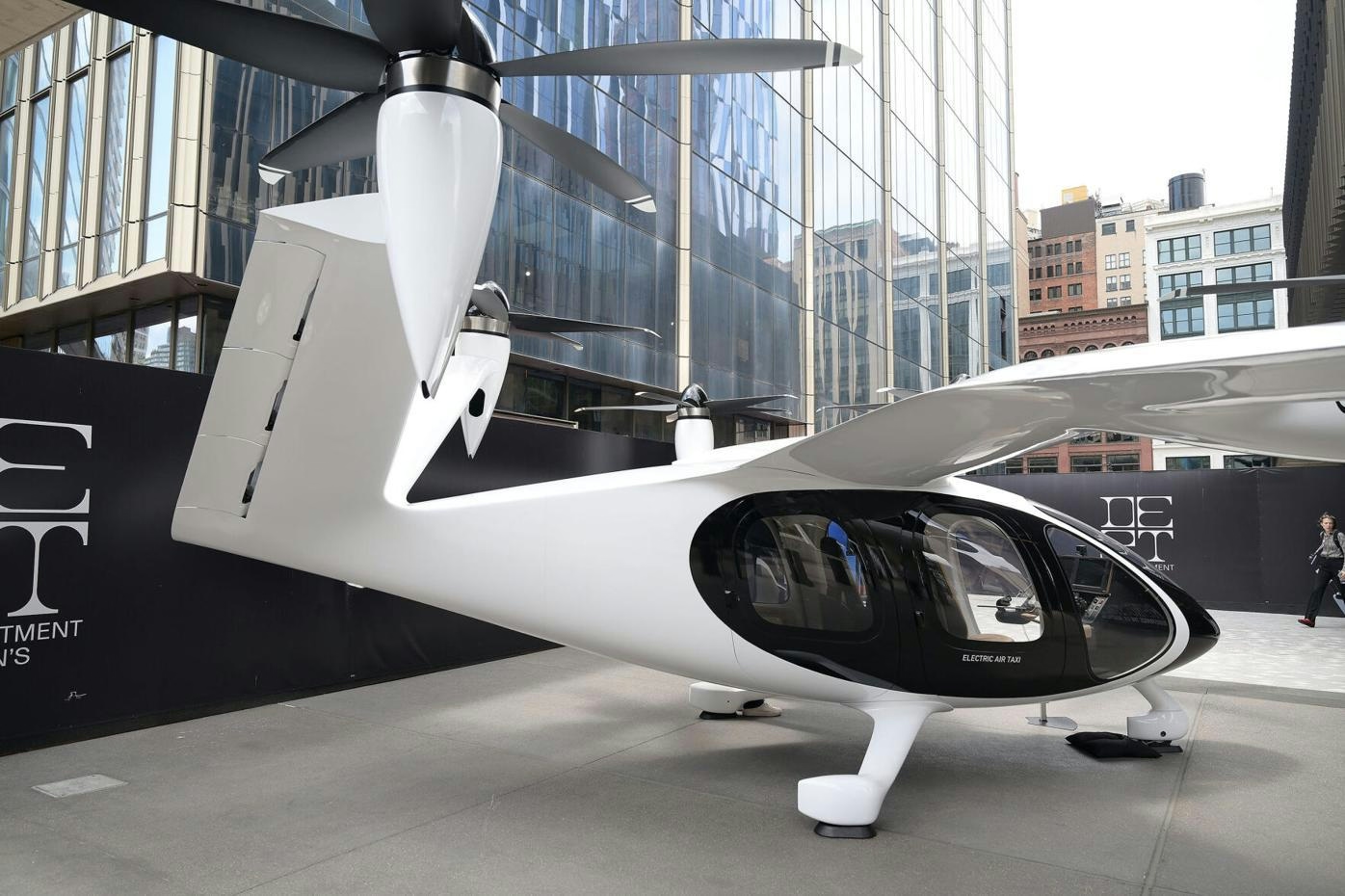
Urban Air Taxis Edge Closer to Reality as FAA Issues Final Airworthiness Standards for eVTOL Fleet
On a recent Tuesday morning in Dallas, commuter Marcus Webb found himself stuck in traffic on Interstate 35, watching a helicopter glide overhead. His phone estimated it would take 47 minutes to travel just six miles. Within two years, that same journey could be reduced to less than 10 minutes aboard a quiet, battery-powered air taxi—provided the Federal Aviation Administration (FAA) and a competitive field of manufacturers successfully navigate the remaining regulatory challenges.
This vision advanced significantly in early 2026 when the FAA formalized updated airworthiness standards for the powered-lift category, which governs electric vertical takeoff and landing vehicles, or eVTOLs. Building on the agency’s landmark powered-lift rule issued in October 2023, the new standards establish concrete requirements for battery safety, rotor failure tolerance, and pilot training. These benchmarks must be met before eVTOLs can carry paying passengers, marking a critical step toward commercial deployment.
New FAA Standards and Certification Requirements
The FAA’s updated framework is not encapsulated in a single document but rather consists of a series of special conditions and issue papers issued under 14 CFR Part 21. Each eVTOL program receives tailored requirements, reflecting the fact that no existing aircraft category fully addresses the unique risks associated with multi-rotor electric flight. The core standards focus on several key areas.
Manufacturers must demonstrate battery containment capabilities that prevent thermal runaway from spreading beyond a single cell for at least 10 minutes, allowing sufficient time for an emergency landing. Aircraft are required to maintain controlled flight even if a single rotor or motor becomes inoperative, including during critical low-altitude transitions. Additionally, an autonomous safe-landing system must activate within three seconds if the pilot becomes incapacitated. On the operational side, all commercial eVTOL pilots will need to obtain a new powered-lift pilot certificate, distinct from existing helicopter or fixed-wing licenses.
The FAA stresses that these special conditions are not universally applied; each manufacturer must negotiate its own certification requirements. Consequently, certification timelines are expected to vary significantly across the industry. Leading companies such as Joby Aviation, Archer Aviation, and Wisk Aero are actively pursuing separate certification programs under these updated standards, each aiming to demonstrate compliance with the rotor failure tolerance and other critical safety benchmarks.
Industry Impact and Market Outlook
The introduction of these updated standards comes amid growing investor interest and intensifying competition among eVTOL developers, including Archer Aviation, Beta Technologies, Joby Aviation, and Wisk. With the regulatory path becoming clearer, companies are accelerating development schedules and forging strategic partnerships to enhance their technological and operational capabilities.
Despite this progress, significant challenges remain. The complexity of regulatory approval, ongoing safety concerns, and technological limitations continue to influence the pace of advancement. The FAA’s pilot program seeks to address these issues by fostering innovation in electric aviation while maintaining rigorous safety standards.
As certification approaches, the race to launch commercial air taxi services is poised to transform urban transportation. This emerging mode of mobility has the potential to convert congested, ground-level commutes into swift, airborne journeys, reshaping how cities move in the near future.

Etihad Airways Suspends Airbus A380 Flights on Key Route

Aditya Birla Group Seeks Approval for Aircraft Leasing in GIFT City

Qatar Airways Highlights Innovation and Connectivity at Arabian Travel Market 2026

Hong Kong's Five-Year Plan Includes Andrew Fan's Aircraft Parts Processing Hub Proposal

ACIA Aero Leasing Delivers ATR72-600 to Air Nostrum

RTX Appoints Jill Albertelli as Head of Pratt & Whitney

TAT Technologies Joins Beyond Aero Hydrogen Aircraft Program

AURAK Study Highlights Barriers to Air Taxi Adoption in Emerging Economies

Xiamen Air Selects Altitude for 787 Maintenance at Heathrow

Etihad and Swissport Extend Global Partnership
