
Orchestrer les insights d’IA pour les transformer en actions

Tendances
Categories
Why The Next Generation Of Aircraft Engines May Not Need A Revolutionary New Design
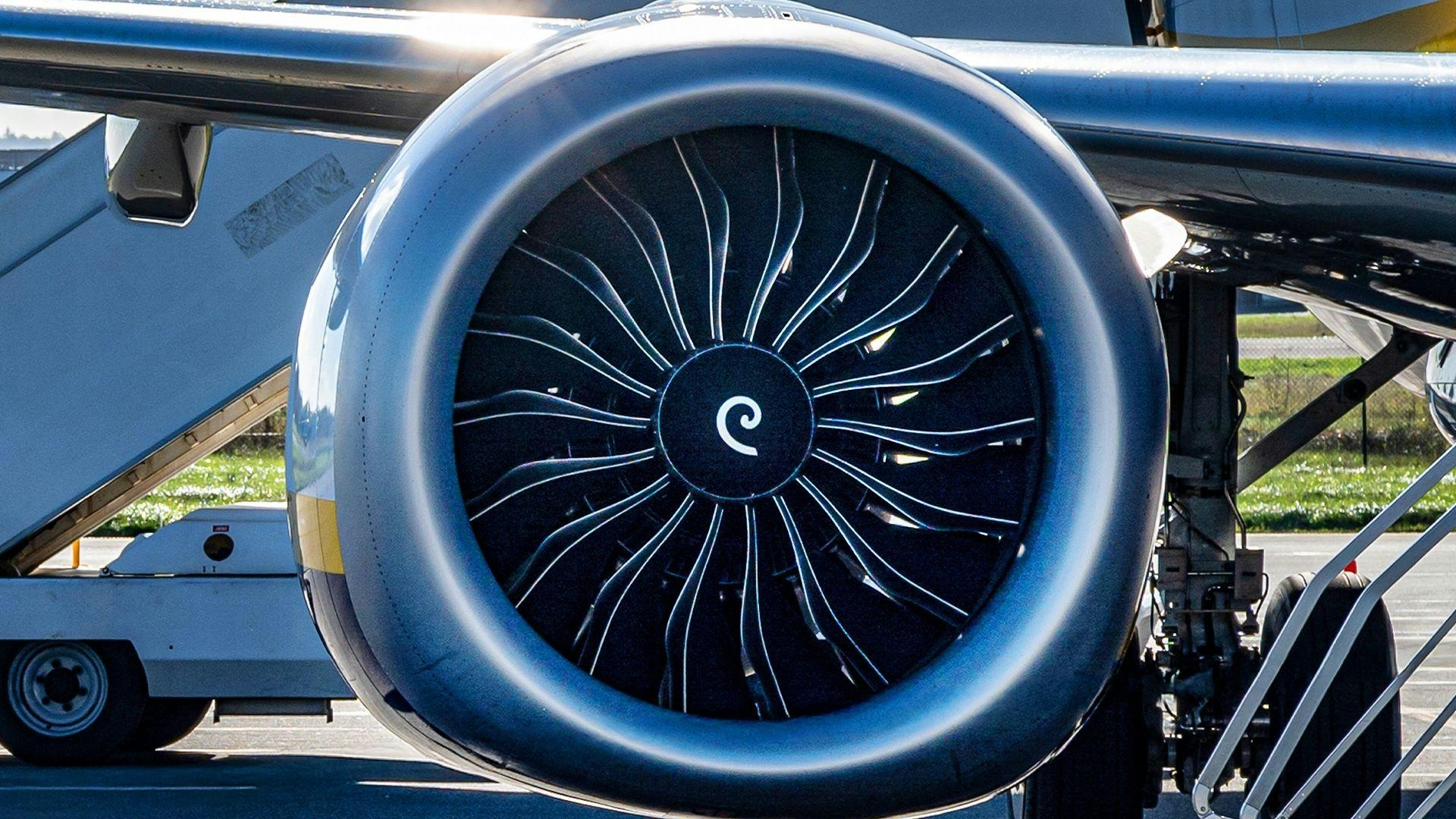
Why the Next Generation of Aircraft Engines May Not Require a Revolutionary New Design
For decades, the aviation industry has been propelled forward by landmark innovations in engine technology, from the introduction of the high-bypass turbofan in the 1960s to the more recent geared turbofan (GTF) advancements. Each of these developments has significantly transformed commercial aviation, often demanding substantial investment and extended development timelines. However, the forthcoming era of aircraft propulsion appears poised to rely less on radical new engine architectures and more on incremental enhancements to existing designs.
Evolution Over Revolution in Engine Development
At the recent Farnborough Airshow, MTU Aero Engines underscored this evolving approach. André Sinanian, Senior Vice President of Commercial Engine Programs, articulated the company’s confidence in the current GTF platform, stating, “We believe that with our current GTF engine, we have an excellent basis to further develop the engine to achieve the next generation requirements. We don't believe that we need a completely new engine architecture. We see a lot of potential in the current geared turbofan concept, and we are working on technologies that will make it even more efficient for the future.”
This viewpoint mirrors a broader industry trend. Rather than anticipating a singular revolutionary breakthrough, manufacturers are concentrating on a series of incremental innovations. These include the adoption of advanced materials, refined manufacturing processes, digital engineering techniques, hybrid propulsion systems, and sustainable fuels. Collectively, these advancements aim to enhance fuel efficiency, reduce emissions, and improve reliability. Airlines continue to emphasize the importance of lowering operating costs, minimizing noise pollution, and increasing dependability.
Industry Dynamics and Competitive Pressures
The competitive environment remains vigorous, with aerospace giants Airbus and Boeing investing heavily in the refinement of their engine technologies. Market responses to the evolutionary strategy have been mixed; some investors and customers question whether incremental improvements can deliver the substantial performance gains the industry demands, potentially tempering enthusiasm for rapid adoption. In response, competitors are intensifying efforts to innovate within existing engine platforms, utilizing digital modeling and advanced wind tunnel testing to extract further efficiencies. Rolls-Royce, for instance, is actively seeking to re-enter the narrowbody jet market by enhancing its current technologies rather than pursuing entirely new engine designs.
MTU Aero Engines, while less prominent among the general public compared to Pratt & Whitney, GE Aerospace, or Rolls-Royce, occupies a critical position within the aerospace ecosystem. The company operates across three primary sectors: original equipment manufacturing (OEM) of engine components, commercial maintenance and overhaul, and military engine production. Unlike some competitors that assemble complete engines, MTU specializes in designing and manufacturing essential components, which are then integrated by major engine manufacturers.
As the industry looks to the future, there is a clear consensus that the next generation of aircraft engines will be shaped by a succession of evolutionary improvements rather than a single revolutionary leap. By maximizing the potential of proven concepts such as the geared turbofan and embracing continuous innovation, manufacturers aim to meet the evolving demands of the market, delivering propulsion systems that are cleaner, quieter, and more efficient for the future of flight.

Etihad Airways Suspends Airbus A380 Flights on Key Route

Aditya Birla Group Seeks Approval for Aircraft Leasing in GIFT City

Qatar Airways Highlights Innovation and Connectivity at Arabian Travel Market 2026

Hong Kong's Five-Year Plan Includes Andrew Fan's Aircraft Parts Processing Hub Proposal

ACIA Aero Leasing Delivers ATR72-600 to Air Nostrum

RTX Appoints Jill Albertelli as Head of Pratt & Whitney

TAT Technologies Joins Beyond Aero Hydrogen Aircraft Program

AURAK Study Highlights Barriers to Air Taxi Adoption in Emerging Economies

Xiamen Air Selects Altitude for 787 Maintenance at Heathrow

Etihad and Swissport Extend Global Partnership
