
Orchestrer les insights d’IA pour les transformer en actions

Tendances
Categories
Wing Walker Struck by American Airlines Jet Highlights Risks of Ramp Work
Wing Walker Struck by American Airlines Jet Highlights Ramp Work Risks
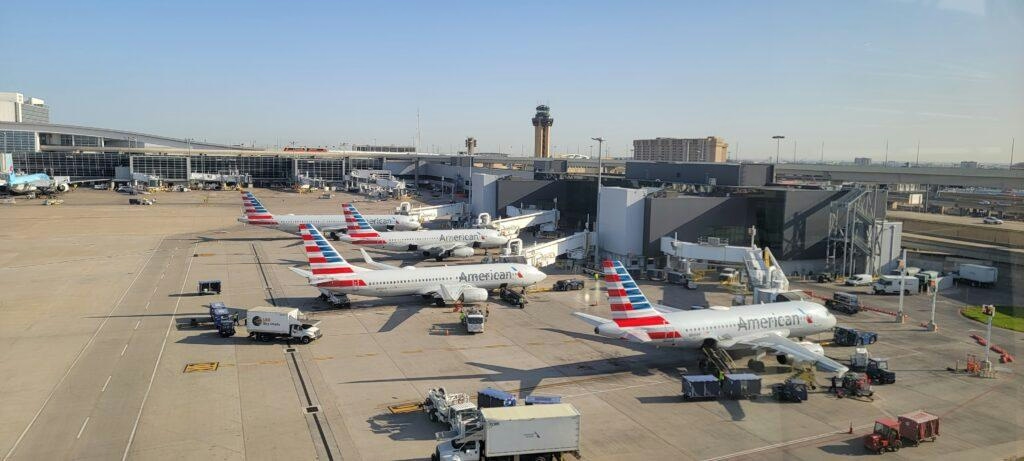
A wing walker was struck by the engine of an American Airlines aircraft arriving at Dallas–Fort Worth International Airport on November 12, an incident initially reported by aviation watchdog JonNYC. Disturbing video footage of the event has since emerged, though it remains sparingly circulated due to its graphic nature. This accident brings renewed attention to the inherent dangers faced by ramp workers, who play a critical role in guiding aircraft and ensuring safe ground operations.
Persistent Hazards in Ramp Operations
While such incidents are not everyday occurrences, they happen with troubling regularity, underscoring ongoing safety challenges within the industry. Recent years have witnessed several fatal ramp accidents. In December 2022, a Piedmont ramp agent in Montgomery, Alabama, was killed after being pulled into the engine of an American Eagle Embraer 175. The National Transportation Safety Board (NTSB) determined that the agent had repeatedly approached the engine despite warnings, with cognitive impairment from cannabis use cited as a contributing factor. In June 2023, a ground worker in San Antonio died after being ingested into a Delta aircraft’s engine, an event later ruled a suicide. More recently, in January 2025, an American Airlines wing walker in Charlotte was fatally run over by a tug during pushback operations.
Historical incidents further illustrate the risks faced by ramp personnel. In 1989, a ramp guide stumbled behind an aircraft’s nose gear in San Juan; in 1992, a worker was killed by a tug at LaGuardia Airport; and in 1997, a wing walker at JFK Airport was run over by an aircraft’s nose gear while retrieving equipment.
Safety Protocols and Operational Challenges
Standard safety protocols are designed to prevent such tragedies. Typically, ground personnel are prohibited from entering hazardous zones until aircraft engines are fully shut down, parking brakes are engaged, and beacon lights are off. However, operational realities can complicate adherence to these procedures. For instance, when an aircraft’s auxiliary power unit (APU) is inoperative, it is common practice to keep an engine running at the gate to supply power and air until ground support equipment is connected. Miscommunication, procedural lapses, and limited cockpit visibility—particularly during nighttime or adverse weather conditions—can all contribute to accidents.
The recent incident at Dallas–Fort Worth has prompted renewed scrutiny of ramp safety practices across the industry. Market reactions often reflect heightened investor concerns, with the potential for regulatory reviews and increased oversight. Competitors may respond by reinforcing their own safety protocols and publicly committing to operational safety improvements.
These developments come amid broader pressures on the aviation sector. Recent flight disruptions caused by a government shutdown have exposed additional vulnerabilities, leaving airlines to brace for continued operational challenges until stability is restored. As investigations into the latest accident proceed, the industry faces mounting calls to reassess and strengthen ramp safety measures to better protect workers and maintain public confidence in air travel operations.

Etihad Airways Suspends Airbus A380 Flights on Key Route

Aditya Birla Group Seeks Approval for Aircraft Leasing in GIFT City

Qatar Airways Highlights Innovation and Connectivity at Arabian Travel Market 2026

Hong Kong's Five-Year Plan Includes Andrew Fan's Aircraft Parts Processing Hub Proposal

ACIA Aero Leasing Delivers ATR72-600 to Air Nostrum

RTX Appoints Jill Albertelli as Head of Pratt & Whitney

TAT Technologies Joins Beyond Aero Hydrogen Aircraft Program

AURAK Study Highlights Barriers to Air Taxi Adoption in Emerging Economies

Xiamen Air Selects Altitude for 787 Maintenance at Heathrow

Etihad and Swissport Extend Global Partnership
