
Trasforma le intuizioni dell’IA in azioni concrete

Tendenze
Categories
DARPA Announces Initial Competitors for Lift Challenge
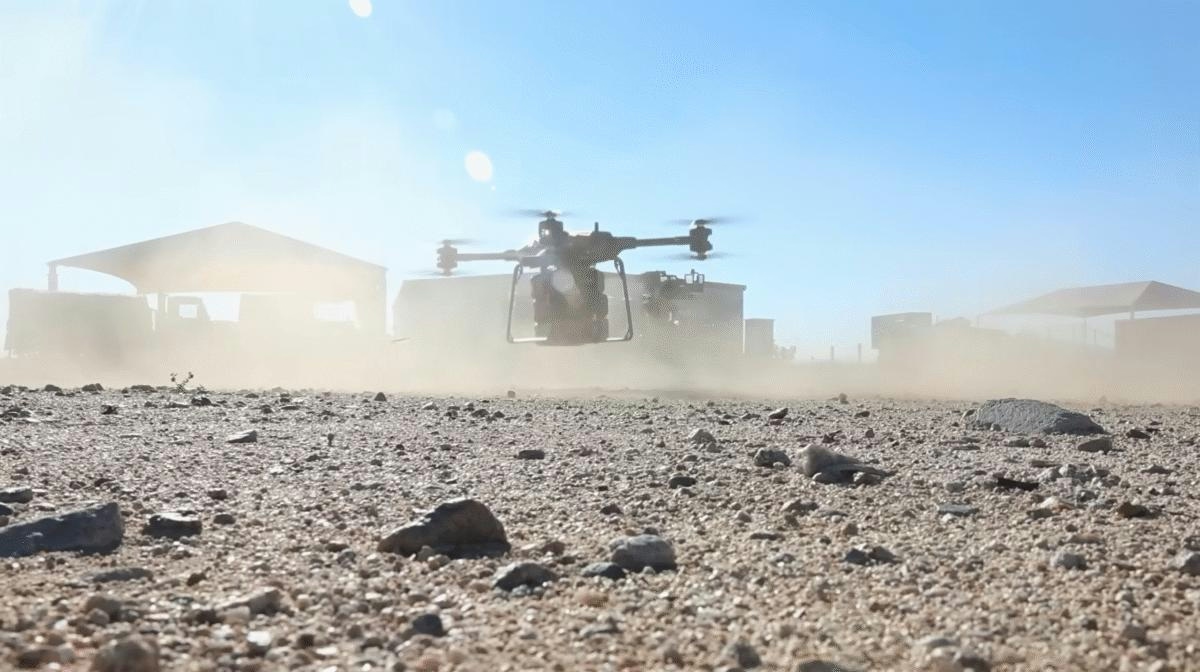
DARPA Announces Initial Competitors for Lift Challenge
The Defense Advanced Research Projects Agency (DARPA) has revealed the first group of teams selected to participate in its Lift Challenge, a national competition designed to revolutionize heavy vertical-lift aviation. The challenge aims to foster the development of drone technologies capable of lifting payloads at least four times their own weight, a significant leap beyond the current industry norm of approximately a 1:1 payload-to-weight ratio. Success in this endeavor could transform both commercial and military aviation sectors, enabling new capabilities in cargo transport, disaster relief, and tactical operations.
A Bold Step in Aviation Innovation
Phillip “Donna” Smith, the Lift Challenge Program Manager, described the competition as a test of pure aviation innovation. He highlighted the diversity and ingenuity of the teams’ designs, which incorporate novel propulsion and power systems, advanced control mechanisms, unique configurations, and innovative aerodynamic solutions. The program anticipates that these pioneering approaches will push the boundaries of what is possible in vertical-lift drone technology.
Interest in the Lift Challenge has been robust, with over 480 applications submitted during the entry period. More than 200 teams met DARPA’s stringent criteria, which included the submission of detailed concept papers, video demonstrations, and evidence of compliance with Federal Aviation Administration (FAA) Small Unmanned Aerial System (UAS) regulations. DARPA plans to invite up to 150 teams in total, with additional participants to be announced in the coming weeks.
A Diverse and Competitive Field
The initial roster of competitors represents a broad cross-section of the aerospace and technology sectors, including startups, established aerospace companies, universities, and independent inventors from across the United States. Notable participants include AdlerAerospace, Advanced Maneuvering, Embry-Riddle Aeronautical University’s Advanced Tactical Lift Aircraft System, Howard University’s AI for Positive Change Lab, Avalon Aero, Avidrone Inc., Arizona State University’s AXUS Lab, Team Fawkes’ Bastion Ascent, Burl Aerospace’s Alpha and Omega teams, Lawrence Livermore National Laboratory’s Collaborative Heavy-lift Aerial unManned Propellor Systems, Pennsylvania State University’s Heavy Blue, Florida Atlantic University’s Hovering Owls, University of Notre Dame’s NDDrone, Pegasus Portal Aircraft Company in collaboration with Galaxy UAS and Texas A&M University, University of Nevada, Reno’s Tactical Intelligent Transport for Autonomous Aerial Logistics, and the University of Maryland’s Autonomous Micro Air Vehicle DLC Team.
Industry Implications and Market Dynamics
The Lift Challenge has already generated considerable momentum within the technology sector, with implications extending beyond the immediate competition. As teams strive to meet DARPA’s ambitious performance targets, they confront not only technical and regulatory challenges but also heightened scrutiny from investors and industry analysts. This intensified focus on advanced drone technologies is accelerating research and development efforts, encouraging strategic partnerships, and prompting some companies to realign their market strategies to seize emerging opportunities.
This surge in innovation parallels developments in other high-tech industries. For instance, companies like Apple are advancing foldable technology designs to meet evolving consumer demands, while industry leaders such as SpaceX and OpenAI prepare for significant market entries, including potential initial public offerings. These trends reflect a broader pattern of intensified competition and investment across cutting-edge technology fields.
Competition Format and Timeline
The Lift Challenge is scheduled to culminate with a live, head-to-head competition at the National Museum of the U.S. Air Force in Dayton, Ohio, from August 2 to 9, 2026. During the event, teams will pilot their drones over a five-nautical-mile circuit, competing not only for the highest payload-to-weight ratios but also for recognition of the most innovative design solutions. This event promises to mark a pivotal moment in the evolution of aerial mobility technology.

Etihad Airways Suspends Airbus A380 Flights on Key Route

Aditya Birla Group Seeks Approval for Aircraft Leasing in GIFT City

Qatar Airways Highlights Innovation and Connectivity at Arabian Travel Market 2026

Hong Kong's Five-Year Plan Includes Andrew Fan's Aircraft Parts Processing Hub Proposal

ACIA Aero Leasing Delivers ATR72-600 to Air Nostrum

RTX Appoints Jill Albertelli as Head of Pratt & Whitney

TAT Technologies Joins Beyond Aero Hydrogen Aircraft Program

AURAK Study Highlights Barriers to Air Taxi Adoption in Emerging Economies

Xiamen Air Selects Altitude for 787 Maintenance at Heathrow

Etihad and Swissport Extend Global Partnership
