
Trasforma le intuizioni dell’IA in azioni concrete

Tendenze
Categories
Hermeus Secures $350 Million to Develop Autonomous Hypersonic Fighters
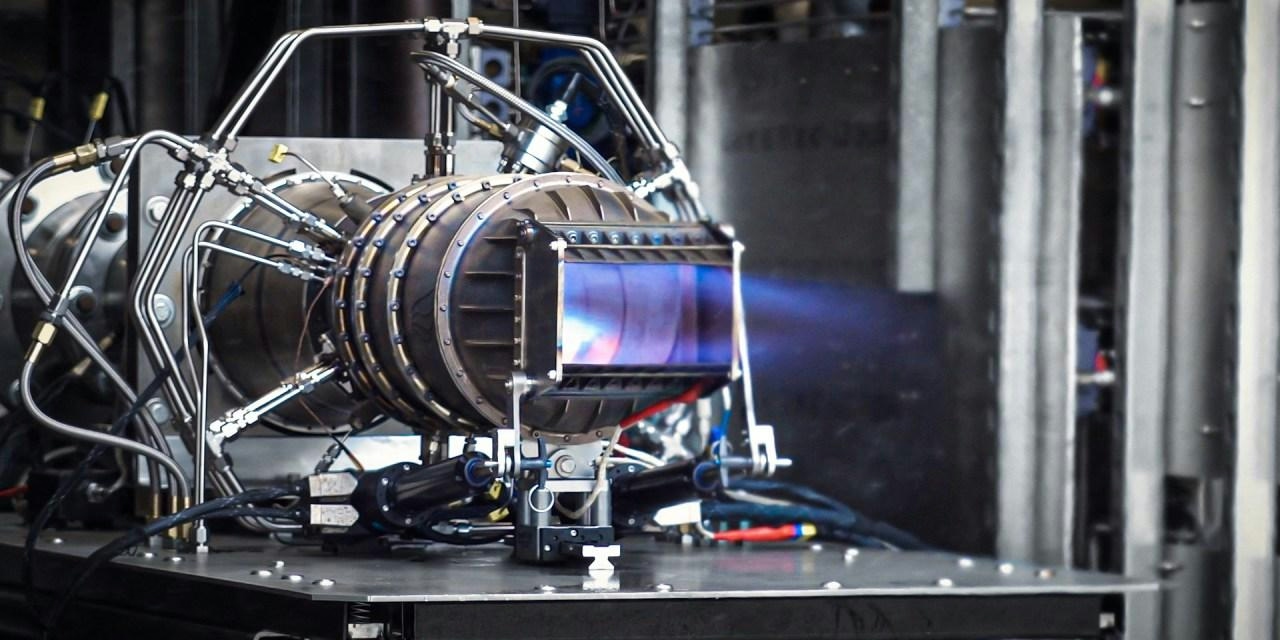
Hermeus Secures $350 Million to Advance Autonomous Hypersonic Fighters
Hermeus, a defense aviation startup based in Atlanta, has announced a $350 million funding round aimed at accelerating the development of autonomous hypersonic aircraft. Valued at $1 billion, the company is building on the momentum generated by two recent successful flight demonstrations as it prepares to push its next test vehicle beyond the sound barrier.
Strategic Focus and Industry Context
This significant investment highlights the increasing interest in next-generation defense technologies, particularly as the Pentagon intensifies efforts to counter hypersonic threats posed by China and Russia. Unlike many startups that have concentrated on commercial applications such as ultra-fast passenger jets, Hermeus has distinguished itself by focusing on military applications from the outset. Founded in 2018, the company has pursued a unique strategy of producing one aircraft annually, each designed to address specific technical challenges inherent in hypersonic flight.
Hermeus’s iterative development approach is complemented by a strategic partnership with aerospace giant Pratt & Whitney, positioning the company as a leader in the emerging hypersonic sector. Nevertheless, the firm faces challenges, including a limited pool of engineers with direct experience in this highly specialized field.
Technological Progress and Market Impact
Recent flight tests have validated Hermeus’s core technologies, demonstrating that its autonomous systems can manage takeoff, navigation, and landing without human intervention. Although the company has not disclosed detailed altitude or speed metrics, these demonstrations mark a significant advancement compared to competitors whose projects often remain conceptual and fail to deliver tangible results despite substantial defense spending.
Rather than developing entirely new propulsion systems, Hermeus has adapted turbine-based combined cycle engines akin to those used in the iconic SR-71 Blackbird. The company’s innovation lies in the miniaturization of these engines, coupled with automation and AI-driven flight controls, enabling autonomous operation at extreme speeds and under demanding conditions.
Market response to the funding round has been overwhelmingly positive, reflecting confidence in Hermeus’s technical achievements and business model. The company’s rapid progress has drawn attention from competitors, who may now intensify their own research and development efforts in hypersonic technology.
As Hermeus prepares for its most ambitious test to date—breaking the sound barrier as a precursor to true hypersonic flight—the company’s combination of proven engineering, strategic partnerships, and methodical development continues to attract significant investor interest. The $350 million capital injection represents one of the largest investments in the hypersonic sector to date, signaling a new phase in autonomous military aviation.

Etihad Airways Suspends Airbus A380 Flights on Key Route

Aditya Birla Group Seeks Approval for Aircraft Leasing in GIFT City

Qatar Airways Highlights Innovation and Connectivity at Arabian Travel Market 2026

Hong Kong's Five-Year Plan Includes Andrew Fan's Aircraft Parts Processing Hub Proposal

ACIA Aero Leasing Delivers ATR72-600 to Air Nostrum

RTX Appoints Jill Albertelli as Head of Pratt & Whitney

TAT Technologies Joins Beyond Aero Hydrogen Aircraft Program

AURAK Study Highlights Barriers to Air Taxi Adoption in Emerging Economies

Xiamen Air Selects Altitude for 787 Maintenance at Heathrow

Etihad and Swissport Extend Global Partnership
