
Trasforma le intuizioni dell’IA in azioni concrete

Tendenze
Categories
Lockheed Martin Tests Missile-Evasion AI on X-62 VISTA Aircraft
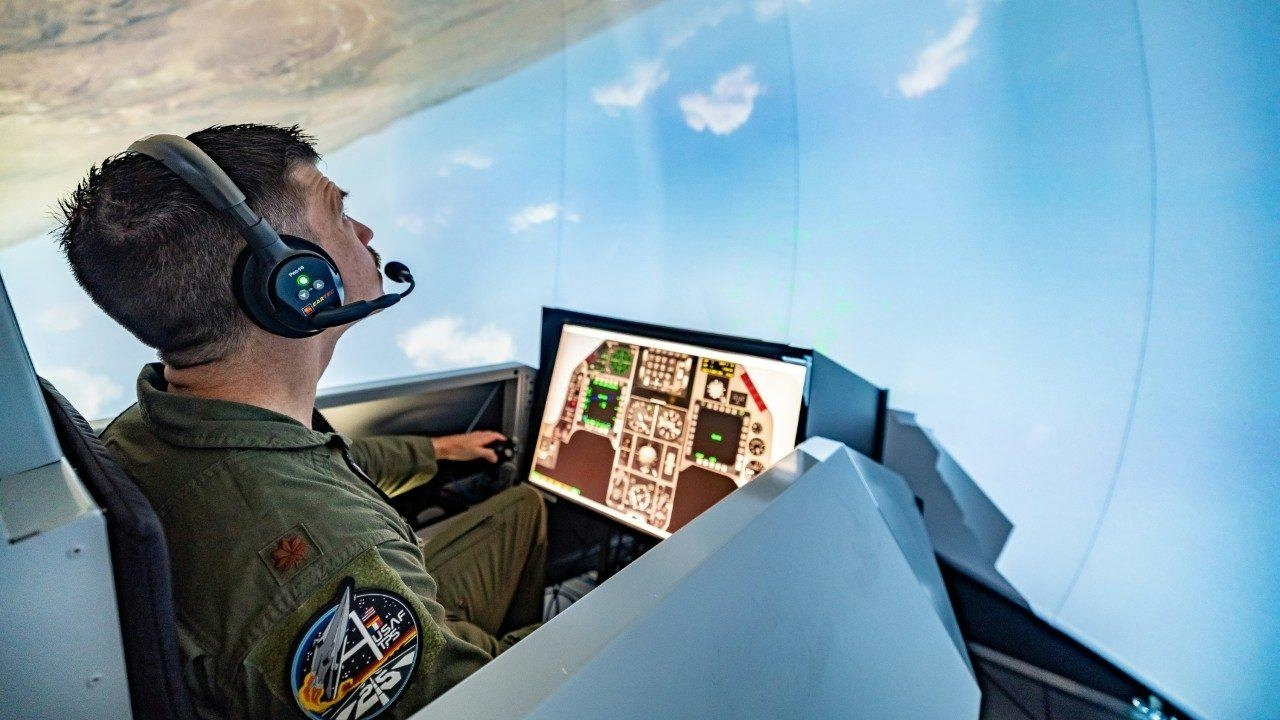
Lockheed Martin Advances AI-Powered Missile Evasion on X-62 VISTA Aircraft
Lockheed Martin’s Skunk Works division, in collaboration with the U.S. Air Force Test Pilot School (TPS), has reached a pivotal milestone in autonomous flight technology by successfully testing an artificial intelligence (AI) system designed for missile evasion aboard the X-62 Variable Stability In-Flight Simulator Test Aircraft (VISTA). This initiative, conducted under the Have Remy Test Management Project (TMP), actively involved TPS students in the development, simulation, and live flight evaluation of the AI agent.
Collaborative Development and Testing
The recent campaign, announced in a Lockheed Martin press release dated February 23, 2026, marked the first occasion on which the X-62 VISTA hosted a Lockheed Martin AI system with direct control over the aircraft. The project was characterized by close cooperation between Skunk Works and TPS, which operates the X-62 VISTA alongside the 412th Test Wing at Edwards Air Force Base, California. TPS students contributed real-time feedback during both high-fidelity F-16 simulator sessions and live flight tests, enabling Lockheed engineers to rapidly refine the AI algorithms and implement updates within hours.
The AI was evaluated across a range of missile evasion scenarios, including high-g maneuvers, deployment of countermeasures such as chaff and flares, and electronic warfare jamming aimed at disrupting incoming missiles and ground-based radar systems. While Lockheed Martin did not clarify whether the testing followed a cyclic or linear development process, the company emphasized that “in over 100 test points, TPS students flew the agents under real-world conditions, demonstrating robust sim-to-real transfer of the autonomous missile-evasion capability.”
Integration Within Broader Autonomous Flight Initiatives
The integration of AI into the X-62 VISTA builds upon earlier autonomous flight programs, notably the Air Force Research Laboratory’s Autonomous Air Combat Operations (AACO) and DARPA’s Air Combat Evolution (ACE) initiatives. In late 2022, these programs demonstrated AI agents piloting the VISTA in both beyond-visual-range and within-visual-range combat simulations, laying the groundwork for the current missile evasion tests.
Looking forward, the X-62 VISTA is slated to receive further enhancements, including the installation of Raytheon’s PhantomStrike Active Electronically Scanned Array (AESA) radar as part of the Mission Systems Upgrade (MSU), funded by the Test Resource Management Center (TRMC). These upgrades align with broader U.S. Air Force and industry efforts to advance autonomous air combat technologies and Collaborative Combat Aircraft (CCA). Concurrent projects in this domain include Anduril’s YFQ-44A Fury, GA-ASI’s YFQ-42A Dark Merlin, Northrop Grumman’s YFQ-48A Talon Blue, and Kratos’ XQ-58A Valkyrie.
Challenges and Industry Implications
Despite the promising progress, integrating AI-driven missile evasion capabilities presents significant challenges. Ensuring the AI’s reliability under actual combat conditions remains a critical concern, as does achieving seamless integration with existing aircraft systems without disrupting ongoing operations. Additional risks include potential data corruption or spoofing, which could undermine mission effectiveness.
The defense sector has responded to Lockheed Martin’s advancements with increased interest in AI-enabled combat technologies. Competitors such as Raytheon, already developing advanced radar systems for autonomous platforms, may accelerate their own AI initiatives in response. The growing trend toward incorporating AI in combat targeting, exemplified by Lockheed Martin’s F-35 testing programs, is expected to drive further innovation across the defense technology landscape as companies strive to maintain a competitive edge.

Etihad Airways Suspends Airbus A380 Flights on Key Route

Aditya Birla Group Seeks Approval for Aircraft Leasing in GIFT City

Qatar Airways Highlights Innovation and Connectivity at Arabian Travel Market 2026

Hong Kong's Five-Year Plan Includes Andrew Fan's Aircraft Parts Processing Hub Proposal

ACIA Aero Leasing Delivers ATR72-600 to Air Nostrum

RTX Appoints Jill Albertelli as Head of Pratt & Whitney

TAT Technologies Joins Beyond Aero Hydrogen Aircraft Program

AURAK Study Highlights Barriers to Air Taxi Adoption in Emerging Economies

Xiamen Air Selects Altitude for 787 Maintenance at Heathrow

Etihad and Swissport Extend Global Partnership
