image

AeroGenie — Uw intelligente copiloot.

Vraag alles. Analyseer alles. Reageer direct.

Trending

Categories

Airbus Issues Repair Directive for 6,000 A320 Family Jets
November 29, 2025By ePlane AI
Airbus Issues Repair Directive for 6,000 A320 Family Jets
0
0
Airbus A320 Family
Flight Control Software
Safety Directive

Airbus Issues Repair Directive for 6,000 A320 Family Jets

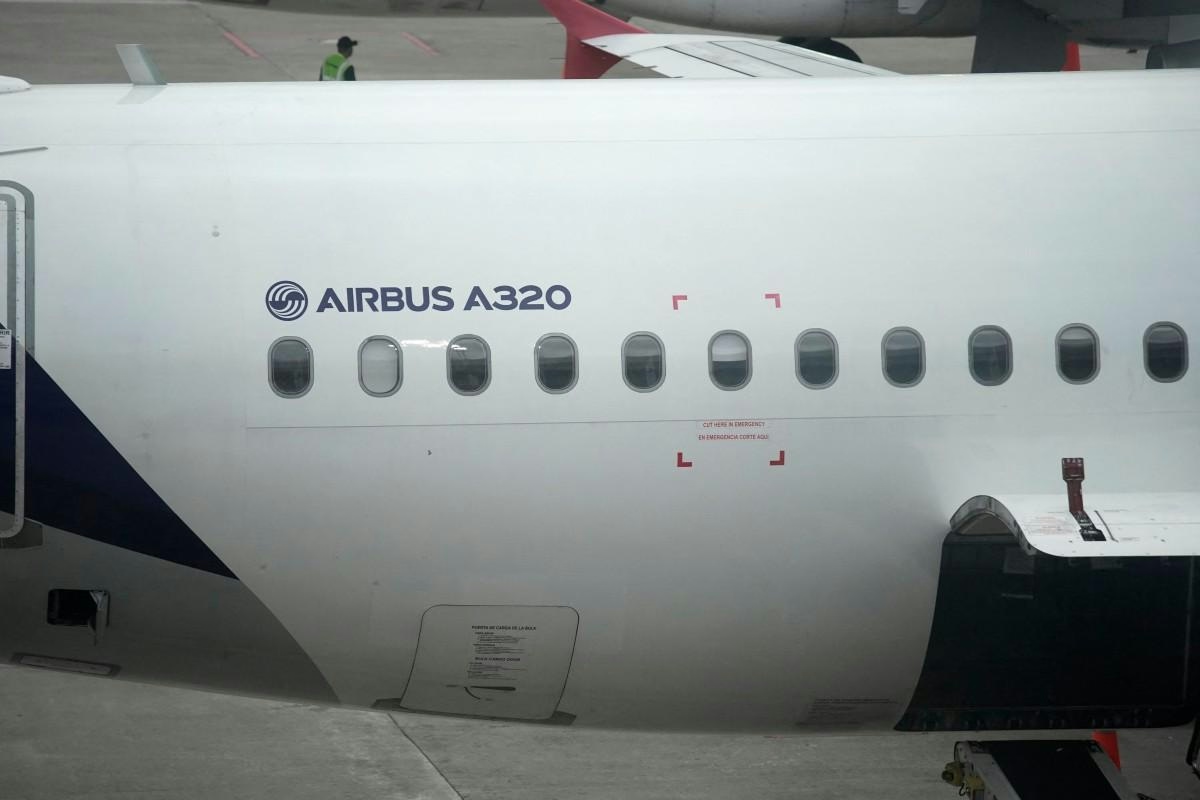
Aviation authorities and Airbus have issued an urgent directive mandating immediate repairs and inspections for approximately 6,000 A320 family aircraft worldwide. This action follows a recent flight-control incident involving a JetBlue aircraft, which experienced an uncontrolled "pitch down" event last month. The incident has raised significant safety concerns regarding one of the most widely operated commercial aircraft families globally.

Cause and Response

Investigations have identified a vulnerability in the flight-control computers of the affected jets, linked to software that may be susceptible to interference from solar radiation. In response, Airbus has ordered a comprehensive software update across its entire A320 family fleet, which includes the A318, A319, A320, and A321 models. The update is designed to address the identified flaw and enhance the resilience of the flight-control systems.

The modifications are classified as urgent and are expected to require approximately two hours per aircraft to complete. Airlines worldwide are now engaged in a concerted effort to implement the necessary changes, resulting in operational disruptions during a peak travel season. Several carriers have reported delays and cancellations as maintenance teams work continuously to minimize the impact on passengers and restore full service.

Industry and Market Implications

The directive has also prompted reactions within financial markets, with investors expressing concerns about the potential economic consequences for airlines compelled to ground aircraft for repairs. Operational efficiency is under heightened scrutiny, and some industry analysts suggest that competitors may attempt to leverage any perceived vulnerabilities in Airbus’s fleet management to their advantage.

Beyond the immediate logistical and financial challenges, the incident has sparked broader discussions about aviation safety and the industry's capacity to address emerging technological risks. It highlights the critical importance of robust software safeguards in modern aircraft and the necessity for swift, coordinated responses when potential hazards are detected.

Airbus has emphasized that the software update is a precautionary measure, reaffirming that passenger safety remains its highest priority. Regulators continue to monitor the situation closely as airlines work to complete the mandated repairs and return affected aircraft to service.

More news
Boeing's 2025 Commercial Deliveries Support Global Aviation Growth

Boeing's 2025 Commercial Deliveries Support Global Aviation Growth

Boeing's 2025 Commercial Deliveries Support Global Aviation Growth Robust Delivery Performance Across Key Aircraft Programs In 2025, Boeing reaffirmed its position as a leader in the global aviation market by delivering a total of 600 commercial aircraft, a critical contribution to the expansion of travel and tourism worldwide. These deliveries have been essential for airlines striving to accommodate increasing passenger demand while ensuring reliable and efficient service on both domestic and international routes. Boeing’s commercial airplanes segment remains the cornerstone of its operations, featuring a diverse portfolio that includes the 737, 767, 777, and 787 models. In the fourth quarter alone, the company delivered 160 commercial aircraft, demonstrating its capacity to meet the evolving needs of airlines serving both tourism and business sectors. The 737 program continues to be the backbone of short- and medium-haul travel, particularly for low-cost carriers. In the final quarter of 2025, Boeing delivered 117 units of the 737, bringing the annual total to 447. This model plays a vital role in providing affordable and frequent flights on popular domestic and regional routes, thereby supporting the growth of tourism and business connectivity. The 767 remains a versatile option for both passenger and cargo operations, with 10 deliveries in the fourth quarter and 30 for the year. Its adaptability makes it valuable for airlines and freight carriers operating transcontinental and high-volume routes, which are increasingly significant for the global tourism sector. Meanwhile, the 777 continues to serve as Boeing’s flagship for long-haul international travel. Six units were delivered in the fourth quarter, totaling 35 for the year. Known for its fuel efficiency and passenger comfort, the 777 is favored by airlines operating intercontinental routes connecting major cities such as Dubai, London, New York, and Sydney. Industry Challenges and Market Dynamics Despite these strong delivery figures, Boeing faces considerable challenges. The company remains under close scrutiny from the Federal Aviation Administration (FAA), particularly concerning the certification of the 737 MAX 10 and the pending decision on the 777F emissions waiver. Additionally, delays in the Air Force One program have added to operational pressures and regulatory attention. Market responses to Boeing’s performance have been mixed. The company’s stock rose by 1.2% in the week ending December 12, 2025, buoyed by strong demand for the 787 and positive order announcements. However, competition within the aerospace sector remains intense. Airbus is positioned to secure the annual order lead, while Embraer has increased its deliveries despite a reduction in E2 jet production. Looking ahead, Boeing’s ability to sustain its role in supporting global connectivity and tourism will depend on how effectively it navigates regulatory and operational hurdles. Wall Street analysts remain divided on the company’s prospects for a turnaround in 2026, with forthcoming FAA decisions and competitive pressures shaping the outlook. Boeing’s 2025 performance underscores its enduring significance in the aviation industry’s recovery and growth, even as it contends with a complex landscape of regulatory, competitive, and market challenges.
Archer Aviation Secures $6 Billion in Orders Despite No Revenue

Archer Aviation Secures $6 Billion in Orders Despite No Revenue

Archer Aviation Secures $6 Billion in Orders Despite No Revenue Archer Aviation Inc. (ACHR), a prominent developer of electric vertical takeoff and landing (eVTOL) aircraft, presents a striking paradox in the emerging urban air mobility sector. The company has amassed an order backlog valued at approximately $6 billion and maintains a market capitalization close to $6.5 billion, yet it has generated virtually no revenue to date. This disparity underscores both the disruptive potential of Archer’s technology and the significant operational and regulatory challenges it faces, contributing to considerable market speculation and volatility. Market Performance and Strategic Partnerships Archer’s stock price has reflected the uncertainty surrounding its business prospects. Although the share price rebounded by more than 60% from its lows in spring 2024, it remains 39% below its peak in October, illustrating investor ambivalence. Enthusiasm for the future of urban air mobility is tempered by doubts about Archer’s capacity to realize its ambitious vision. The company’s flagship aircraft, the “Midnight” eVTOL, is engineered to carry a pilot and four passengers up to 100 miles at speeds of 150 miles per hour, targeting urban air taxi and airport shuttle markets. Archer has secured high-profile partnerships with major industry players including United Airlines, Japan Airlines and Sumitomo’s Soracle joint venture, Ethiopian Airlines, Abu Dhabi Aviation, and the U.S. Air Force. Notably, Archer is designated as the official air taxi provider for the 2028 Los Angeles Olympic Games, a commitment that underscores its strategic positioning. Financial Projections and Operational Realities Wall Street analysts project rapid revenue growth for Archer over the next several years, with estimates rising from $32 million in 2026 to $1.75 billion by 2029. Based on these forecasts, Archer’s stock trades at less than four times its projected 2029 sales, with some analysts anticipating that the company could achieve adjusted profitability ahead of competitors such as Joby Aviation (JOBY). Despite these optimistic projections, Archer’s operational track record remains sobering. Since its 2021 merger via a special purpose acquisition company (SPAC), the company has consistently missed aggressive targets. Initial plans envisioned delivering 10 aircraft in 2024 and generating $3.4 billion in revenue by 2027. In reality, Archer delivered only one test aircraft to the U.S. Air Force in 2024, reported negligible revenue, and posted a net loss of $537 million. As of August 2025, the company had built just two commercial prototypes, with six additional units under development. Challenges and Competitive Landscape Archer faces significant hurdles on its path to commercial viability. Manufacturing scale remains a critical concern, as the company depends on contract manufacturing through its major investor Stellantis (STLA). Progress in this area has been slower than anticipated, casting doubt on Archer’s goal to produce 650 aircraft annually by 2030. Regulatory certification also poses a formidable challenge. Archer requires four separate Federal Aviation Administration (FAA) certifications in the United States, having secured only maintenance and air carrier certificates to date, while the essential type certification remains pending. The absence of meaningful revenue has intensified skepticism regarding Archer’s ability to fulfill its substantial order backlog. This uncertainty has contributed to pronounced stock price volatility and created opportunities for competitors—including Joby Aviation, Beta Technologies, and Eve Air Mobility—to accelerate their development and marketing efforts, seeking to capitalize on any perceived instability at Archer. In response, Archer has pursued strategic differentiation through partnerships, notably collaborating with NVIDIA to develop advanced artificial intelligence technology for aviation applications. While this initiative could provide a competitive edge, it requires significant investment and time before yielding tangible results. As Archer Aviation continues to navigate these operational and regulatory challenges, its future remains a high-stakes proposition, contingent on its ability to convert substantial orders into sustainable revenue streams.
Jet Engine in December 29 Passenger Plane Crash Required Five Safety Upgrades

Jet Engine in December 29 Passenger Plane Crash Required Five Safety Upgrades

Jet Engine in December 29 Passenger Plane Crash Required Five Safety Upgrades The jet engine installed on the Boeing 737-800 involved in the December 29 passenger plane crash had undergone five mandatory safety upgrades within the four years preceding the accident. This revelation has raised significant concerns about the engine’s reliability and prompted calls for a more comprehensive investigation into the incident. Safety Directives and Engine Components Data provided by the Ministry of Land, Infrastructure and Transport (MOLIT) to National Assembly member Jeong Jun-ho of the Democratic Party of Korea revealed that the aircraft’s engine was subject to five Airworthiness Directives between November 2020 and March 2024. These directives, akin to recalls in the automotive sector, mandate inspections, repairs, or modifications to address manufacturing defects or unsafe conditions in aircraft systems. The corrective measures focused on critical internal components, including the power transmission system—specifically the accessory gearbox—and the high-pressure turbine (HPT). One of these directives was classified as an emergency action, highlighting the severity of the identified risks. Industry Response and Regulatory Context The repeated need for safety improvements has intensified scrutiny of the engine’s performance and the broader safety protocols within the aviation industry. In the aftermath of the crash, market analysts anticipate increased pressure on airlines and manufacturers to implement more rigorous safety measures. Competitors are also expected to reassess and potentially enhance their own safety standards to maintain public confidence and comply with regulatory requirements. These developments coincide with ongoing efforts by global aviation authorities, including the U.S. Federal Aviation Administration (FAA), to strengthen safety oversight. The FAA’s "Flight Plan 2026" initiative exemplifies this trend, aiming to improve hiring and training practices to better identify and mitigate potential hazards. This reflects a growing industry-wide emphasis on proactive risk management and enhanced regulatory vigilance. Calls for Thorough Investigation Jeong Jun-ho stressed the necessity of a meticulous and impartial investigation into the engine’s condition, stating, "Now that the past safety improvement history of the accident aircraft’s engine has been confirmed, a more thorough examination of the engine is necessary to ensure an objective accident investigation." He urged the Aviation and Railway Accident Investigation Board (ARAIB) to undertake additional in-depth inquiries, including independent investigations and consultations with both domestic and international experts. As the investigation proceeds, the incident underscores the persistent challenges of maintaining aircraft safety amid evolving technical standards and regulatory expectations. The findings may have significant implications for future industry practices and regulatory frameworks as stakeholders work to restore confidence and prevent similar tragedies.
Austro Engines Reach 5 Million Service Hours

Austro Engines Reach 5 Million Service Hours

Austro Engines Surpasses Five Million Flight Hours Austrian engine manufacturer Austro Engine has reached a significant milestone, surpassing five million operational flight hours as of December. This achievement highlights the company’s expanding footprint in the global aviation market and underscores the reliability and widespread adoption of its powerplants, which have been in service since 2009. Owned by Diamond Aircraft, Austro Engine currently operates more than 5,500 engines worldwide. The company’s production facility in Wiener Neustadt, Austria, specializes in adapting Mercedes-Benz diesel engines for aviation applications. These engines power a range of Diamond’s general aviation aircraft, including the DA40, DA42, and DA62 models. Innovation and Market Presence Jürgen Schwarz, General Manager of Austro Engine, emphasized the significance of the milestone, stating that it reflects the reliability and innovation embedded in their engines. He noted that Austro’s powerplants operate in over 80 countries, serving diverse sectors such as flight schools, professional operators, special missions, private owners, and business travelers. This broad adoption attests to the engines’ exceptional performance and efficiency. Diamond Aircraft was an early adopter of modern diesel technology, initially utilizing Thielert engines before establishing Austro Engine to modify Mercedes automotive engines for aviation use. Following Thielert’s bankruptcy and acquisition by Continental in 2013, Austro expanded its product line. The company currently produces the 168-horsepower AE300 for the DA40 and DA42, the 180-horsepower AE330 for the seven-seat DA62, and the AE50R rotary engine for unmanned aerial vehicles. Additionally, the 110-horsepower AE110R rotary engine is under development. The larger DA50 single-engine aircraft employs Continental’s CD300 diesel engine. Industry Challenges and Future Outlook While the five million flight hour milestone underscores Austro’s reliability and innovation, it arrives amid ongoing challenges in the aviation industry, particularly within business aviation. Supply chain disruptions remain a critical concern, with any interruption in parts or materials posing significant risks to engine manufacturers like Austro. Ensuring consistent production and support will be essential as the company seeks to build on its established reputation. Market response to Austro’s achievement is anticipated to be favorable, potentially boosting confidence among existing customers and attracting new operators drawn to the proven durability of Austro’s engines. Nevertheless, competitors are likely to emphasize their own advancements in reliability and technology, especially as regulatory changes and supply chain issues continue to influence the sector. Austro Engine’s milestone not only solidifies its position as a key player in the general aviation market but also sets the stage for intensified competition and innovation as the industry adapts to evolving challenges.
Baykar Proposes Upgrades for Piaggio Avanti and UAVs

Baykar Proposes Upgrades for Piaggio Avanti and UAVs

Baykar Proposes Upgrades for Piaggio Avanti and UAVs Amid Intensifying Market Competition Baykar’s recent acquisition of Italy’s Piaggio Aerospace represents a significant turning point for the historic aviation company. The Turkish defense firm has unveiled an extensive strategy aimed at revitalising Piaggio’s operations and product portfolio. Central to this plan is a substantial increase in the production of the P180 Avanti aircraft, expansion of engine manufacturing and maintenance capabilities, and the introduction of a comprehensive upgrade program culminating in the new “Avanti Next” configuration. Baykar positions this acquisition as a long-term strategic investment designed to merge Piaggio’s 140-year heritage in civil aviation with Baykar’s expertise in unmanned aerial vehicle (UAV) technologies. Strategic Vision and Operational Revitalisation Haluk Bayraktar, Baykar’s General Manager and Chairman of Piaggio Aerospace, highlighted that the acquisition aims to combine Italian and Turkish industrial strengths to create a distinctive competitive advantage. Since entering extraordinary administration in 2018 due to insolvency, Piaggio Aerospace has maintained continuity in key areas such as P180 Avanti manufacturing, engine component production, and established maintenance, repair, and overhaul (MRO) services. Currently, Piaggio produces approximately four to five Avanti aircraft annually, a figure Bayraktar describes as temporary. Baykar’s objective is to increase this output to 25–30 aircraft per year by leveraging existing facilities and supply chain infrastructure. The P180 Avanti, renowned as the world’s fastest turboprop, remains central to Baykar’s vision of restoring its competitiveness in the global market. “Avanti Next”: Comprehensive Upgrades and Customer-Driven Innovation A key element of Baykar’s strategy is the development of the “Avanti Next” modernisation package. This initiative includes advanced avionics with a transition toward Garmin systems, refreshed interiors that reflect Italian design aesthetics, and systems enhancements aimed at extending maintenance intervals. These upgrades are being developed collaboratively by Baykar and Piaggio engineering teams, with a strong emphasis on incorporating customer feedback to ensure the Avanti platform meets evolving market demands. Global Support Expansion and Market Focus Baykar also plans to enhance after-sales support and global service operations, focusing particularly on the United States, which represents the largest civil aviation market. Of the more than 220 P180 aircraft currently in service worldwide, around 100 are based in the US, another 100 in Europe, and the remainder in other regions. Strengthening support infrastructure is viewed as essential to sustaining and expanding the Avanti’s global presence. Rising Competitive Pressures and Market Dynamics Baykar’s ambitious plans emerge amid intensifying competition in both civil and defense aviation sectors. The rapidly evolving battlefield environment, especially in Ukraine, is driving increased demand for advanced UAV solutions. The United Kingdom is accelerating production of Octopus interceptor UAVs for Ukraine, while Quantum Systems and Frontline JV are preparing to deliver 10,000 Zoom and Linza UAVs by 2026. These developments are expected to heighten market pressure on Baykar and Piaggio to produce innovative, reliable, and cost-effective products. Industry analysts suggest that competitors may expedite their own development schedules and enhance product offerings in response, underscoring the necessity for Baykar’s proposed upgrades to keep pace with technological advancements and shifting customer requirements. As Baykar advances its integration and modernisation efforts, the company confronts both significant opportunities and considerable challenges within a rapidly transforming global aviation landscape.
Boeing Surpasses Airbus in 2025 Aircraft Orders

Boeing Surpasses Airbus in 2025 Aircraft Orders

Boeing Surpasses Airbus in 2025 Aircraft Orders Boeing has overtaken Airbus in net aircraft orders for 2025, marking its first annual lead over the European manufacturer since 2018. According to company reports, Boeing secured 1,175 net new orders, surpassing Airbus’s total of 1,000. This achievement represents a significant turnaround for Boeing following several difficult years characterized by production challenges and safety concerns. Production Improvements Drive Order Growth The increase in Boeing’s orders is primarily attributed to enhancements in production quality and delivery efficiency, especially within its 737 Max program. The company experienced a notable surge in momentum during the final quarter of the year, recording 354 orders—more than double the 153 orders logged in the preceding quarter. This growth reflects renewed confidence among customers in Boeing’s capacity to fulfill its commitments reliably. In the commercial aerospace sector, order volumes are a critical indicator of future revenue potential. Boeing’s strong performance in securing orders throughout 2025 suggests it is regaining competitiveness in the commercial jet market. However, it is important to note that orders only translate into revenue once aircraft are delivered to customers. Airbus Maintains Lead in Deliveries Despite Boeing’s lead in orders, Airbus continued to dominate in actual aircraft deliveries. The European manufacturer delivered 793 aircraft in 2025, exceeding its revised annual target of 790 and representing a 4% increase compared to the previous year. Boeing, by contrast, delivered 600 jets during the same period. Although this marks progress for Boeing, it remains behind Airbus in this crucial metric, which directly impacts revenue realization. The data underscores a shifting dynamic within the aerospace industry. Boeing’s resurgence in orders signals restored market confidence and operational improvements, while Airbus’s sustained delivery performance highlights its robust production capabilities and ability to meet customer demand effectively. As both companies look to the future, the competition between Boeing and Airbus remains intense. Boeing’s recovery in orders positions it favorably for growth, but narrowing the gap in deliveries will be essential for the company to fully capitalize on its order backlog and maintain its upward trajectory.
Alaska Airlines Debuts First Branded Widebody Jet Following Major Boeing Order

Alaska Airlines Debuts First Branded Widebody Jet Following Major Boeing Order

Alaska Airlines Debuts First Branded Widebody Jet Amid Major Boeing Order Alaska Airlines has introduced its first branded widebody aircraft, a Boeing 787-9 Dreamliner, marking a pivotal moment in the carrier’s expansion into long-haul international markets. The Dreamliner, now operating routes such as Seattle to Tokyo, coincides with Alaska’s announcement of its largest-ever aircraft order: 110 planes from Boeing, comprising 105 737 Max-10s and five 787-10 Dreamliners. This strategic investment signals the airline’s commitment to growing its global footprint and modernizing its fleet. Overcoming Past Safety Challenges This significant order follows a challenging period for Alaska Airlines and Boeing. In January 2024, a safety incident involving a Boeing 737 Max-9 raised serious concerns when a mid-cabin door plug, missing critical bolts, detached at 14,800 feet. The event prompted Alaska to ground its entire 737 Max-9 fleet. An investigation by the National Transportation Safety Board subsequently identified major lapses in Boeing’s manufacturing oversight and quality control, concluding that the door plug had not been properly secured during production. Despite these setbacks, Alaska Airlines’ renewed partnership with Boeing reflects restored confidence in the manufacturer’s ability to deliver safe, reliable aircraft. At the Dreamliner unveiling in Seattle, Alaska CEO Ben Minicucci addressed Boeing employees, acknowledging their efforts over the past two years. He emphasized the airline’s high standards for quality, safety, performance, and efficiency, affirming a shared commitment to success between the carrier and the manufacturer. Strategic Vision and Industry Impact Minicucci outlined an ambitious vision to elevate Alaska Airlines to become America’s fourth-largest global carrier, positioning it to compete directly with United, Delta, and American Airlines. The launch of the Dreamliner on direct Seattle-Tokyo flights represents a tangible step toward this goal, with ticket sales already underway. The debut of Alaska’s branded widebody jet and its substantial Boeing order have attracted considerable attention within the aviation sector. Market responses have been predominantly positive, reflecting increased investor confidence in Boeing’s capacity to address prior safety issues and meet delivery schedules. Alaska’s endorsement is widely viewed as a significant vote of confidence in Boeing’s ongoing recovery, particularly as the manufacturer accelerates production of both the 737 Max and 787 Dreamliner following recent certification milestones. Competitors are closely monitoring Alaska’s fleet expansion, with some reportedly reevaluating their own aircraft orders and production timelines. As Boeing strives to rebuild its reputation and satisfy growing demand, the industry is poised for further adjustments in fleet strategies and competitive positioning. Alaska Airlines’ bold expansion highlights the complex interplay of opportunity and challenge confronting U.S. carriers and aircraft manufacturers alike, as they navigate evolving safety standards, operational reliability, and intensifying global competition.
Boeing Reports Fourth-Quarter Deliveries Amid Rising Backlog

Boeing Reports Fourth-Quarter Deliveries Amid Rising Backlog

Boeing Reports Fourth-Quarter Deliveries Amid Rising Backlog Strong Fourth-Quarter Performance Signals Market Recovery Boeing announced a notable rebound in its fourth-quarter 2025 deliveries, achieving its highest annual jet output since 2018 and demonstrating renewed strength in the global aerospace sector. The company delivered 160 commercial aircraft in the final quarter and a total of 600 for the year, surpassing European rival Airbus in net orders for the first time in seven years. The fourth-quarter commercial deliveries comprised 117 737s, 10 767s, six 777s, and 27 787 Dreamliners. On the defense front, Boeing delivered 37 aircraft across its Defense, Space & Security portfolio, including AH-64 Apaches, CH-47 Chinooks, KC-46 tankers, and other platforms. Boeing emphasized that these delivery figures remain preliminary and will be finalized with the release of its upcoming quarterly financial results. Robust Order Book and Strategic Partnerships Boeing’s resurgence is supported by a strong order backlog. The company secured 368 Dreamliner orders in 2025, narrowly missing its 2007 record of 369. Market analysts have responded positively, citing improvements in production quality and recovery from recent operational challenges as indicators of renewed confidence. Although Airbus maintains a larger backlog, ongoing production delays at the European manufacturer may provide Boeing with a competitive advantage in securing new orders throughout 2026. This delivery update follows several significant order announcements in January. Boeing and Delta Air Lines revealed Delta’s first direct order for up to 60 787 Dreamliners, including 30 firm orders for the 787-10 and options for an additional 30 aircraft. These widebody jets are intended to enhance Delta’s long-haul international operations and support its fleet renewal strategy. Delta CEO Ed Bastian remarked, “Delta is building the fleet for the future,” while Boeing Commercial Airplanes President and CEO Stephanie Pope expressed eagerness to support Delta’s operational objectives. In addition, Aviation Capital Group placed an order for 50 737 MAX aircraft—comprising 25 737-8s and 25 737-10s—raising its 737 MAX backlog to 121 and marking the largest 737-10 order ever placed by a leasing company. Earlier in the month, Boeing and Alaska Airlines announced the carrier’s largest aircraft order to date, including 105 737-10s and five 787 Dreamliners. As Boeing’s backlog expands and production stabilizes, industry observers are closely monitoring how competitors will respond. For now, Boeing’s strong delivery performance and record-setting orders position the company for continued recovery and growth in the year ahead.
Sabena Technics Secures DMAé Contract for Franco-German C-130J Fleet Support

Sabena Technics Secures DMAé Contract for Franco-German C-130J Fleet Support

Sabena Technics Awarded Long-Term Support Contract for Franco-German C-130J Fleet France’s Directorate of Aeronautical Maintenance (DMAé) has entrusted Sabena Technics with a significant maintenance and operational support contract for the Franco-German C-130J and KC-130J aircraft fleet. Operated by the Binational Air Transport Squadron (BATS) “Rhin” at Évreux Air Base 105, the contract was signed on December 24 and spans ten years. Known as CAROLUS (Combined Aircraft Repair and Operational Long-term Unified Support for C-130J), this agreement represents one of the largest military contracts ever awarded to the independent French maintenance, repair, and overhaul (MRO) provider, marking a pivotal step in its defense sector expansion. Scope of the CAROLUS Contract The Franco-German Super Hercules fleet comprises five C-130J and five KC-130J aircraft. Under the terms of the CAROLUS contract, Sabena Technics will deliver a comprehensive suite of support services. These include conducting maintenance checks at its Bordeaux facility, managing the supply chain, performing repairs, and establishing a dedicated technical office and logistics infrastructure at Évreux. The company will also provide round-the-clock technical assistance and Continuing Airworthiness Management Organization (CAMO) support. DMAé has stipulated enhanced performance standards, focusing on improving aircraft operational availability, mission readiness, maintenance turnaround times, and expanding logistics capabilities. Competitive Landscape and Industry Implications Sabena Technics enters this contract with a solid track record, having previously maintained the French Air and Space Force’s C-130H fleet and performed periodic C-Checks on the Franco-German C-130Js. Nevertheless, the company’s selection comes amid intense competition from established defense contractors such as Lockheed Martin and BAE Systems, which maintain significant market shares, particularly in microelectronics and related support contracts. The awarding of the CAROLUS contract to Sabena Technics is expected to attract close scrutiny regarding its capacity to meet the demanding operational requirements and sustain consistent performance throughout the contract’s duration. Industry analysts suggest that this development may trigger increased efforts by competitors like Lockheed Martin and BAE Systems to secure further contracts and strengthen their foothold in the European defense support market. As Sabena Technics assumes this expanded role, its performance will be closely monitored by defense authorities and industry stakeholders alike, given the strategic importance of the Franco-German C-130J fleet and the broader implications for future military maintenance and support agreements in the region.
Forecast International Introduces Commercial Aircraft OEM Intelligence Brief

Forecast International Introduces Commercial Aircraft OEM Intelligence Brief

Forecast International Launches Commercial Aircraft OEM Intelligence Brief Amid Market Challenges Forecast International has introduced its Commercial Aircraft OEM Intelligence Brief, a monthly publication designed to deliver structured, data-driven insights into the short-term performance of leading global commercial aircraft manufacturers. Targeting a 0-to-12-month horizon, the brief provides detailed visibility into the operational execution of major original equipment manufacturers (OEMs) such as Airbus, Boeing, Embraer, ATR, and COMAC. Addressing Information Gaps in OEM Performance Short-term performance metrics at commercial aircraft OEMs are critical, influencing revenue streams, supply chain stability, delivery schedules, and financial risk across the aerospace sector. However, obtaining a clear and comprehensive view of these factors has traditionally been hindered by the limitations inherent in public disclosures. Forecast International’s Intelligence Brief seeks to bridge this gap by integrating both publicly available and proprietary data sources, offering a month-to-month analysis of OEM production and delivery execution. Each edition adheres to a consistent analytical framework, presenting program-level data on production volumes, deliveries, orders, and backlog figures for both the current month and year-to-date. The brief compares production targets against actual output, examines production-to-delivery lead times to identify shifts in delivery flow, and provides variant-level performance tables segmented by aircraft family. Complementing these data points, expert analyst commentary interprets execution pacing, identifies constraints, and assesses supply chain stability. Executive summaries are supported by charts and visuals tailored for internal corporate briefings, enabling users to monitor changes in OEM performance, detect emerging risks, and evaluate alignment with stated production objectives. Navigating a Competitive and Disrupted Market The launch of this Intelligence Brief occurs amid a crowded market for aircraft intelligence and analytics. Established competitors such as Dassault, Cirrus, and Textron Aviation already maintain significant presence in the aircraft computing and intelligence domain, raising expectations for new entrants. Forecast International may therefore encounter increased scrutiny from OEMs regarding the distinct value proposition of its reports. In response, competitors might enhance their own intelligence offerings or pursue strategic partnerships to deliver more comprehensive data solutions. Compounding these competitive pressures are ongoing disruptions within the aerospace supply chain, recently highlighted by Aviation Week Network. Challenges in securing critical materials for aircraft manufacturing have intensified the need for timely and accurate OEM intelligence. These supply chain complexities are likely to drive demand for detailed analysis as manufacturers and suppliers strive to manage operational risks in an increasingly volatile environment. By providing clear interpretations of recent changes, their significance, and emerging execution risks, Forecast International’s Commercial Aircraft OEM Intelligence Brief aims to serve as a vital resource for industry stakeholders seeking actionable insights in a rapidly evolving aerospace market.
Ask AeroGenie










