
Zet AI‑inzichten om in gerichte actie

Trending
Categories
Airbus Navigates Jet Demand and Production Challenges Amid Global Travel Recovery
Airbus Navigates Jet Demand and Production Challenges Amid Global Travel Recovery
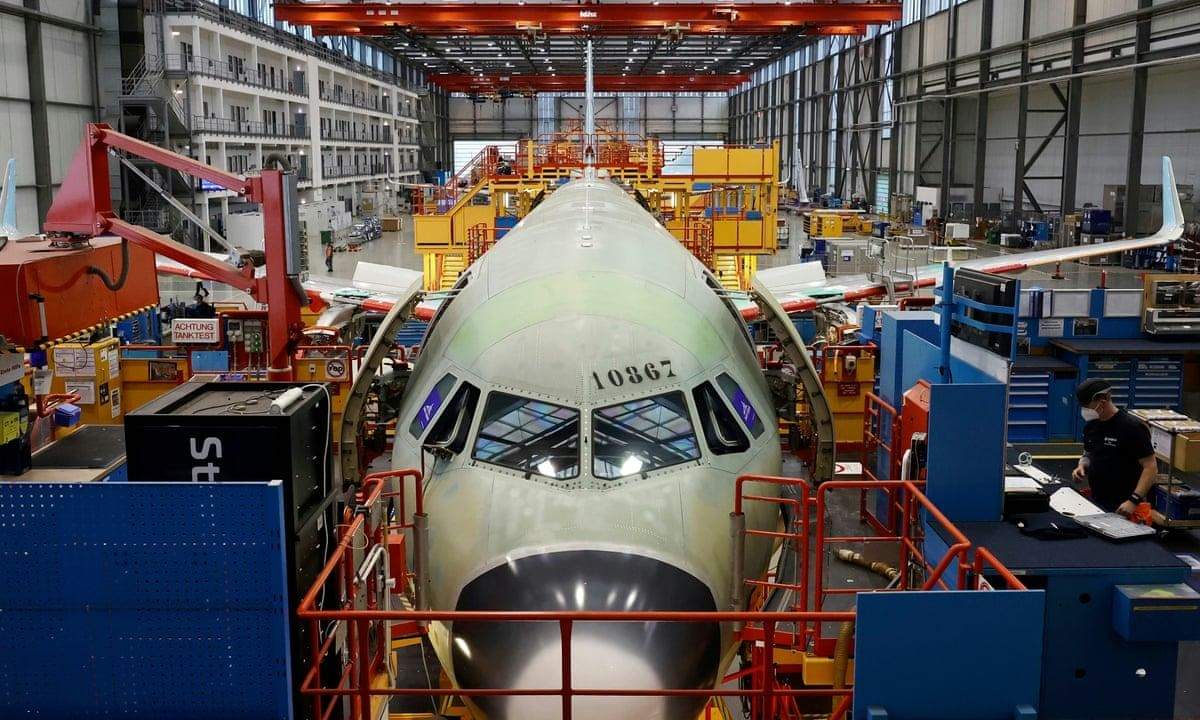
Airbus stands at the forefront of a vigorous resurgence in commercial aviation, as airlines worldwide renew their fleets and expand capacity in response to a sharp increase in post-pandemic travel demand. The European aerospace giant’s extensive order backlog, encompassing both single-aisle and widebody aircraft, underpins its long-term growth prospects. However, the company continues to grapple with persistent production and supply-chain challenges as it strives to convert these orders into delivered aircraft and generate corresponding cash flow.
Order Backlog and Market Position
Global air traffic has largely rebounded to, and in some regions exceeded, pre-pandemic levels. This recovery has prompted airlines to prioritize the acquisition of more fuel-efficient aircraft to reduce operating costs and comply with increasingly stringent emissions regulations. Airbus’s capacity to scale up production on its core programs while upholding rigorous quality and safety standards remains a critical strategic focus, closely monitored by investors.
The company has amassed a substantial backlog across its product range, providing multi-year revenue visibility and a buffer against short-term market volatility. Recent large orders from carriers in Europe, Asia, and the Middle East reflect strong airline confidence in both long-haul and regional travel over the coming decade. Nevertheless, managing this backlog requires careful allocation of delivery slots, as airlines compete for earlier delivery positions.
The single-aisle segment, particularly the A320neo family, continues to be the cornerstone of Airbus’s commercial operations. Narrowbody aircraft dominate short- and medium-haul routes, with airlines increasingly favoring models that offer enhanced fuel efficiency and extended range. Consequently, Airbus’s production planning and workforce deployment are heavily concentrated on these high-volume platforms, making any disruption in narrowbody manufacturing a significant risk to the company’s financial performance.
Production Ramp-Up and Supply Chain Constraints
In an effort to address its backlog, Airbus is working to increase monthly production rates but faces ongoing challenges related to component bottlenecks and labor shortages. The global aviation supply chain remains strained by capacity limitations, parts shortages, and certification delays for critical systems. Engine delays, particularly from supplier Pratt & Whitney, have grounded hundreds of A320neo aircraft, drawing sharp criticism from airline executives such as United Airlines CEO Scott Kirby, who has described the engine shortage as a major constraint for the industry.
Airbus CEO Guillaume Faury has acknowledged the inherent difficulties in scaling up production, emphasizing the necessity of close coordination across the company’s factories in Europe, China, and the United States. The firm is investing in industrial efficiency improvements, digital planning tools, and workforce training to ensure that production growth does not come at the expense of quality. Despite these challenges, Faury reports no indications of jet order cancellations, signaling resilient long-term demand. However, Airbus has informed customers of delivery delays for the A320neo series—particularly the A321neo variant—affecting jets scheduled for 2027 and 2028.
Strategic Outlook
Beyond the narrowbody segment, Airbus’s widebody aircraft remain vital to long-haul markets such as transatlantic and Asia-Europe routes. The company’s investor communications highlight its robust commercial backlog, ongoing research and development investments, and commitments to sustainability. Recent analyses have focused on how Airbus balances capital allocation among new technology development, debt management, and shareholder returns, while maintaining flexibility in a cyclical industry.
As airlines rely on timely aircraft deliveries to implement network strategies and retire aging fleets, Airbus’s ability to navigate supply-chain constraints and ramp up production will be central to sustaining its growth trajectory and maintaining its leadership position in the global aerospace sector.

Hong Kong's Five-Year Plan Includes Andrew Fan's Aircraft Parts Processing Hub Proposal

ACIA Aero Leasing Delivers ATR72-600 to Air Nostrum

RTX Appoints Jill Albertelli as Head of Pratt & Whitney

TAT Technologies Joins Beyond Aero Hydrogen Aircraft Program

AURAK Study Highlights Barriers to Air Taxi Adoption in Emerging Economies

Xiamen Air Selects Altitude for 787 Maintenance at Heathrow

Etihad and Swissport Extend Global Partnership
Sepehran Airlines B737 Returns to Mashhad After Tyre and Engine Issues

Etihad Deploys Widebody Fleet to Meet Strong Demand
Korean Air Finalizes $36.2 Billion Deal with Boeing
