
Zet AI‑inzichten om in gerichte actie

Trending
Categories
Challenges Boeing Faced Following 787 Production Outsourcing
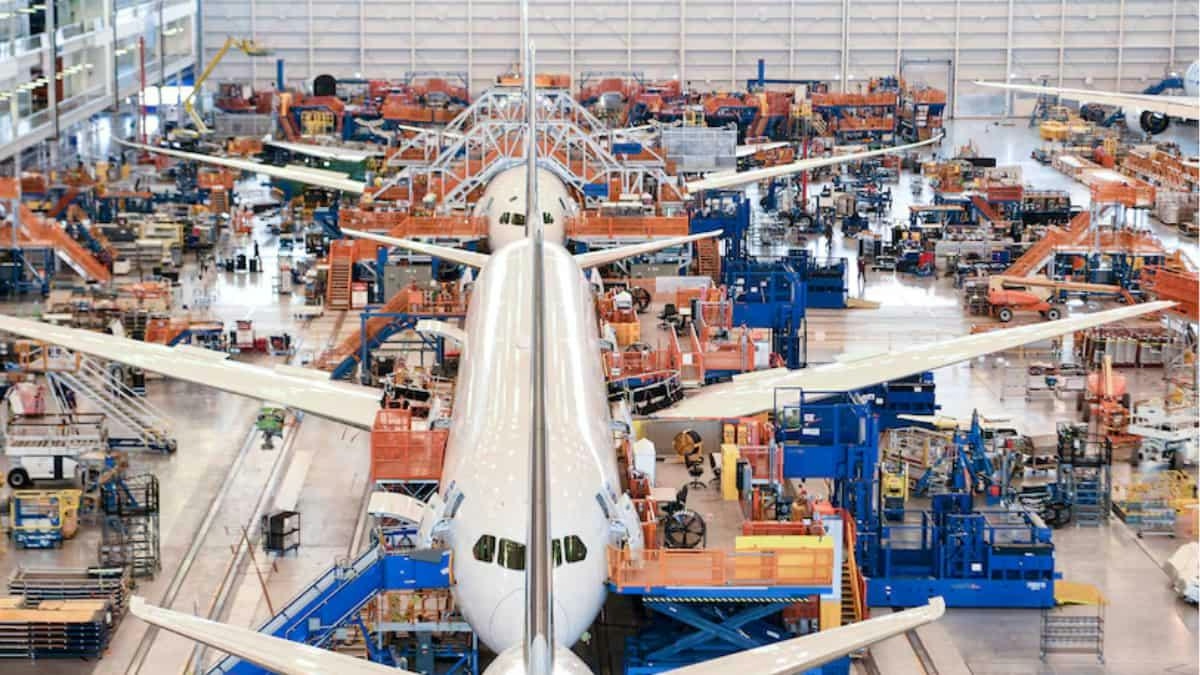
Challenges Boeing Faced Following 787 Production Outsourcing
Outsourcing Ambitions and Their Consequences
The Boeing 787 Dreamliner was initially celebrated as a revolutionary advancement in aviation, integrating cutting-edge composite materials, sophisticated systems, and a global pool of engineering expertise. However, beneath its innovative design lies a complex narrative of strategic errors that have had lasting repercussions for Boeing and the aerospace sector at large.
Historically, Boeing maintained stringent control over its manufacturing processes, predominantly conducting development in-house at its Everett, Washington facility. The introduction of the 787 Dreamliner marked a significant departure from this approach. Boeing implemented an ambitious outsourcing strategy, delegating major design and production responsibilities to over 50 international suppliers. This strategy aimed to reduce costs, accelerate development timelines, and distribute financial risks.
In practice, this decentralized model generated substantial difficulties. Suppliers based in countries such as Japan and Italy were responsible for delivering fully assembled fuselage sections, wings, and systems for final assembly in the United States. Many of these suppliers encountered challenges integrating their components, leading to compatibility problems, engineering discrepancies, and production delays. Communication breakdowns further undermined Boeing’s ability to maintain oversight, resulting in a delay of more than two years for the Dreamliner’s inaugural flight and billions of dollars in unforeseen expenses. To reassert control over the production process, Boeing ultimately reacquired key suppliers, including Vought and Global Aeronautica.
Industry experts, including analysts from Forbes and Supply Chain Digital, have highlighted Boeing’s underestimation of the complexities involved in managing such an extensive global supply chain. The consequences manifested in missed deadlines, increased quality control issues, and enduring damage to Boeing’s reputation.
Innovation Confronts Manufacturing Challenges
The technical innovations embedded in the Dreamliner added layers of complexity to its production. The aircraft was the first large commercial jet to extensively utilize carbon fiber reinforced plastic (CFRP), which constitutes approximately 50% of its airframe by weight. This transition to composite materials, combined with advanced electronic systems, introduced novel regulatory and operational challenges. A notable example was the incorporation of lithium-ion batteries, which led to thermal runaway incidents and prompted a worldwide grounding of the fleet in 2013.
These manufacturing and technical difficulties coincided with broader challenges facing Boeing. The company was compelled to reduce production rates following fatal crashes involving its 737 Max aircraft and, more recently, a midair door plug failure in early 2024. These events further strained Boeing’s reputation and underscored persistent quality control concerns.
Prospects for Recovery Amidst Intensifying Competition
Despite these setbacks, Boeing is preparing to increase production of both the 737 Max and the 787 Dreamliner. The company plans to establish new assembly lines with the objective of doubling 787 output to 20 jets per month by 2028. Nevertheless, Boeing confronts formidable competition from Airbus in the wide-body aircraft market and must also strive to reclaim its position in the narrowbody segment.
There are indications of renewed market demand. For instance, Delta Air Lines has placed its first order for Boeing 787 Dreamliners and anticipates robust growth in both consumer and corporate travel by 2026. Yet, Boeing’s experience with the 787 Dreamliner serves as a cautionary example of the risks inherent in aggressive outsourcing strategies and highlights the ongoing challenges of balancing innovation, quality assurance, and global supply chain management in contemporary aircraft manufacturing.

Etihad Airways Suspends Airbus A380 Flights on Key Route

Aditya Birla Group Seeks Approval for Aircraft Leasing in GIFT City

Qatar Airways Highlights Innovation and Connectivity at Arabian Travel Market 2026

Hong Kong's Five-Year Plan Includes Andrew Fan's Aircraft Parts Processing Hub Proposal

ACIA Aero Leasing Delivers ATR72-600 to Air Nostrum

RTX Appoints Jill Albertelli as Head of Pratt & Whitney

TAT Technologies Joins Beyond Aero Hydrogen Aircraft Program

AURAK Study Highlights Barriers to Air Taxi Adoption in Emerging Economies

Xiamen Air Selects Altitude for 787 Maintenance at Heathrow

Etihad and Swissport Extend Global Partnership
