
Zet AI‑inzichten om in gerichte actie

Trending
Categories
Connected Aircraft Market Outlook and Forecasts Through 2035
Connected Aircraft Market Set for Robust Growth Through 2035
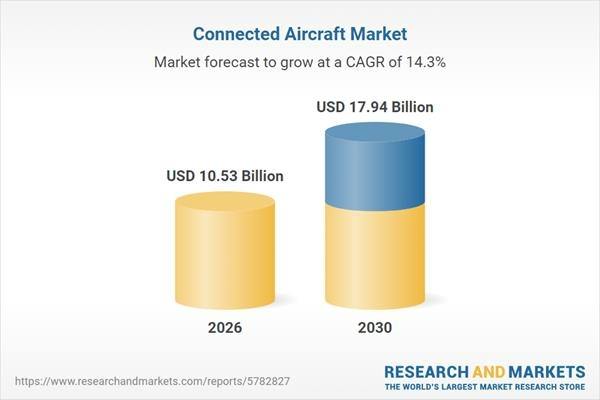
The global connected aircraft market is poised for significant expansion over the coming decade, driven by rapid advancements in connectivity and innovation. According to the recently published "Connected Aircraft Market Report 2026" by ResearchAndMarkets.com, the market value is expected to increase from $9.11 billion in 2025 to $10.53 billion in 2026, representing a compound annual growth rate (CAGR) of 15.5%. Projections indicate that by 2030, the market will reach $17.94 billion, sustained by a 14.3% CAGR.
This growth is underpinned by the widespread adoption of satellite-based connectivity and real-time data exchange, alongside a rising demand for enhanced passenger services. Airlines are increasingly investing in advanced airborne communication systems aimed at optimizing fuel efficiency and improving flight operations. The deployment of next-generation broadband satellite networks and predictive analytics is accelerating the sector’s development, with a particular focus on real-time fleet management and cyber-secure communications.
Rising air travel volumes are a critical driver of market expansion. Eurostat data reveals that air travel within the European Union surged to 973 million passengers in 2023, marking a 19.3% increase from the previous year. This surge is prompting airlines to expand their fleets and invest heavily in connected technologies to meet growing demand.
Industry Innovations, Regional Dynamics, and Market Challenges
Key industry players such as Garmin, Viasat Inc., Honeywell International Inc., Thales Group, Collins Aerospace, and The Boeing Company are at the forefront of shaping the connected aircraft landscape. Garmin’s introduction of the PlaneSync system in July 2023 exemplifies the sector’s shift toward automation and remote system monitoring through 4G LTE and Wi-Fi technologies. Meanwhile, Viasat Inc.’s acquisition of Inmarsat in May 2023 has bolstered its satellite communication capabilities, reflecting a broader industry trend toward integrating advanced technologies to enhance inflight services across both commercial and military aviation sectors.
Regionally, North America remains the largest and fastest-growing market, with significant contributions from Asia-Pacific and Europe. The United States, in particular, leads in the integration of artificial intelligence into avionics-grade computing systems, enabling real-time decision support and predictive maintenance. Despite these advances, the market faces challenges including stringent regulatory compliance, cybersecurity threats, and the technical complexities involved in integrating new systems with existing aircraft infrastructure.
Trade relations and tariffs have impacted the cost of satellite communication components, yet these pressures have simultaneously encouraged domestic production and increased research and development investment. This dynamic is fostering the emergence of more cost-effective solutions within the industry.
Competitive Landscape and Market Insights
As competition intensifies, industry participants are enhancing connectivity features and data analytics capabilities to meet evolving safety and performance standards. Investments in advanced avionics and AI-enabled systems are expected to accelerate, driven by airlines and manufacturers prioritizing digital transformation, automation, and sustainability initiatives.
The connected aircraft market report offers a comprehensive analysis of market size, regional shares, competitive dynamics, and emerging trends. It covers key geographies including the United States, Canada, the United Kingdom, and China, providing detailed insights into market revenues, consumption patterns, and production origins. The report also examines supply chain structures, regulatory frameworks, and investment flows, highlighting opportunities for strategic growth and innovation.
As the aviation industry continues to evolve, connected aircraft solutions are set to revolutionize operational efficiency, safety, and passenger experience through cutting-edge connectivity and data management technologies.

Etihad Airways Suspends Airbus A380 Flights on Key Route

Aditya Birla Group Seeks Approval for Aircraft Leasing in GIFT City

Qatar Airways Highlights Innovation and Connectivity at Arabian Travel Market 2026

Hong Kong's Five-Year Plan Includes Andrew Fan's Aircraft Parts Processing Hub Proposal

ACIA Aero Leasing Delivers ATR72-600 to Air Nostrum

RTX Appoints Jill Albertelli as Head of Pratt & Whitney

TAT Technologies Joins Beyond Aero Hydrogen Aircraft Program

AURAK Study Highlights Barriers to Air Taxi Adoption in Emerging Economies

Xiamen Air Selects Altitude for 787 Maintenance at Heathrow

Etihad and Swissport Extend Global Partnership
