
Zet AI‑inzichten om in gerichte actie

Trending
Categories
FAA Approves Joby Aviation for Commercial Electric Air Taxi Operations
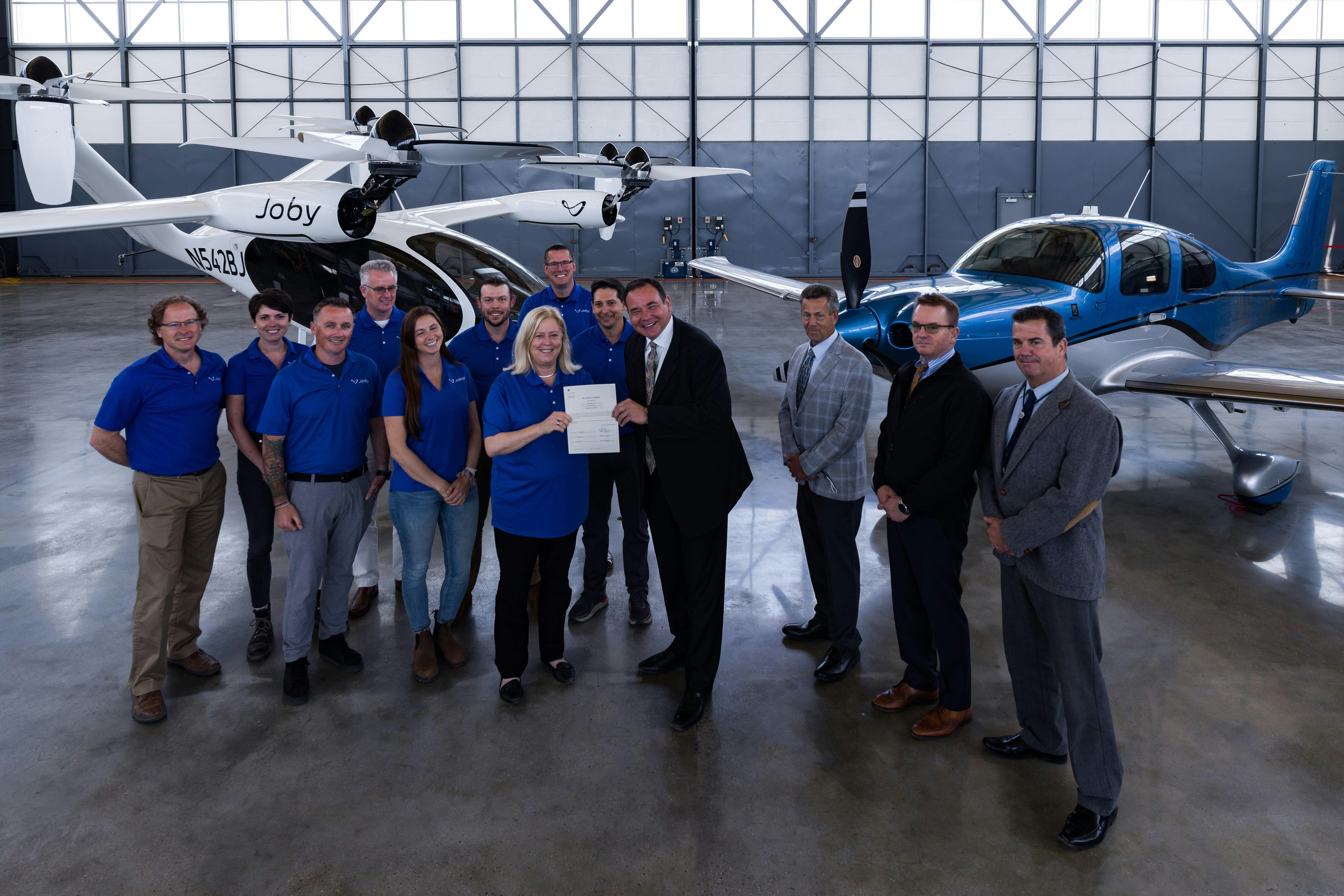
FAA Grants Joby Aviation Certification for Commercial Electric Air Taxi Operations
Americans collectively lose an estimated 3.7 billion hours annually due to urban traffic congestion, a persistent challenge that has long vexed transportation experts. In a significant development poised to transform urban mobility, Joby Aviation has become the first electric vertical takeoff and landing (eVTOL) company to receive a full commercial air carrier certificate from the Federal Aviation Administration (FAA). This milestone, achieved in early 2026, represents a landmark moment in civilian aviation, comparable in significance to the deregulation era of 1978.
Joby’s all-electric, five-seat aircraft, which operates at noise levels quieter than a typical restaurant conversation, is now authorized to carry paying passengers on select routes across the United States. Far from a mere prototype, the aircraft has completed over 1,000 test flights and is certified to reach speeds up to 200 miles per hour, with a range of approximately 150 miles per charge. Its noise footprint is substantially lower than that of conventional helicopters, positioning it as a promising alternative for urban air travel.
A Decade of Innovation and Regulatory Collaboration
Founded in 2009 by aerospace engineer JoeBen Bevirt in Santa Cruz, California, Joby Aviation initially operated in near-total secrecy. The company dedicated years to refining rotor design, battery technology, and fly-by-wire control systems while many competitors sought public attention. Emerging publicly in 2020 with a functional prototype, Joby faced a formidable challenge in securing FAA certification. Existing regulatory frameworks, tailored to fixed-wing aircraft and helicopters, were ill-suited to the unique characteristics of eVTOL vehicles. Consequently, Joby’s engineering team engaged in extensive collaboration with FAA officials to establish new certification standards, a process that extended over several years and entailed substantial compliance costs.
A critical factor in Joby’s endurance was a significant $894 million investment from Toyota, which provided the financial resources necessary to navigate the protracted certification process. The FAA’s review encompassed more than 60,000 pages of technical documentation, making Joby’s certification one of the most complex in the agency’s history.
Market Prospects and Industry Challenges
Currently, Joby’s FAA air carrier certificate authorizes operations on specific approved routes and under defined conditions. Expanding to nationwide, unrestricted commercial service will require the development of vertiport infrastructure and securing local regulatory approvals, processes that remain ongoing in several target cities. The FAA’s approval forms part of a broader initiative to test electric aircraft across 26 states, potentially accelerating the integration of air taxis into the U.S. transportation network.
The eVTOL industry remains highly competitive and dynamic. Of approximately 200 companies that entered the sector between 2015 and 2022, fewer than a dozen maintain substantial capital backing. Notable competitors such as Archer Aviation and Beta Technologies are also advancing electric air taxi development. Joby recently showcased its aircraft in flight demonstrations over San Francisco, highlighting its potential to alleviate commute times in the Bay Area.
Nevertheless, the path ahead is fraught with challenges. Archer Aviation has initiated legal proceedings against Joby, alleging misrepresentation regarding its origins and undisclosed ties to Chinese entities—claims that could affect Joby’s reputation and future investment prospects. Additionally, regulatory hurdles, safety validations, infrastructure development, and public acceptance remain critical issues to address.
While the FAA’s certification marks a new chapter for urban air mobility, the competition to shape the future of air taxis is intensifying. Joby Aviation stands at the forefront of this emerging industry, yet it faces significant challenges from rivals and regulatory complexities alike.

Etihad Airways Suspends Airbus A380 Flights on Key Route

Aditya Birla Group Seeks Approval for Aircraft Leasing in GIFT City

Qatar Airways Highlights Innovation and Connectivity at Arabian Travel Market 2026

Hong Kong's Five-Year Plan Includes Andrew Fan's Aircraft Parts Processing Hub Proposal

ACIA Aero Leasing Delivers ATR72-600 to Air Nostrum

RTX Appoints Jill Albertelli as Head of Pratt & Whitney

TAT Technologies Joins Beyond Aero Hydrogen Aircraft Program

AURAK Study Highlights Barriers to Air Taxi Adoption in Emerging Economies

Xiamen Air Selects Altitude for 787 Maintenance at Heathrow

Etihad and Swissport Extend Global Partnership
