
Zet AI‑inzichten om in gerichte actie

Trending
Categories
Five Air Taxis Poised to Shape Urban Mobility by 2026
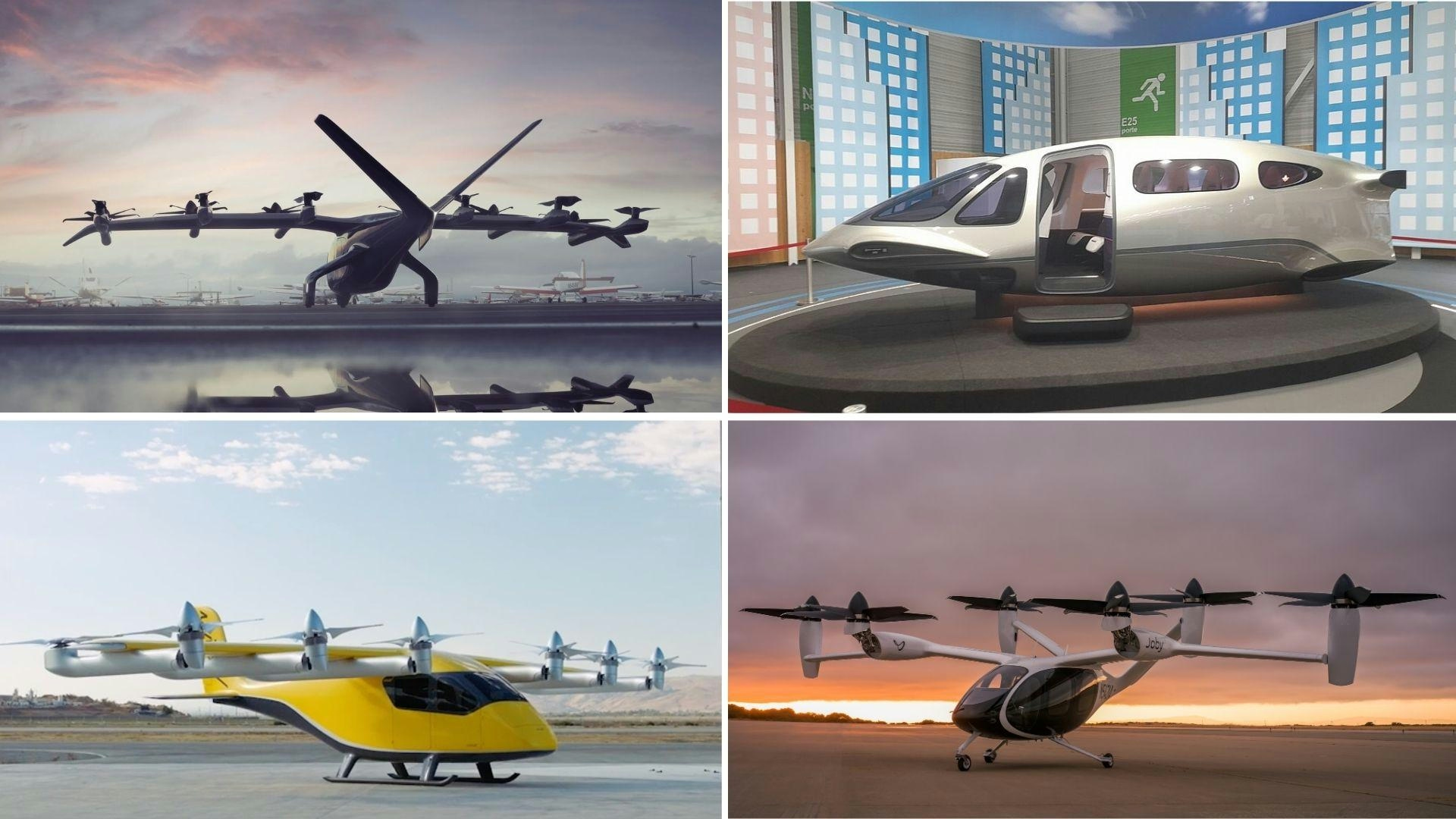
Five Air Taxis Poised to Shape Urban Mobility by 2026
The autonomous air taxi sector is nearing a pivotal moment, with 2026 set to witness the commercial launch of electric vertical takeoff and landing (eVTOL) services in major cities worldwide. This transition from concept to operational reality is driven by leading manufacturers racing to obtain regulatory certifications, establish strategic partnerships, and develop the necessary infrastructure. Supported by advancements in airspace management and innovative landing solutions, these efforts indicate that air taxis will soon become an integral component of urban transportation networks.
Leading eVTOL Aircraft and Their Progress
Joby Aviation stands at the forefront with its S4 eVTOL aircraft, designed to carry one pilot and four passengers. The S4 cruises at speeds up to 200 miles per hour and offers a range of approximately 100 miles. Its six dual-wound electric motors deliver nearly twice the power of a Tesla Model S Plaid. Joby has showcased the S4 at the Dubai Airshow and secured exclusive agreements with Dubai’s Roads and Transport Authority (RTA) to commence commercial operations in 2026. The company has completed a significant point-to-point test flight in the UAE and is currently conducting power-on tests of its first aircraft conforming to Federal Aviation Administration (FAA) standards. Despite these advances, Joby continues to navigate regulatory, safety, and infrastructure challenges ahead of full-scale deployment.
Archer Aviation is advancing its Midnight aircraft, which features 12 rotors and accommodates one pilot alongside four passengers. The aircraft is progressing through FAA certification and international regulatory processes. Demonstrating strong performance, Midnight completed a 55-mile flight in 31 minutes and achieved a climb to 7,000 feet. Archer plans to initiate passenger flights in Abu Dhabi in 2026, with commercial operations potentially commencing within the same year. The company aims to operate globally in parallel as it meets ongoing certification milestones.
Vertical Aerospace is developing the VX4, available in both all-electric and hybrid-electric variants, with a seating capacity of five to six passengers and a range exceeding 100 miles. The VX4 completed its initial phase of piloted flight testing in 2024, conducting 20 flights to collect extensive performance data. With a payload capacity of 2,425 pounds and a potential range reaching up to 1,000 miles, the VX4 is designed for versatility across multiple sectors, including defense, healthcare, and logistics.
Lilium focuses on regional air mobility with its six-passenger Lilium Jet, which employs ducted-fan technology to enable quieter and more efficient flights compared to traditional open-rotor designs. Manned flight testing is scheduled for early 2025, with first customer deliveries anticipated in 2026. Lilium is currently conducting parallel propulsion testing, gathering thousands of data points per second to optimize performance. The company plans to announce its initial launch market for 2026 by the end of the year.
Innovations in Infrastructure and Airspace Management
In addition to aircraft development, the industry is addressing critical challenges related to airspace integration and landing infrastructure. NASA has introduced its Strategic Deconfliction Simulation platform, designed to safely integrate electric air taxis and drones into congested urban airspace, targeting operational readiness by 2026. Concurrently, companies like AutoFlight are developing solar-powered mobile water platforms that serve as flexible, fast-charging vertiports, providing solutions to the scarcity of suitable landing sites in densely populated urban areas.
As these technological advancements and regulatory frameworks converge, the prospect of autonomous air taxis seamlessly navigating urban environments is rapidly approaching, signaling a transformative shift in global urban mobility.
Comments

Etihad Airways Suspends Airbus A380 Flights on Key Route

Aditya Birla Group Seeks Approval for Aircraft Leasing in GIFT City

Qatar Airways Highlights Innovation and Connectivity at Arabian Travel Market 2026

Hong Kong's Five-Year Plan Includes Andrew Fan's Aircraft Parts Processing Hub Proposal

ACIA Aero Leasing Delivers ATR72-600 to Air Nostrum

RTX Appoints Jill Albertelli as Head of Pratt & Whitney

TAT Technologies Joins Beyond Aero Hydrogen Aircraft Program

AURAK Study Highlights Barriers to Air Taxi Adoption in Emerging Economies

Xiamen Air Selects Altitude for 787 Maintenance at Heathrow

Etihad and Swissport Extend Global Partnership
