
Zet AI‑inzichten om in gerichte actie

Trending
Categories
How GE Is Meeting Global Jet Engine Demand
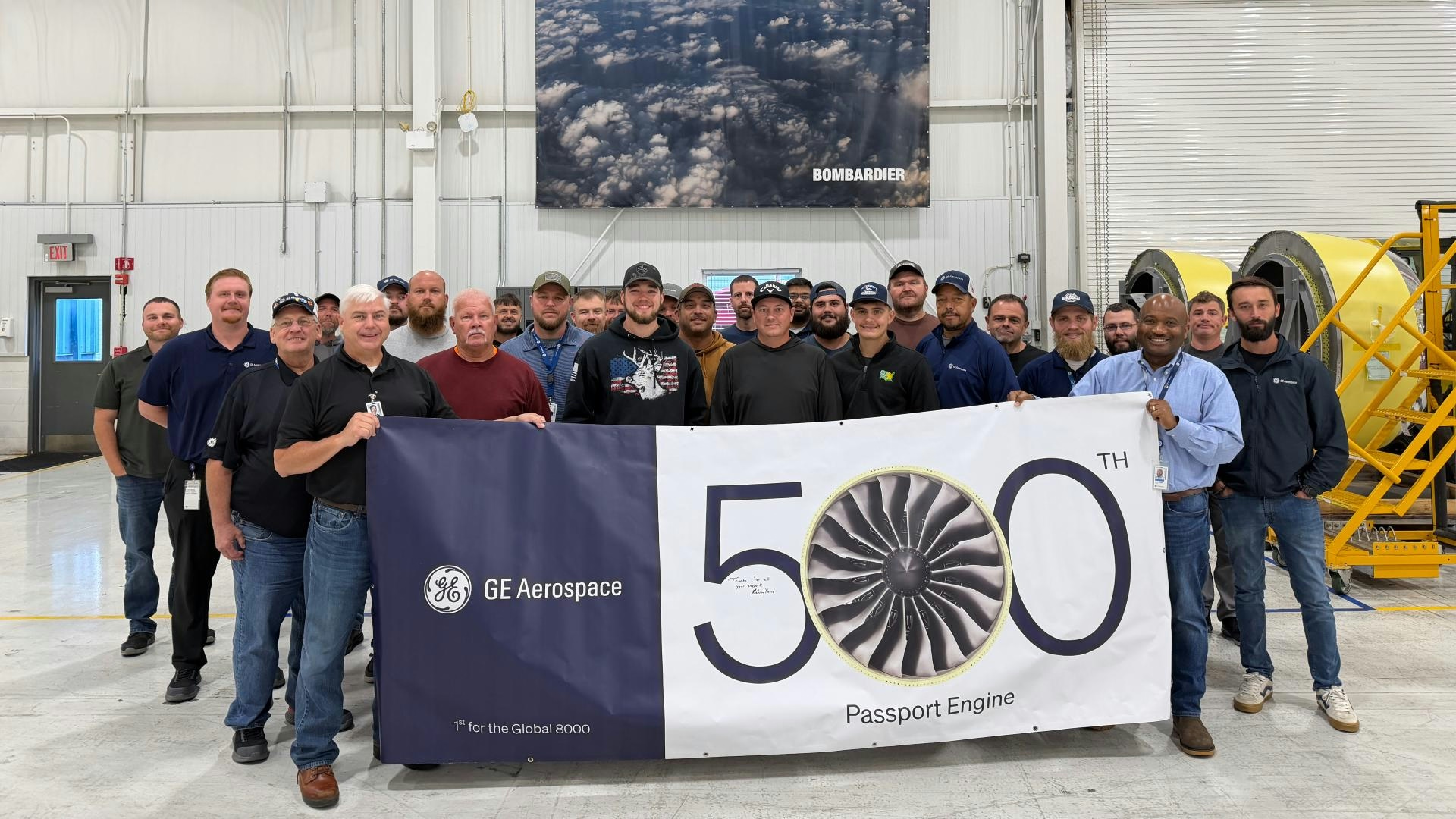
How GE Is Meeting Global Jet Engine Demand
Jet engines serve as the critical foundation of global commercial aviation, enabling the aircraft that connect people, economies, and industries across the world. With airlines accelerating the expansion of narrowbody fleets and new aircraft deliveries reaching unprecedented levels, engine manufacturers are under increasing pressure to meet this surge in demand. At the forefront of this response is GE Aerospace, working in close partnership with CFM International, its joint venture with Safran Aircraft Engines.
A Legacy of Innovation and Partnership
GE Aerospace has played a defining role in the evolution of jet engines for over a century. From pioneering America’s first turbojet in the 1940s to developing iconic engines such as the CF6 and GE90, the company continues to lead with the GE9X, which powers the Boeing 777X. A landmark development occurred in 1974 when GE joined forces with France’s Snecma (now Safran Aircraft Engines) to establish CFM International. This collaboration leveraged GE’s expertise in high-pressure core technology alongside Snecma’s strengths in low-pressure systems and manufacturing efficiency. The result was the creation of the CFM56 engine, which remains the world’s best-selling jet engine, followed by its advanced successor, the LEAP family.
The enduring partnership between GE and Safran allows both companies to share risks, coordinate global production, and provide comprehensive support to extensive fleets worldwide. This synergy ensures reliable and cost-effective propulsion solutions for airlines, reinforcing their competitive edge in a demanding market.
Manufacturing Expansion: Scaling Up for Soaring Demand
The combination of fleet renewal, rising passenger traffic, and substantial aircraft backlogs has presented one of the most significant production challenges in GE’s recent history. To address this, GE Aerospace is implementing a comprehensive strategy to expand manufacturing capacity and enhance supply chain resilience.
In the United States and Europe, GE is undertaking major factory expansions. A prominent example is the $53 million upgrade of its West Jefferson, North Carolina facility, which adds 35,000 square feet dedicated to producing LEAP engine components. This expansion will be supported by the recruitment of 40 new operators, inspectors, and engineers. Furthermore, GE plans to invest $1 billion in U.S. manufacturing in 2025, nearly doubling its previous year’s expenditure, to stabilize the supply chain and increase output of both LEAP and GE9X engine components.
In Europe, GE is investing close to €80 million to strengthen its component-manufacturing network. This initiative includes plans to hire approximately 500 manufacturing and engineering personnel to alleviate production bottlenecks and meet growing demand.
Navigating Challenges and Market Dynamics
Despite these ambitious expansions, GE continues to face challenges in maintaining supply chain stability, particularly as it scales up its On Wing Support facility in Dubai and intensifies support for the GE9X engine. The company’s ability to execute these plans effectively remains under close scrutiny by airlines and industry analysts.
Market response to GE’s efforts has been largely positive. GE Aerospace shares are trading near record highs following significant contract wins at the Dubai Airshow, a major engine order from Turkish Airlines, and an upward revision of financial guidance. Competitors are closely monitoring GE’s strategic initiatives, which include the development of a small turbofan engine for the Collaborative Combat Aircraft program and the potential deployment of a 747-400 flying testbed in Dubai to support GE9X operations.
Additionally, GE Vernova’s strong stock performance after a recent investor day reflects investor confidence in the company’s high-margin backlog and robust execution of its services business.
As GE Aerospace continues to expand its manufacturing footprint and invest in research and development geared toward future technologies, it is positioning itself to meet the current surge in jet engine demand and to power the next decade of global aviation.

Etihad Airways Suspends Airbus A380 Flights on Key Route

Aditya Birla Group Seeks Approval for Aircraft Leasing in GIFT City

Qatar Airways Highlights Innovation and Connectivity at Arabian Travel Market 2026

Hong Kong's Five-Year Plan Includes Andrew Fan's Aircraft Parts Processing Hub Proposal

ACIA Aero Leasing Delivers ATR72-600 to Air Nostrum

RTX Appoints Jill Albertelli as Head of Pratt & Whitney

TAT Technologies Joins Beyond Aero Hydrogen Aircraft Program

AURAK Study Highlights Barriers to Air Taxi Adoption in Emerging Economies

Xiamen Air Selects Altitude for 787 Maintenance at Heathrow

Etihad and Swissport Extend Global Partnership
