
Zet AI‑inzichten om in gerichte actie

Trending
Categories
Technology Investment Reshapes MRO in Asia-Pacific
Technology Investment Reshapes MRO in Asia-Pacific
Advancing Maintenance and Repair Capabilities
As airlines increasingly demand enhanced reliability and efficiency from their engines, the focus has shifted beyond engineering innovations to the robustness of maintenance, repair, and overhaul (MRO) support networks. In the Asia-Pacific region, GE Aerospace has emerged as a leader in this transformation, harnessing technology to reduce engine downtime and optimize operational performance. Over the past forty years, GE Aerospace’s MRO facilities in the region have consistently driven innovation, underscoring the company’s enduring commitment to improvement.
This commitment is exemplified by a recent $75 million investment in regional MRO operations, supplementing an earlier $45 million pledge and forming part of a broader $1 billion global MRO expenditure plan announced in 2024. These investments focus on automation, advanced repair techniques, and optimized shop-floor layouts, all designed to accelerate turnaround times and enhance service delivery.
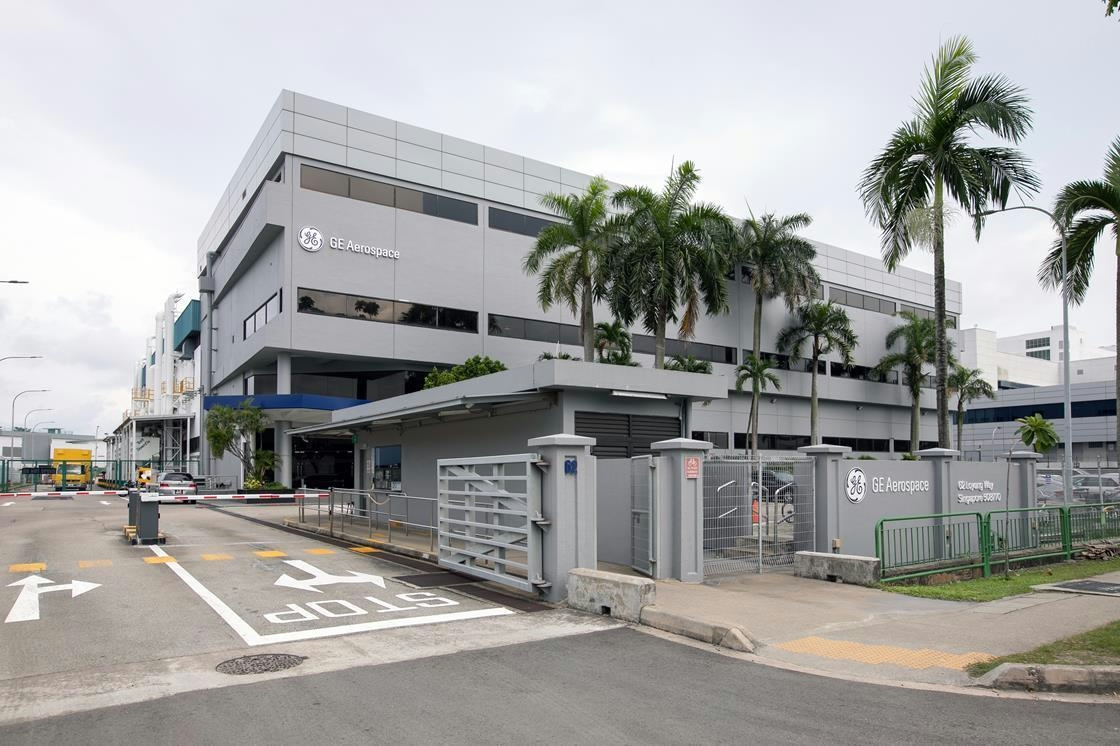
Iain Rodger, managing director at GE Aerospace Component Repair Singapore—the company’s flagship regional facility—emphasizes the critical importance of minimizing engine downtime. “It’s simple: when an engine is off the wing, it’s not being utilized,” he states. Operating across three locations, the Singapore facility repairs components for all GE Aerospace and CFM International commercial jet engines, including turbine blades, nozzles, high-pressure compressor blades and vanes, and combustors. The site handles over 60% of GE’s global repair volume, highlighting its strategic significance.
The Role of Additive Manufacturing and Automation
A pivotal factor in enhancing efficiency has been the adoption of additive manufacturing (AM), commonly known as 3D printing. This technology, which has revolutionized aerospace manufacturing, is now making substantial inroads into aftermarket repairs. Since 2021, the Singapore facility has employed AM for high-pressure compressor blade tip repairs on CF6 and CFM56 engines, with plans to extend its application to GEnx and LEAP engine models. Rodger identifies the next challenge as applying AM to “hot end” parts, underscoring the facility’s pioneering role as the first MRO site worldwide to utilize additive technology in jet engine component repairs.
The benefits of AM are significant: repair processes are 60% faster, require 50% less post-processing, and occupy 40% less floor space. These efficiencies effectively double daily repair capacity, enabling airlines to return aircraft to service more rapidly. Beyond additive manufacturing, the Singapore facility has also advanced automation through the implementation of automated laser weld repairs for turbine blades. This innovation has replaced 54 manual welding booths with just 13 automated stations, setting new industry benchmarks for efficiency and precision.
Challenges and Market Dynamics
Despite these technological advancements, the rapid pace of change presents challenges. Substantial capital investment is necessary to adopt new systems, and integrating cutting-edge technologies with existing infrastructure can be complex. Additionally, the risk of technological obsolescence looms as innovation accelerates, requiring continuous adaptation.
Nevertheless, market response remains robust. Sustained demand for engine MRO services is driving increased investment across the sector. Competitors are responding with strategic partnerships, such as Rolls-Royce’s joint venture with Air China, while companies like Korean Air and Sanad are achieving significant MRO milestones to maintain their competitive positions. This momentum signals a strong future for aftermarket support as global air traffic demand continues to grow.
In this evolving landscape, technology investment is not merely reshaping MRO in Asia-Pacific; it is redefining industry standards for reliability, speed, and customer value across the aviation sector.

Etihad Airways Suspends Airbus A380 Flights on Key Route

Aditya Birla Group Seeks Approval for Aircraft Leasing in GIFT City

Qatar Airways Highlights Innovation and Connectivity at Arabian Travel Market 2026

Hong Kong's Five-Year Plan Includes Andrew Fan's Aircraft Parts Processing Hub Proposal

ACIA Aero Leasing Delivers ATR72-600 to Air Nostrum

RTX Appoints Jill Albertelli as Head of Pratt & Whitney

TAT Technologies Joins Beyond Aero Hydrogen Aircraft Program

AURAK Study Highlights Barriers to Air Taxi Adoption in Emerging Economies

Xiamen Air Selects Altitude for 787 Maintenance at Heathrow

Etihad and Swissport Extend Global Partnership
