
Zet AI‑inzichten om in gerichte actie

Trending
Categories
The Factory Nicknamed ‘Hitler’s Headache’ That Spanned Miles
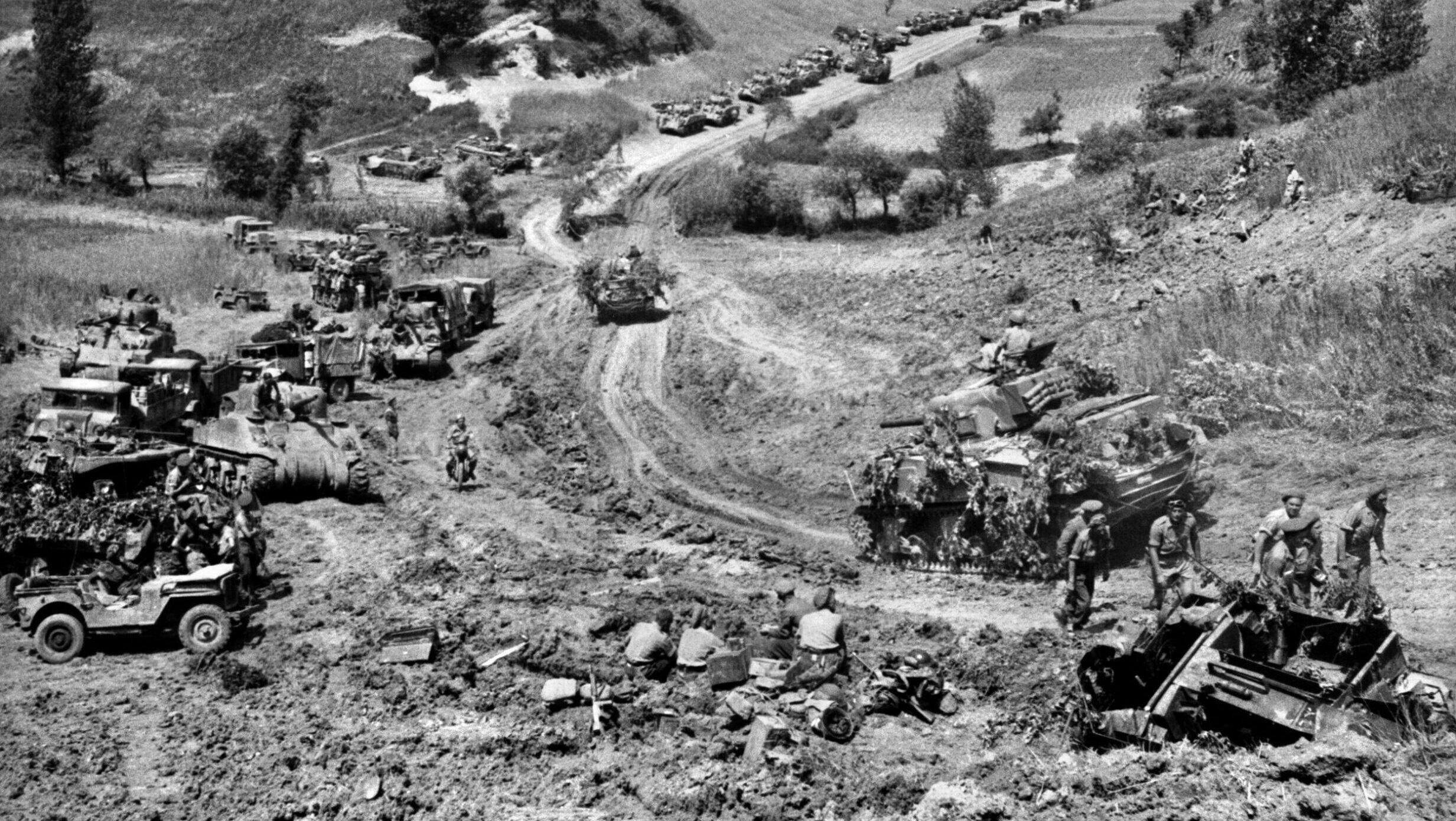
The Factory Nicknamed ‘Hitler’s Headache’ That Spanned Miles
During World War II, the Dodge Chicago Plant, a division of the Chrysler Corporation, emerged as a monumental symbol of American industrial power. Once the world’s largest airplane engine factory, this sprawling complex was designed to produce some of the most powerful bomber engines ever built, earning the moniker “Hitler’s Headache” for its critical role in the Allied war effort.
An Industrial Marvel of Unprecedented Scale
The plant’s main building alone covered an astonishing 80 acres—equivalent to about 50 city blocks—surpassing even the Ford Willow Run bomber plant in size. Its vast floor space exceeded that of both the Pentagon and Chicago’s Merchandise Mart, with room to accommodate 20 baseball diamonds around its perimeter. The building was so immense that binoculars were required to see from one end to the other, a testament to the scale of wartime manufacturing.
At its peak, the Dodge Chicago Plant employed over 16,000 workers and 1,400 engineers, operating thousands of precision machine tools beneath a concrete roof that seemed to stretch endlessly. Nearly 20 buildings spanned 500 acres, with the main plant serving as the centerpiece of this industrial complex. The factory’s weekly engine output was expected to be staggering, reflecting the urgency and scale of America’s wartime production.
Engineering Feat and Strategic Importance
The engines produced at the plant were advanced Wright models featuring 18 cylinders and generating over 2,000 horsepower. These powerplants were destined for the U.S. military’s most secretive bombers, believed to be the aircraft General Henry H. Arnold described as “the last of the small bombers.” These bombers were capable of record-breaking payloads on missions extending from American bases to Berlin and Tokyo, underscoring the plant’s strategic significance.
Construction of the Dodge Chicago Plant itself was an engineering triumph. Utilizing a rapid building method, reinforced concrete structures were topped with concrete slab roofs, including the arches. Sixty portable concrete forms, likened to Helen of Troy’s wooden horse, were wheeled into place to pour the main building’s concrete, accelerating construction at an unprecedented pace.
Legacy and Contemporary Reflections
The legacy of the Dodge Chicago Plant resonates in today’s industrial landscape, which faces its own set of challenges and opportunities. Modern manufacturing grapples with multi-billion dollar tariff cliffs, such as a projected $1.2 billion in tariff costs for a leading agricultural company. However, the ongoing boom in AI data centers and North American infrastructure mega-projects provides a vital buffer, stabilizing margins and preventing severe downturns.
These tariffs are increasingly viewed as a manageable cost of doing business rather than an existential threat. As long as the surges in AI and infrastructure investment continue, industrial companies are expected to maintain equilibrium, much like the Dodge Chicago Plant once anchored America’s wartime production.
The story of the Dodge Chicago Plant serves as a powerful reminder that when industry rises to meet critical moments, it can reshape the world and endure even the most formidable challenges.

Bangladesh Launches Initiative to Become Regional Aviation Hub
Russia Transports PD-8 Engine to India for International Certification

Kyrgyzstan to Adopt EMPIC GmbH Software for Flight Safety Oversight

Why Hawaiian Airlines Is Waiting Until 2028 To Add A Premium Economy Cabin To Its Airbus A330 Fleet

Engine Fault Causes Royal Navy Helicopter Crash Fatality

Joby Aviation Begins Texas Air Taxi Test Flights Amid Stock Decline

Iberia Receives Full Approval for Airbus A350 Heavy Maintenance

NetJets to Construct Terminal and Hangar at Dallas Love Field

Using AI in Aircraft Purchases

CIAM Unveils RPD-150T Engine to Replace Rotax 150 hp Model
