
Orquestre insights de IA em ações

Tendências
Categories
AI Advances Support Sustainable Aviation and Efficient Flight Paths
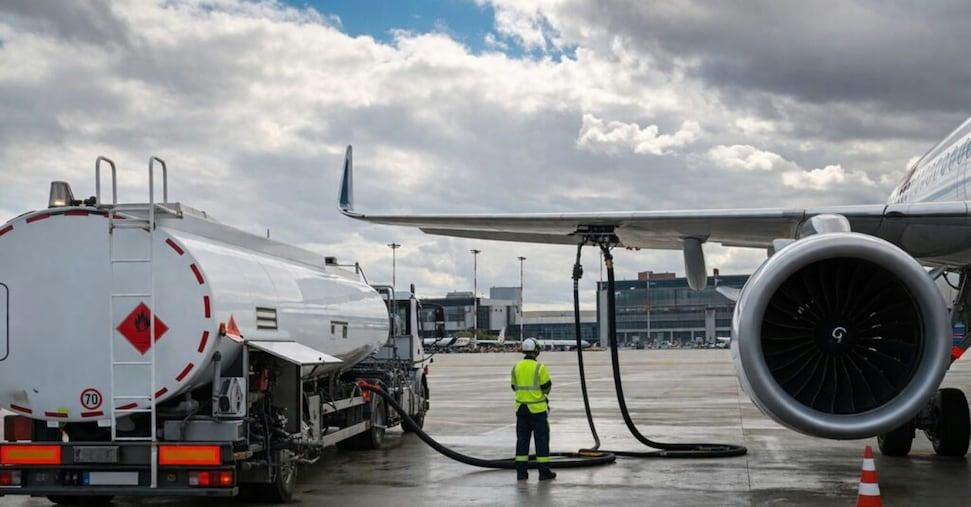
AI Advances Support Sustainable Aviation and Efficient Flight Paths
The aviation industry is increasingly leveraging artificial intelligence (AI) alongside innovative flight path strategies to mitigate its environmental impact. A pioneering British-led trial, conducted across the North Atlantic, is examining whether minor altitude adjustments can substantially reduce the climate effects of air travel without necessitating new aircraft designs, engines, or alternative fuels.
Operation Blue Skies: Integrating AI with Flight Management
Central to this effort is Operation Blue Skies, a research initiative supported by the British government. Over the course of two winters, hundreds of commercial flights traversing the northeast Atlantic will participate in the study. The primary objective is to assess whether small altitude changes—sometimes as little as a few hundred meters—can effectively prevent the formation of contrails. These condensation trails, under certain atmospheric conditions, contribute to global warming by trapping heat in the atmosphere.
Google UK plays a crucial role in the project by supplying AI-driven forecasts that identify regions where contrails are most likely to develop. During designated testing periods, air traffic controllers will direct selected flights to adjust their altitude by up to 2,000 feet (approximately 610 meters) to avoid these high-risk zones. These altitude modifications are modest, remain within standard operational limits, and are coordinated through existing air traffic control systems to ensure safety and efficiency.
Addressing Aviation’s Complex Emissions Beyond CO₂
While carbon dioxide (CO₂) emissions remain the primary focus in evaluating aviation’s environmental footprint, the sector’s impact is further complicated by high-altitude phenomena such as contrails and aircraft-induced clouds. These factors exacerbate the challenge of achieving climate neutrality. Although advancements in aircraft efficiency, sustainable aviation fuels (SAF), electrification, and novel propulsion technologies are integral to long-term solutions, optimizing flight operations through altitude adjustments offers an immediate and practical approach.
Sustainable aviation fuel is widely regarded as a vital component in reducing aviation’s carbon footprint, given its compatibility with existing aircraft without requiring significant modifications. However, the current supply of SAF is limited, and the prospect of direct electrification remains distant for medium- and long-haul flights, underscoring the need for complementary strategies like those explored in Operation Blue Skies.
Navigating Market and Regulatory Challenges
Despite the potential benefits of AI-driven interventions, the aviation industry faces considerable hurdles in integrating advanced technologies. As one of the most heavily regulated sectors, aviation must contend with complex approval processes that could delay the adoption of AI systems and increase operational costs. Furthermore, the expanding role of AI in aviation may prompt shifts in market dynamics, including reassessments of AI’s long-term revenue potential. This could lead to market corrections or deflation, with competitors responding variably—some absorbing higher costs, others expressing concerns over sudden price fluctuations.
Future Outlook
Although aviation currently accounts for only 2 to 3 percent of global emissions, the anticipated growth in air travel demand makes addressing its environmental impact increasingly urgent. By combining AI, optimized flight paths, and sustainable fuels, the industry aims to advance toward more sustainable air travel. Success will depend on overcoming regulatory and market challenges to fully realize the potential of these technological and operational innovations.

Etihad Airways Suspends Airbus A380 Flights on Key Route

Aditya Birla Group Seeks Approval for Aircraft Leasing in GIFT City

Qatar Airways Highlights Innovation and Connectivity at Arabian Travel Market 2026

Hong Kong's Five-Year Plan Includes Andrew Fan's Aircraft Parts Processing Hub Proposal

ACIA Aero Leasing Delivers ATR72-600 to Air Nostrum

RTX Appoints Jill Albertelli as Head of Pratt & Whitney

TAT Technologies Joins Beyond Aero Hydrogen Aircraft Program

AURAK Study Highlights Barriers to Air Taxi Adoption in Emerging Economies

Xiamen Air Selects Altitude for 787 Maintenance at Heathrow

Etihad and Swissport Extend Global Partnership
