
Orquestre insights de IA em ações

Tendências
Categories
AI-Driven Overhaul of Air Traffic Control Underway in $875 Million Project

AI-Driven Overhaul of Air Traffic Control Underway in $875 Million Project
The Federal Aviation Administration (FAA) has initiated a comprehensive modernization of the United States’ air traffic control system through a 12-year, $875 million contract awarded to Boston-based Air Space Intelligence (ASI). This ambitious project seeks to harness advanced, cloud-based artificial intelligence to address systemic flight delays and enhance capacity management across the National Airspace System.
A Data-Driven Transformation of Air Traffic Management
This initiative represents a fundamental shift from the traditional air traffic control paradigm, which has long been hindered by fragmented data and reactive operational practices. Historically, regional controllers operated in isolation, resulting in disconnected timelines among airlines, airports, and control towers. The legacy system’s inability to anticipate and mitigate the ripple effects of severe weather or unexpected runway closures frequently led to widespread cancellations and delays.
The FAA’s collaboration with ASI introduces a unified, AI-powered platform designed to transition air traffic management from a reactive to a proactive model. Central to this transformation are two integrated, cloud-native systems: the Flow Management Data System (FMDS) and the System-Wide Market Analysis and Review Tool (SMART). Both platforms are built upon the Flyways AI architecture, enabling the creation of a live digital twin of the entire U.S. aviation network.
The Mechanics of the AI System
The newly deployed software continuously processes over 100 real-time data streams, including federal weather reports, aircraft transponder signals, and airline schedules. This data fusion generates highly accurate, four-dimensional simulations of the airspace, capable of forecasting conditions days, weeks, or even months in advance. By identifying potential bottlenecks early, the system can recommend optimal routing strategies before flights depart, thereby minimizing disruptions.
Industry stakeholders are closely monitoring the rollout, utilizing ASI’s product directory to track development milestones and system performance. The overarching objective is to dynamically manage airspace capacity and reduce operational disruptions, potentially setting a new global benchmark for air traffic management.
Challenges and Industry Response
Despite the promise of enhanced efficiency through AI, the project faces considerable challenges. Integrating these sophisticated systems with existing infrastructure demands seamless data interoperability among a wide array of stakeholders. Resistance is expected from established players within the air traffic control market, as the shift threatens entrenched roles and traditional business models.
Airlines have expressed reservations regarding the system’s readiness and reliability, voicing concerns about the accuracy of AI predictions and the risk of unforeseen technical complications during implementation. Meanwhile, competitors are responding in diverse ways: some are accelerating their own AI development efforts or seeking partnerships with the FAA, while others may attempt to impede the new system to safeguard their market positions.
A New Era for U.S. Airspace Management
The FAA’s decision to partner with a relatively young, venture-backed firm like ASI marks a departure from its historical reliance on legacy defense contractors and bespoke hardware solutions. ASI’s mature software platform, honed over years of development, enabled the company to circumvent traditional bureaucratic obstacles and secure this landmark contract.
As the project advances, its success will hinge not only on technological innovation but also on the industry’s capacity to adapt to a rapidly evolving operational environment. The outcome of this AI-driven overhaul has the potential to redefine airspace management in the United States for decades to come.

Etihad and Swissport Extend Global Partnership

Sepehran Airlines B737 Returns to Mashhad After Tyre and Engine Issues

Etihad Deploys Widebody Fleet to Meet Strong Demand

Korean Air Finalizes $36.2 Billion Deal with Boeing

Australia’s RFDS Queensland Section Orders Six King Air 260Cs

Korean Air Finalizes Order for 103 Boeing Jets and Engines
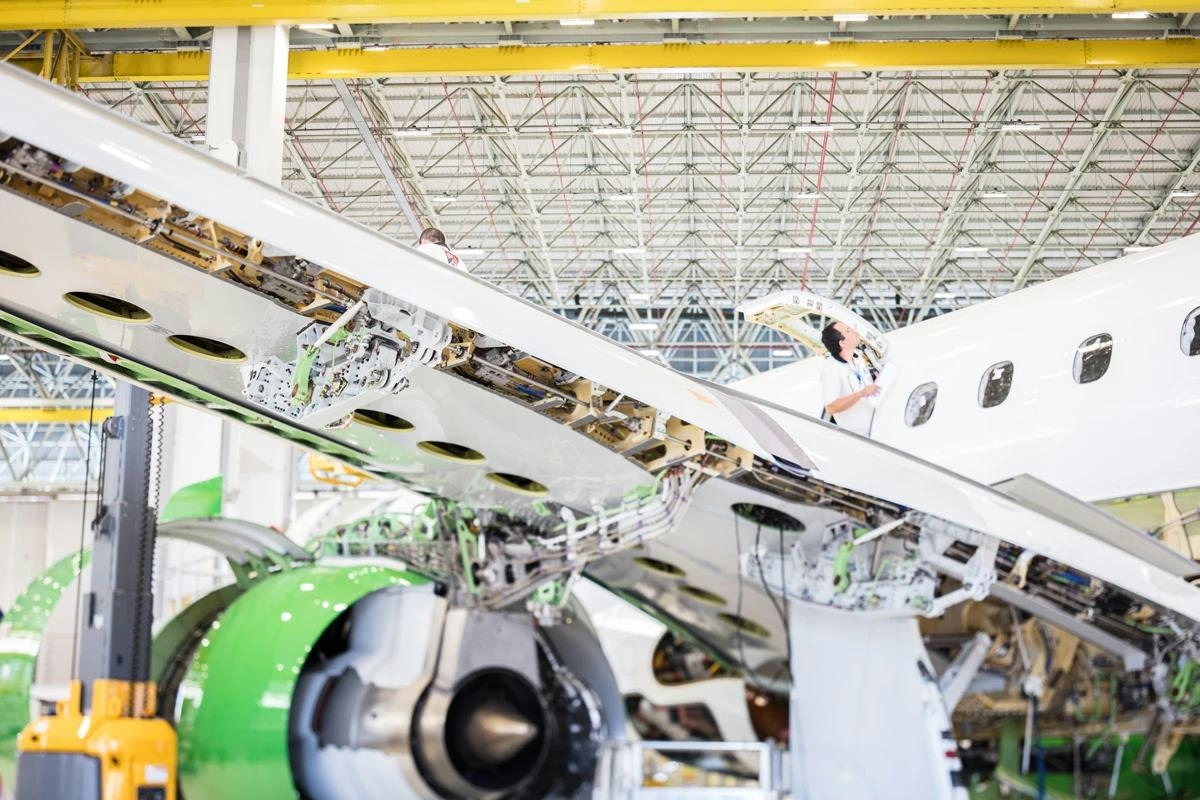
Embraer E195-E2 Features Distinctive Engine Placement Among Regional Jets

What Passengers Can Expect on Boeing’s New 777X Jet

How Ethiopian Airlines Became Africa’s Leading Carrier Amid Gulf Competition

Joby Aviation Extends Autonomous Flight Capabilities with Cross-Country Tour
