
Orquestre insights de IA em ações

Tendências
Categories
AI Quietly Rewrites How Travelers Book, Fly and Explore
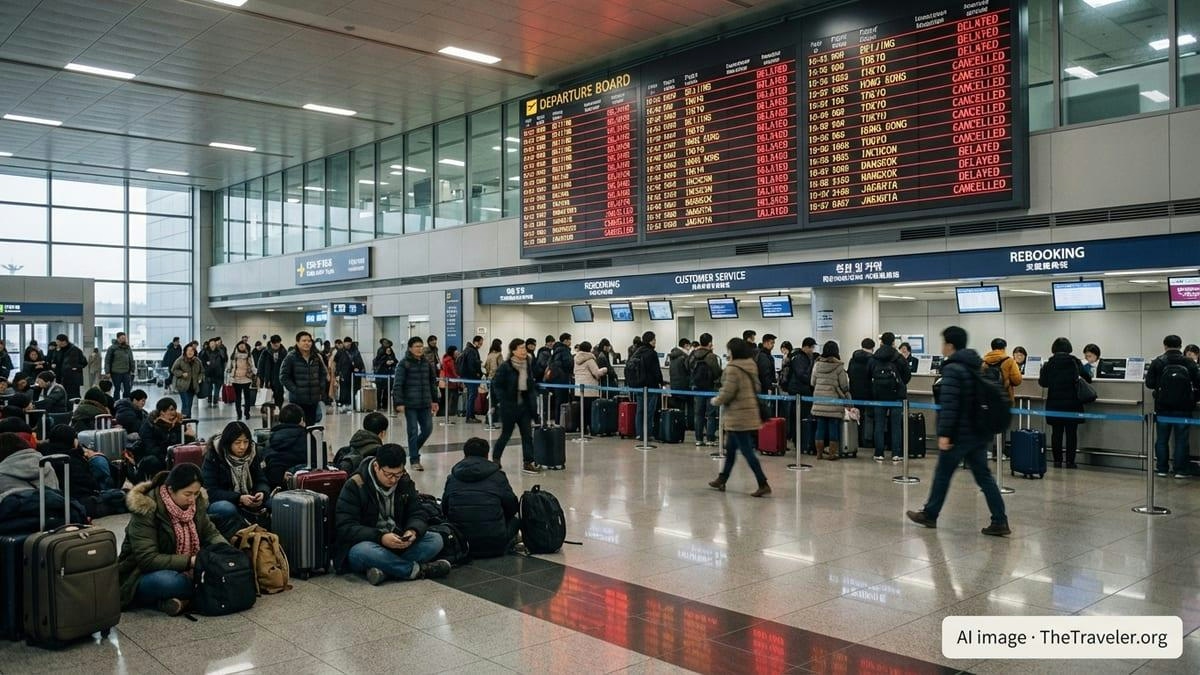
AI Quietly Rewrites How Travelers Book, Fly and Explore
Artificial intelligence is increasingly becoming the invisible force reshaping the global travel industry. From flight scheduling and hotel pricing to trip planning, AI is transforming key processes long before travelers arrive at the airport, fundamentally altering how journeys are organized and experienced.
AI’s Expanding Role in Aviation
In the aviation sector, AI has progressed from experimental applications to essential tools for major airlines across the United States and Europe. Airlines now rely on AI to model aircraft turnaround times, predict operational disruptions, and adjust schedules in near real time. By analyzing data streams such as weather conditions, crew availability, air traffic, and airport congestion, AI platforms recommend gate changes, aircraft swaps, and recovery strategies—tasks that previously demanded extensive manual coordination.
Beyond scheduling, AI is beginning to influence flight routing itself. By optimizing paths and altitudes, AI helps reduce flight times and fuel consumption. Several North American carriers report that AI-generated routing alternatives are now offered on most flights, yielding measurable time savings. Additionally, collaborations between airlines and technology firms have produced AI models capable of predicting contrail formation, allowing dispatchers to select routes that minimize environmental impact.
European airlines, including both network and low-cost carriers, are investing heavily in AI to manage the complexities of day-of-operations. Computer-vision systems monitor airport ramps and stands to detect delays in baggage loading or catering, triggering early alerts to prevent disruptions from cascading through the network. AI is also being trained to make nuanced decisions about whether flights should hold briefly for connecting passengers or depart promptly to maintain overall schedule integrity.
For travelers, these AI-driven changes remain largely imperceptible. While boarding procedures and in-flight experiences appear unchanged, many critical decisions regarding connections, re-routings, and seat assignments are increasingly determined by AI systems operating behind the scenes in airline control centers.
Transformation of Hotel Pricing and Revenue Management
The hotel industry in the U.S. and Europe is undergoing a significant but less visible transformation through AI-driven revenue management. Leading hotel chains such as Marriott, Hilton, and Accor have adopted AI systems that analyze a wide array of factors—including historical booking trends, local events, competitor pricing, and guest behavior—to dynamically adjust room rates multiple times daily. This approach replaces traditional fixed seasonal pricing with fluid rates based on probabilistic demand models tailored to specific room types and dates.
Industry reports indicate that these AI-powered pricing engines are delivering tangible financial benefits, with some hotel brands reporting notable increases in revenue per available room. This shift enables hotels to respond more precisely to market conditions and optimize profitability in an increasingly competitive environment.
Challenges and Opportunities for Online Travel Agencies
As AI assumes a central role in travel planning, online travel agencies (OTAs) confront new challenges. Increasingly, travelers are turning to AI tools for trip discovery and itinerary creation before engaging with traditional booking platforms. While some OTAs have welcomed recent decisions by companies like OpenAI to step back from direct booking services, the greater challenge lies in adapting to AI’s expanding influence over the initial discovery phase of travel.
The travel technology landscape is becoming more fragmented, with major players such as Amazon, Meta, and Google developing proprietary AI systems for travel planning. This diversification introduces new distribution complexities for travel brands seeking to reach consumers through multiple AI-driven channels.
Emerging agentic AI technologies, capable of autonomously managing discovery, comparison, and booking processes, are beginning to take shape, though widespread consumer adoption remains limited. As these technologies evolve, the entire travel ecosystem—from airlines and hotels to OTAs—faces a rapidly shifting environment increasingly orchestrated by AI operating quietly behind the scenes.

Etihad Airways Suspends Airbus A380 Flights on Key Route

Aditya Birla Group Seeks Approval for Aircraft Leasing in GIFT City

Qatar Airways Highlights Innovation and Connectivity at Arabian Travel Market 2026

Hong Kong's Five-Year Plan Includes Andrew Fan's Aircraft Parts Processing Hub Proposal

ACIA Aero Leasing Delivers ATR72-600 to Air Nostrum

RTX Appoints Jill Albertelli as Head of Pratt & Whitney

TAT Technologies Joins Beyond Aero Hydrogen Aircraft Program

AURAK Study Highlights Barriers to Air Taxi Adoption in Emerging Economies

Xiamen Air Selects Altitude for 787 Maintenance at Heathrow

Etihad and Swissport Extend Global Partnership
