
Orquestre insights de IA em ações

Tendências
Categories
Boeing Faces Delays as $175 Million Machine Won't Be Ready Until 2029
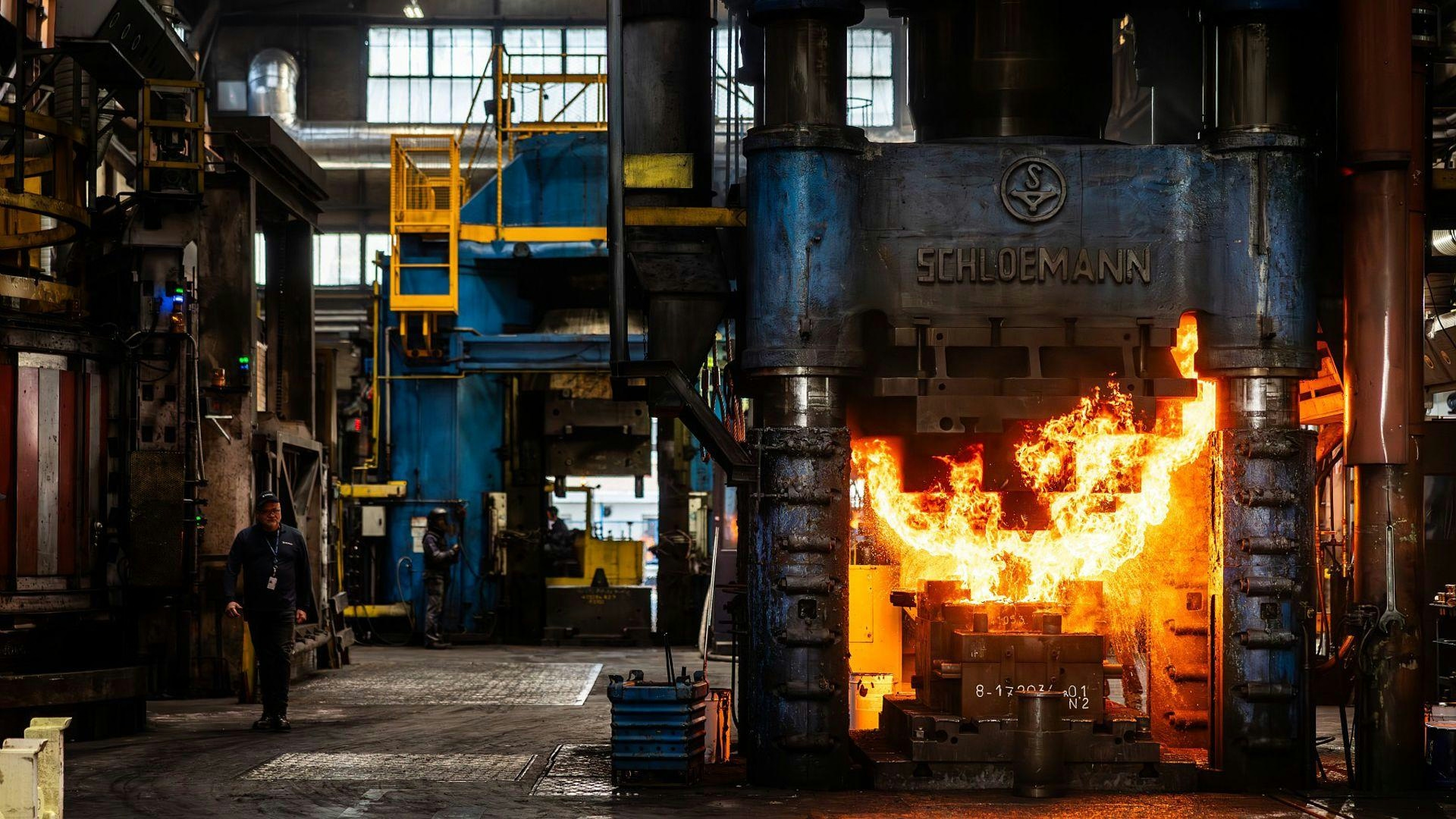
Boeing Faces Significant Delays as $175 Million Hydraulic Press Won’t Be Operational Until 2029
The postponement of Safran’s $175 million hydraulic press, now expected to become operational only by 2029, highlights the growing pressures within the global aircraft engine manufacturing sector. In an industry where precision and timing are critical, a nearly five-year wait for a single piece of industrial equipment underscores the severity of current supply chain disruptions. For Boeing, this delay represents more than a technical hurdle; it directly affects the company’s capacity to stabilize production schedules, meet increasing airline demand, and rebuild confidence following years of operational challenges.
Strategic Investment in Engine Component Production
Safran’s acquisition of a 33,000-ton (30,000-metric-ton) hydraulic press is a calculated response to a pressing bottleneck: the scarcity of high-quality forged engine components. Once fully operational, the press is projected to manufacture up to 14,000 precision-forged parts annually, which are vital for both next-generation commercial and military engines. These components require advanced metallurgical processes, extreme pressure, and precise temperature control to satisfy the stringent standards of modern high-bypass turbofan engines, making them difficult to source from alternative suppliers.
The complexity and scale of the press mean it cannot be rapidly procured or installed. Its construction demands specialized engineering, integration with existing manufacturing systems, and extensive testing to ensure it meets the exacting tolerances necessary for engine parts. The extended timeline to 2029 reflects not only technical challenges but also the absence of surplus capacity within the global supply chain.
Implications for Boeing and the Wider Aerospace Industry
Boeing’s reliance on engine manufacturers to maintain its assembly lines means the delay introduces a significant production lag that cannot be mitigated through short-term measures. This challenge is compounded by geopolitical tensions, particularly between the United States and China, which threaten to disrupt delivery schedules and impact Boeing’s order book in the strategically important Asia-Pacific region. In response, competitors may seek to reinforce domestic markets or forge new partnerships to counterbalance potential losses.
The market’s reaction to the delay is also a critical concern. Investors may interpret the prolonged timeline for integrating this advanced technology as a risk factor, potentially influencing Boeing’s stock performance and broader industry sentiment.
Forgings: A Critical Supply Chain Bottleneck
While supply chain issues in aviation are often discussed broadly, the shortage of castings and forgings remains particularly acute. Forged components are fundamental to engine manufacturing, and their production depends on rare and costly equipment such as Safran’s hydraulic press. Unlike other segments of the supply chain, forging capacity expands in large, infrequent increments, making rapid scaling difficult.
Despite these challenges, Boeing has demonstrated resilience in its delivery performance. In the first quarter of 2026, the company delivered more commercial aircraft than in any comparable period since 2019, reflecting robust demand and operational momentum amid ongoing supply constraints.
As the industry awaits the commissioning of Safran’s press, this episode underscores how narrow the margins for error have become and how a single piece of machinery can significantly influence the pace of global aircraft production.

Etihad Airways Suspends Airbus A380 Flights on Key Route

Aditya Birla Group Seeks Approval for Aircraft Leasing in GIFT City

Qatar Airways Highlights Innovation and Connectivity at Arabian Travel Market 2026

Hong Kong's Five-Year Plan Includes Andrew Fan's Aircraft Parts Processing Hub Proposal

ACIA Aero Leasing Delivers ATR72-600 to Air Nostrum

RTX Appoints Jill Albertelli as Head of Pratt & Whitney

TAT Technologies Joins Beyond Aero Hydrogen Aircraft Program

AURAK Study Highlights Barriers to Air Taxi Adoption in Emerging Economies

Xiamen Air Selects Altitude for 787 Maintenance at Heathrow

Etihad and Swissport Extend Global Partnership
