
Orquestre insights de IA em ações

Tendências
Categories
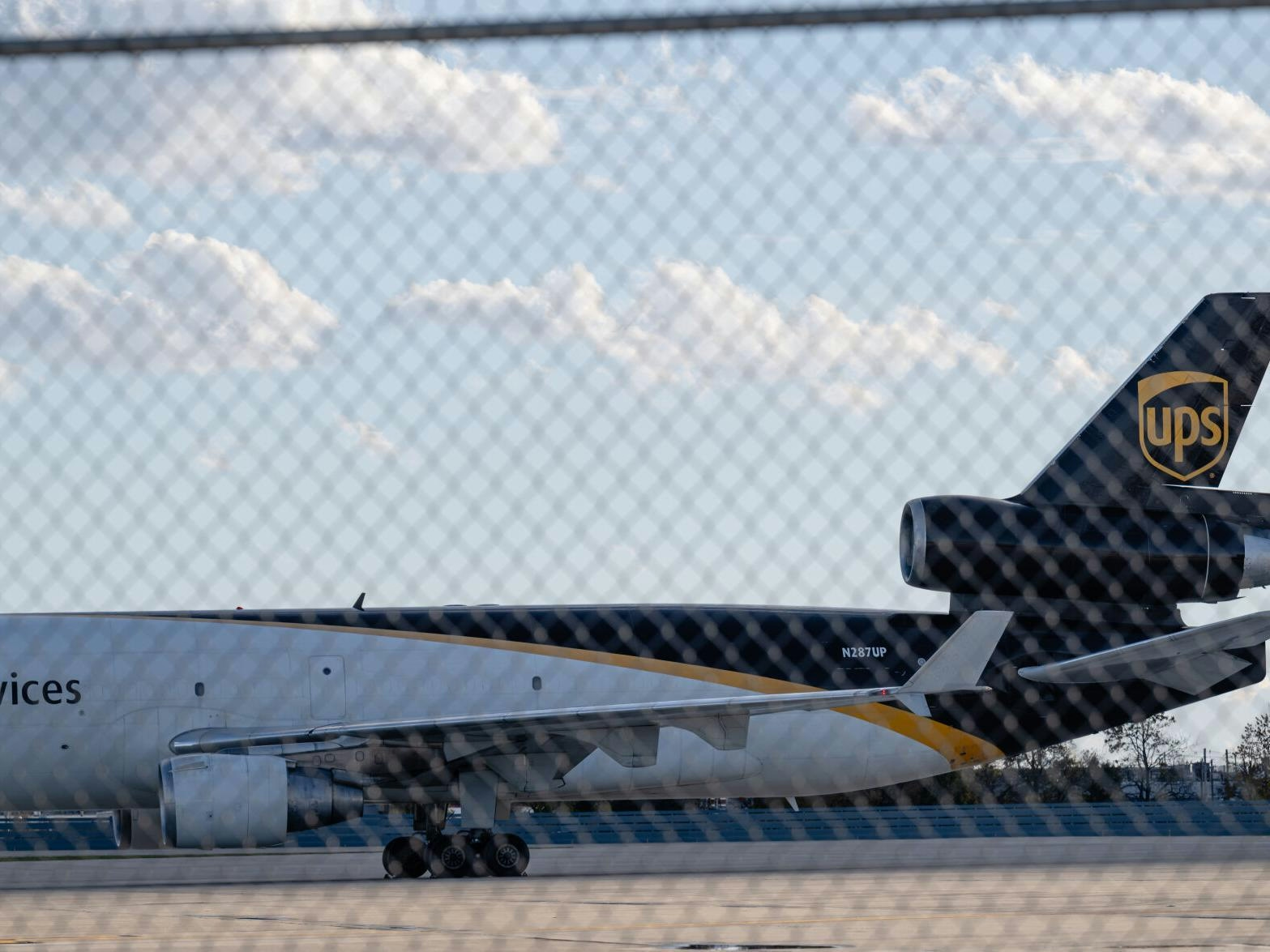
Does the McDonnell Douglas MD-11’s Tail Engine Affect Its Handling?
Does the McDonnell Douglas MD-11’s Tail Engine Affect Its Handling?
The McDonnell Douglas MD-11 remains the most prevalent trijet in operation today, although this status is somewhat qualified. Currently, all MD-11s are grounded following the 2025 UPS crash, with UPS having expedited the retirement of its fleet. Meanwhile, FedEx plans to resume flying the aircraft by the end of May 2026. The MD-11 has long been regarded as a challenging aircraft to land, and it is often assumed that its tail-mounted third engine is the primary cause of its handling difficulties. However, the reality is more nuanced. The aircraft’s handling challenges stem more from efficiency-driven design changes than from the presence of the tail engine itself. It is important to note that other trijets with tail-mounted engines, such as the Boeing 727, Lockheed L-1011 TriStar, and Dassault Falcon 900, were not considered inherently more difficult to fly due to their engine configuration.
The Rationale Behind the MD-11’s Third Engine
The MD-11’s third engine is a legacy of its design evolution from the earlier Douglas DC-10, which also featured a tail-mounted engine. The prevalence of trijets in the 1960s was largely a response to Federal Aviation Administration (FAA) regulations that restricted twin-engine aircraft to routes within 60 minutes of a suitable emergency airport in the event of an engine failure. At that time, more powerful and reliable engines capable of Extended-range Twin-engine Operational Performance Standards (ETOPS) certification were not yet available. Trijets and quadjets circumvented these restrictions by maintaining the ability to continue flight safely on multiple engines if one failed.
Another design consideration was the effect of the third engine on the aircraft’s center of gravity. Positioning the engine at the rear shifted the center of gravity aft, allowing the wings to be moved backward. This configuration enabled the placement of three evenly spaced emergency exits, facilitating faster boarding and deboarding and thereby reducing turnaround times. When the DC-10 was introduced, available engines produced approximately 40,000 pounds of thrust each. The MD-11’s engines, including the Pratt & Whitney PW4000 and General Electric CF6, deliver around 62,000 pounds of thrust. The General Electric CF6, in particular, is recognized as one of the most successful widebody engines ever developed and continues to be produced for Boeing’s 767-300F freighters.
Efficiency-Driven Design Changes and Handling Characteristics
The presence of a tail engine does not inherently make the MD-11 more difficult to fly, though it does contribute to a less forgiving flight envelope and increased pilot workload in certain flight regimes. This is true even when compared to the DC-10. The tail engine does not cause asymmetric thrust issues, as it is mounted on the aircraft’s centerline, resulting in negligible engine-out yaw effects. However, the installation of the engine and its impact on airflow are significant factors.
The primary contributors to the MD-11’s handling challenges are the modifications made to improve efficiency. Compared to the DC-10, the MD-11 features a substantially smaller horizontal stabilizer and an aft-biased center of gravity during cruise. These changes, driven by the desire to enhance aerodynamic performance and fuel efficiency, have made the aircraft more demanding to operate, particularly during landing and low-speed flight phases.

Etihad Airways Suspends Airbus A380 Flights on Key Route

Aditya Birla Group Seeks Approval for Aircraft Leasing in GIFT City

Qatar Airways Highlights Innovation and Connectivity at Arabian Travel Market 2026

Hong Kong's Five-Year Plan Includes Andrew Fan's Aircraft Parts Processing Hub Proposal

ACIA Aero Leasing Delivers ATR72-600 to Air Nostrum

RTX Appoints Jill Albertelli as Head of Pratt & Whitney

TAT Technologies Joins Beyond Aero Hydrogen Aircraft Program

AURAK Study Highlights Barriers to Air Taxi Adoption in Emerging Economies

Xiamen Air Selects Altitude for 787 Maintenance at Heathrow

Etihad and Swissport Extend Global Partnership
