
Orquestre insights de IA em ações

Tendências
Categories
Flight Testing Begins for Poland’s New Twin-Engine Aircraft
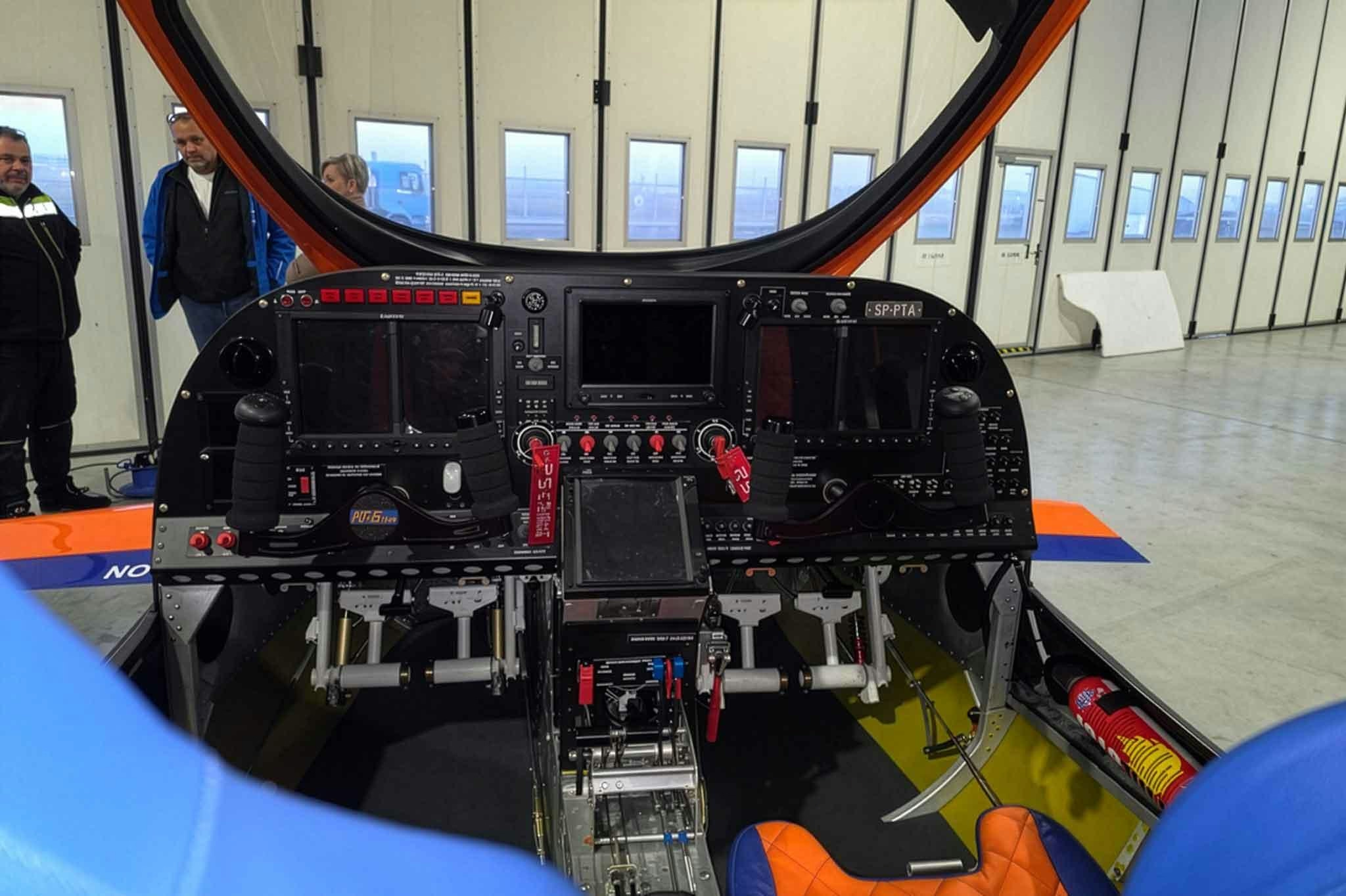
Flight Testing Advances for Poland’s New Twin-Engine Aircraft
Flight testing of Poland’s latest twin-engine aircraft, the AT-6 Twin PSE, is currently underway at Mielec, with the program slated for completion by November 2026. This testing phase is critical to validating the aircraft’s performance, safety, and operational efficiency, marking a significant development for the Polish aviation sector.
Design and Development
The AT-6 Twin PSE is the product of a team led by Tomasz Antoniewski, a distinguished aircraft designer known for the Aero AT-3 and AT-4 models widely used by flight schools and private pilots. Conceived as a new generation four-seat light twin aircraft, the project began in 2012 and gained renewed momentum in 2022 through funding from the Polish Agency for Enterprise Development. The aircraft is intended to serve both domestic and international training markets, with its designation, PSE, underscoring its focus on Performance, Safety, and Economy.
A key innovation in the AT-6 Twin PSE is the integration of a ballistic parachute rescue system (BRS), which is believed to be the first implementation of such a system in a twin-engine aircraft. The all-metal airframe is powered by two Rotax 915 engines, each producing 141 horsepower, with plans to upgrade to Rotax 916 units delivering 160 horsepower. This anticipated enhancement aims to improve short-field performance and align the aircraft with evolving standards in the U.S. Light Sport Aircraft category, which has recently expanded to include certain twin-engine designs.
In addition to conventional propulsion, the development team is investigating hybrid propulsion concepts that combine combustion engines with electric motors mounted on the propeller shaft. Although still in the exploratory phase, this approach reflects broader industry trends toward sustainable aviation by potentially improving efficiency and reducing emissions.
Aerodynamic Features and Certification Challenges
The AT-6 Twin PSE incorporates distinctive three-surface aerodynamics, featuring a forward-mounted tailplane alongside a conventional rear tail. This configuration is designed to optimize stability, reduce drag, and broaden the center-of-gravity envelope. Antoniewski has highlighted the use of advanced aluminum forming techniques, which enable aerodynamic performance comparable to composite structures while maintaining a lower weight profile.
Despite these technical advancements, the aircraft faces significant regulatory challenges on its path to certification. Similar to other innovative designs such as Leonardo Helicopters’ AW609 tiltrotor, the AT-6 Twin PSE must navigate complex regulatory environments that have been further complicated by personnel changes within the Federal Aviation Administration (FAA). Market reception will also be influenced by the progress of other advanced air mobility projects, including Joby Aviation’s FAA-conforming aircraft, which has recently commenced flight testing. Meanwhile, competitors continue to advance their own technologies and certification efforts, exemplified by Safran Aircraft Engines’ open-fan engine testing and Collins Aerospace’s hybrid engine initiatives.
As the AT-6 Twin PSE progresses through its flight test program, its ultimate success will depend not only on meeting technical milestones but also on effectively managing regulatory hurdles and responding to rapid technological developments within the global aviation industry.

Etihad Airways Suspends Airbus A380 Flights on Key Route

Aditya Birla Group Seeks Approval for Aircraft Leasing in GIFT City

Qatar Airways Highlights Innovation and Connectivity at Arabian Travel Market 2026

Hong Kong's Five-Year Plan Includes Andrew Fan's Aircraft Parts Processing Hub Proposal

ACIA Aero Leasing Delivers ATR72-600 to Air Nostrum

RTX Appoints Jill Albertelli as Head of Pratt & Whitney

TAT Technologies Joins Beyond Aero Hydrogen Aircraft Program

AURAK Study Highlights Barriers to Air Taxi Adoption in Emerging Economies

Xiamen Air Selects Altitude for 787 Maintenance at Heathrow

Etihad and Swissport Extend Global Partnership
