
Orquestre insights de IA em ações

Tendências
Categories
Fuel Exhaustion Caused by Incorrect Fuel Selector Installation
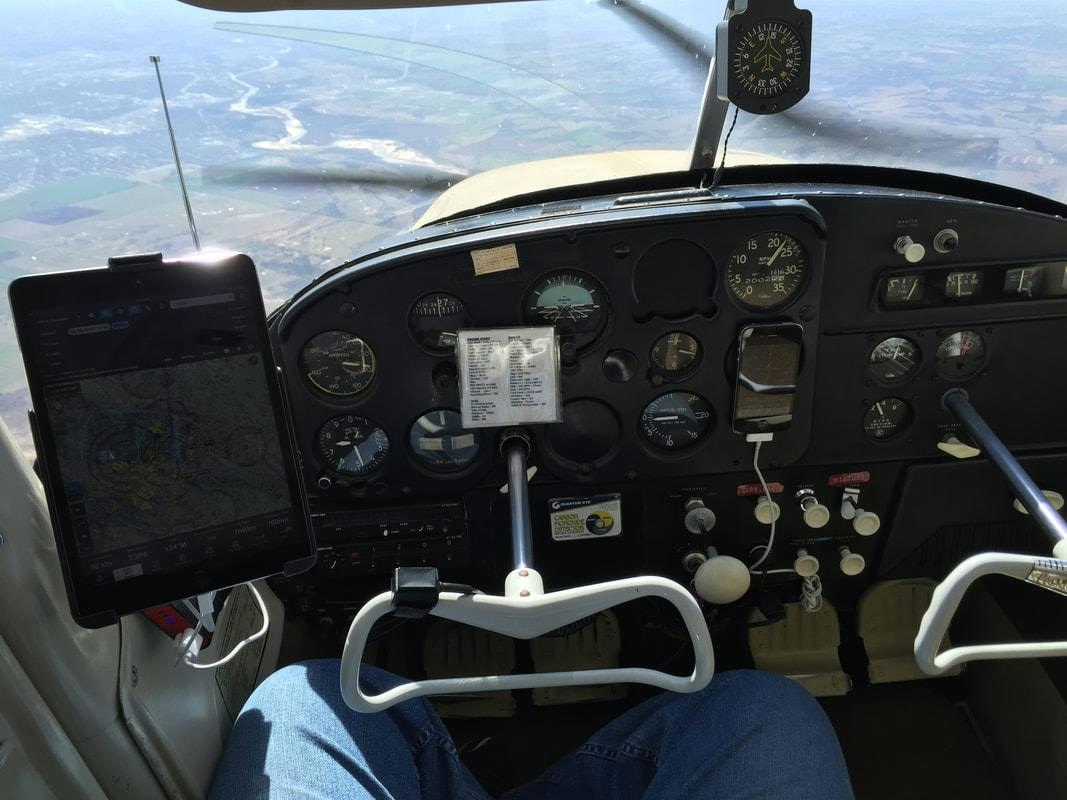
Fuel Exhaustion Incident Highlights Risks of Incorrect Fuel Selector Installation
A recent accident involving a Cessna 172 near Terrell, Texas, has brought renewed attention to the dangers posed by fuel exhaustion linked to improper fuel selector installation. The incident underscores significant safety and operational challenges within the aviation industry.
Sequence of Events Leading to the Accident
The pilot departed Arlington Municipal Airport (KGKY) after refueling with 12.75 gallons of 100LL aviation fuel, reporting that both wing tanks were “topped off.” The flight was intended to build flight hours, with planned stops at East Texas Regional Airport (KGGG) and Terrell Municipal Airport (KTRL). Upon landing at KGGG and subsequently at KTRL, the pilot attempted to refuel at Terrell but discovered the fuel pumps were “out of order.” Notably, KTRL does not offer self-service fueling; all refueling is conducted by a technician using a fuel truck, with after-hours service available only by prior arrangement—a request that was not made on the night of the accident.
Using a fuel measurement stick, the pilot estimated approximately four gallons remained in the right tank and twelve gallons in the left. Choosing to proceed to Mesquite Metro Airport (KHQZ) for refueling, the pilot observed a “rough” engine idle before takeoff but decided to continue after the engine appeared to stabilize at higher throttle settings. Shortly after departing Runway 18 at KTRL, at an altitude of roughly 400 to 450 feet above ground level, the engine lost all power. Although the pilot briefly restarted the engine, it failed again, necessitating an emergency landing in a nearby field. The aircraft sustained substantial damage, but both occupants escaped with only minor injuries.
Investigation Findings and Industry Implications
Post-accident examination revealed approximately two gallons of fuel remaining in the left tank and a mere quarter gallon in the right. The fuel selector was positioned on “both,” and no external fuel leaks were detected. The pilot reported observing a “steady stream” of fuel from the left side after landing. These findings suggest that incorrect fuel selector installation and fuel management errors contributed directly to the engine failure.
This incident highlights the critical safety risks and operational disruptions that can arise from improper fuel system installation and inadequate fuel management. Beyond the immediate threat to life, such events impose significant financial burdens on operators. In response, the aviation sector is experiencing heightened scrutiny of safety protocols, with insurance providers reportedly increasing premiums for companies engaged in aviation and transportation.
Competitors within the industry are accelerating innovation in fuel management technologies and reinforcing quality control measures to mitigate the risk of similar occurrences. These efforts coincide with ongoing energy reforms that are already exerting pressure on profit margins, further challenging resources allocated to fuel management and safety enhancements.
The accident serves as a stark reminder of the essential need for correct fuel system installation, comprehensive preflight inspections, and strict adherence to fueling procedures to maintain flight safety and operational integrity.

Etihad Airways Suspends Airbus A380 Flights on Key Route

Aditya Birla Group Seeks Approval for Aircraft Leasing in GIFT City

Qatar Airways Highlights Innovation and Connectivity at Arabian Travel Market 2026

Hong Kong's Five-Year Plan Includes Andrew Fan's Aircraft Parts Processing Hub Proposal

ACIA Aero Leasing Delivers ATR72-600 to Air Nostrum

RTX Appoints Jill Albertelli as Head of Pratt & Whitney

TAT Technologies Joins Beyond Aero Hydrogen Aircraft Program

AURAK Study Highlights Barriers to Air Taxi Adoption in Emerging Economies

Xiamen Air Selects Altitude for 787 Maintenance at Heathrow

Etihad and Swissport Extend Global Partnership
