
Orquestre insights de IA em ações

Tendências
Categories
Incheon Airport Seeks Operator for Aviation AI Innovation Hub
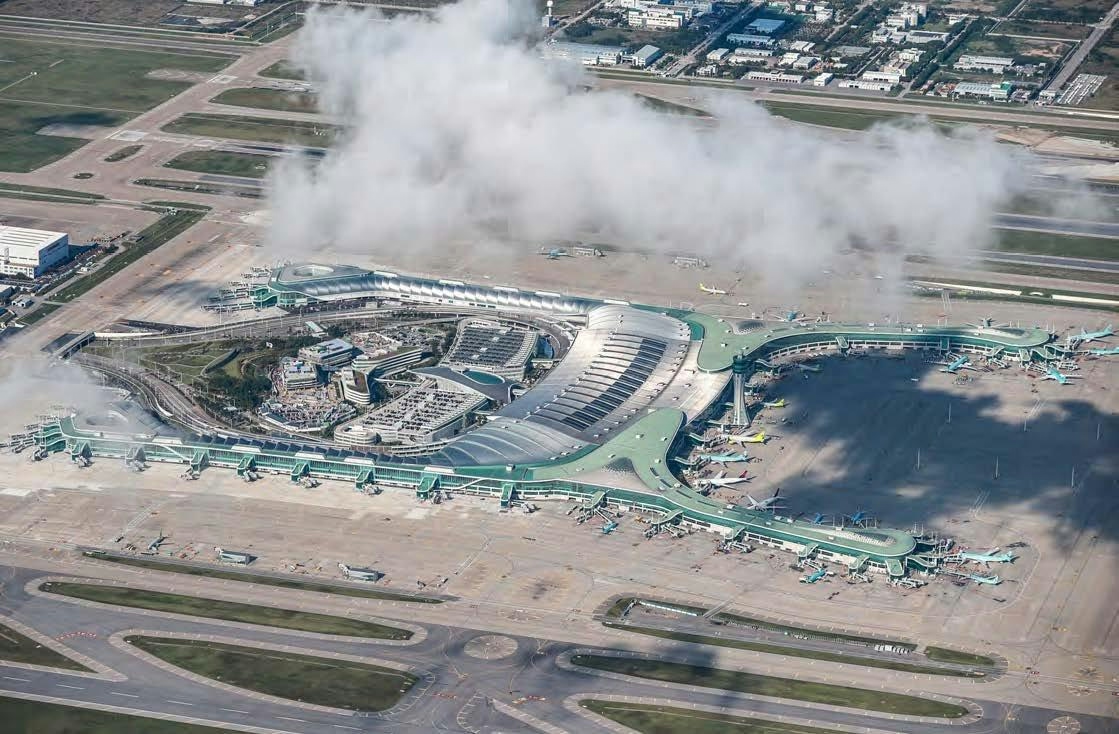
Incheon Airport Launches Search for Operator of Aviation AI Innovation Hub
Incheon International Airport Corporation announced on June 12 that it is seeking an operator for its flagship project, the “Aviation AI Innovation Hub.” This initiative is a cornerstone of the airport’s strategic vision to transition into the Incheon Airport 4.0 era, emphasizing the integration of artificial intelligence within the aviation sector. The proposed hub will encompass an AI data center, research and development facilities, and a business center, collectively designed to foster a comprehensive ecosystem dedicated to aviation-focused AI technologies.
A Center for Advanced AI Development and Commercialization
The planned data center will be outfitted with state-of-the-art AI computing infrastructure, including high-performance graphics processing units (GPUs). This will enable aviation and airport-related companies to develop, test, and commercialize AI-driven solutions within a single, centralized location. The project aligns closely with South Korea’s national ambition to rank among the world’s top three AI powerhouses. It aims to establish the hub as a premier site for “physical AI,” where artificial intelligence is seamlessly integrated with real-world applications such as robotics, autonomous vehicles, predictive maintenance, and logistics automation.
Incheon Airport’s extensive operational systems and vast data infrastructure provide an ideal environment for the real-time validation and deployment of physical AI technologies. Despite its promising potential, the project faces significant challenges. These include attracting a qualified operator amid intense global competition, integrating cutting-edge AI technologies into the existing airport infrastructure, and managing the financial and regulatory complexities inherent in such a large-scale development.
Project Structure and Selection Process
The Aviation AI Innovation Hub is structured as a private investment development project. The corporation will lease approximately 23,000 square meters of land (around 7,000 pyeong) to the selected operator, who will be responsible for developing and managing the facilities for up to 50 years. The site is designed to support up to 40 megawatts of power, accommodating the substantial energy requirements of AI computing operations.
Eligible applicants include established corporations or entities planning to form a legal entity specifically for this project. Interested parties must submit a detailed business plan in person by July 22. Further information and submission guidelines are available on the corporation’s official website. A panel of experts will evaluate proposals based on the applicants’ ability to cultivate an aviation AI ecosystem, secure and effectively utilize AI computing resources, and execute comprehensive construction and infrastructure plans. The leading candidate will enter final negotiations before the project is awarded.
Implications for the AI and Aviation Sectors
Industry observers suggest that the launch of the Aviation AI Innovation Hub could stimulate heightened interest from AI and technology firms aiming to expand their presence in South Korea’s rapidly growing AI market. The initiative may also prompt competing airports worldwide to accelerate their own AI-driven projects to attract global investment and technological attention. This development occurs amid a broader global race to establish advanced AI infrastructure, with notable investments such as SK Telecom’s expansion of AI data centers and significant projects underway at Birmingham Airport and Kuwait International Airport.
“Incheon Airport aims to evolve beyond a traditional transport facility to become the Silicon Valley of AI,” stated Lee Hak-jae, CEO of Incheon International Airport Corporation. “We are committed to making Incheon Airport a central hub for AI innovation across all industries.”

Etihad Airways Suspends Airbus A380 Flights on Key Route

Aditya Birla Group Seeks Approval for Aircraft Leasing in GIFT City

Qatar Airways Highlights Innovation and Connectivity at Arabian Travel Market 2026

Hong Kong's Five-Year Plan Includes Andrew Fan's Aircraft Parts Processing Hub Proposal

ACIA Aero Leasing Delivers ATR72-600 to Air Nostrum

RTX Appoints Jill Albertelli as Head of Pratt & Whitney

TAT Technologies Joins Beyond Aero Hydrogen Aircraft Program

AURAK Study Highlights Barriers to Air Taxi Adoption in Emerging Economies

Xiamen Air Selects Altitude for 787 Maintenance at Heathrow

Etihad and Swissport Extend Global Partnership
