
Orquestre insights de IA em ações

Tendências
Categories
Investor Confidence Declines in Air Taxi Sector for 2026
Investor Confidence Declines in Air Taxi Sector for 2026
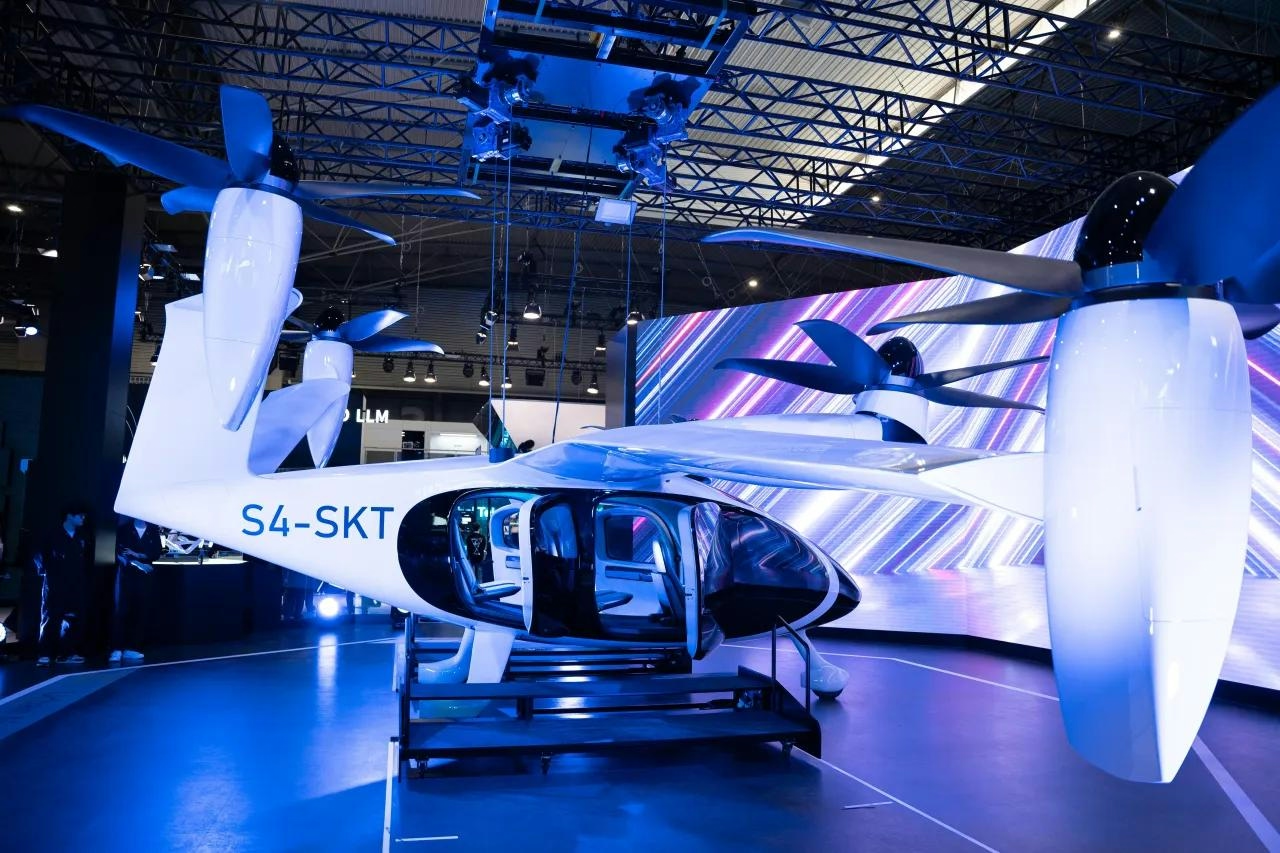
Investor sentiment in the air taxi industry is showing signs of decline as companies confront a range of challenges, including regulatory obstacles, funding difficulties, and increasing competition. Although the long-term prospects for urban air mobility remain promising, many firms within the sector, such as Archer Aviation, continue to operate without generating revenue and have reported significant operating losses over the past year. To maintain their operations, these companies have frequently issued additional shares, diluting existing shareholders and underscoring ongoing financial pressures.
Regulatory and Financial Challenges
Archer Aviation has made progress with its electric air taxi program, recently securing all necessary Federal Aviation Administration (FAA) compliance approvals for its Midnight aircraft. The company is now collaborating with local regulators across several states to develop operational networks. Despite these advancements, the broader air taxi industry, which garnered substantial enthusiasm in 2025, is experiencing diminished investor optimism. Share prices for companies like Archer Aviation have fallen sharply from their peak valuations, reflecting a wider market shift away from higher-risk assets.
Smaller operators face even more formidable hurdles. For instance, Hopscotch Go must obtain approval from the Securities and Exchange Commission (SEC) before it can begin accepting capital investments, highlighting the financial constraints confronting emerging players. The sector is further complicated by regulatory fragmentation and growing demand for charter services, as noted in the latest report from the Air Charter Council (ACC). On a global scale, structural barriers persist; Azul CEO John Rodgerson has emphasized significant challenges in Brazil, illustrating the international nature of these difficulties.
Despite these headwinds, some companies continue to secure funding and advance pilot programs. Both Eve Air Mobility and Archer Aviation have attracted new investments and are progressing with development efforts, indicating a market that, while cautious, retains a degree of resilience.
Comprehensive Overview of the U.S. Helicopter Industry
The report also offers an extensive analysis of the helicopter industry in the United States, examining demand, supply, and trade flows throughout the national value chain. It explores how consumption patterns are shaped by demand across key channels and end-use segments, while also assessing the impact of input availability, production efficiency, and regulatory standards on supply dynamics. Beyond headline figures, the study benchmarks prices, margins, and trade routes, providing insights into value creation and the movement of goods between domestic suppliers and international partners.
Domestic demand is driven by both household and industrial usage, with trade flows linking local supply to imports and exports. Pricing dynamics are influenced by factors such as unit values, freight costs, exchange rates, and regulatory changes that affect sourcing decisions. Supply depends heavily on input availability and production efficiency, which together shape the national cost curve. Market concentration varies across segments, resulting in diverse competitive landscapes and entry barriers. Looking ahead to 2035, the report identifies areas where capacity investment and demand growth are most closely aligned within the United States.
The analysis integrates market sizing with trade intelligence and price analytics, covering both historical performance and forward-looking projections to 2035. It facilitates comparisons of market cycles, structural shifts, and policy impacts, encompassing market size and growth in value and volume terms, consumption structure by end-use segments, production capacity and cost dynamics, trade flows including exporters and importers, price benchmarks, and competitive context.
The methodology underpinning the report draws on a multi-source framework that incorporates official statistics, trade records, company disclosures, and expert validation. Data are standardized and cross-checked to ensure consistency across time series, providing a robust foundation for strategic planning, market entry, portfolio prioritization, and risk management within the evolving air taxi and helicopter sectors.

Etihad Airways Suspends Airbus A380 Flights on Key Route

Aditya Birla Group Seeks Approval for Aircraft Leasing in GIFT City

Qatar Airways Highlights Innovation and Connectivity at Arabian Travel Market 2026

Hong Kong's Five-Year Plan Includes Andrew Fan's Aircraft Parts Processing Hub Proposal

ACIA Aero Leasing Delivers ATR72-600 to Air Nostrum

RTX Appoints Jill Albertelli as Head of Pratt & Whitney

TAT Technologies Joins Beyond Aero Hydrogen Aircraft Program

AURAK Study Highlights Barriers to Air Taxi Adoption in Emerging Economies

Xiamen Air Selects Altitude for 787 Maintenance at Heathrow

Etihad and Swissport Extend Global Partnership
