
Orquestre insights de IA em ações

Tendências
Categories
Joby Aviation Invests $450 Million to Nearly Double Revenue
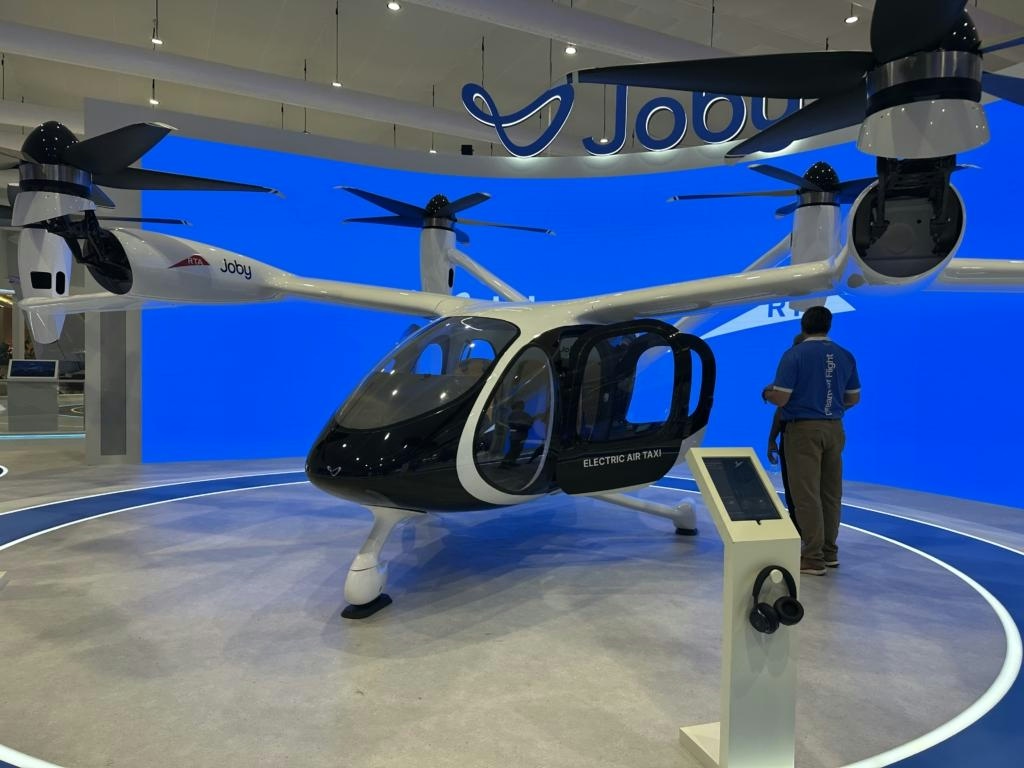
Joby Aviation Invests $450 Million to Nearly Double Revenue Amid Market Skepticism
Shares of Joby Aviation (NYSE: JOBY) have been trading below $7, approaching their 52-week low and down approximately two-thirds from a peak near $20. Investor confidence appears to be waning as the anticipated promise of electric air taxis has yet to yield substantial revenue. In response, Joby announced on August 11 a significant strategic move: a $500 million agreement to acquire Resonant Sciences, a defense technology firm, for $450 million in cash and $50 million in stock. This acquisition is projected to nearly double Joby’s revenue base.
Strategic Shift Toward Defense Technology
Resonant Sciences, headquartered in Dayton, Ohio, specializes in radio frequency and mission systems for U.S. national security clients, focusing on low-observability technology that enhances military aircraft’s ability to detect threats while avoiding detection. Over the past twelve months, Resonant generated more than $100 million in revenue, marking a 40% year-over-year increase, and achieved positive adjusted EBITDA. Demand for its products is accelerating rapidly; in the first half of 2026, Resonant secured over three times the new business compared to the previous year, with its backlog more than doubling.
Joby’s own revenue guidance for 2026, updated in August, forecasts between $115 million and $125 million for the full year. Resonant’s trailing revenue is nearly equivalent to Joby’s entire expected revenue for 2026. However, the acquisition is not anticipated to close until the first half of 2027, pending regulatory approval, meaning Resonant’s financial results are not yet incorporated into Joby’s statements.
Financial Position and Market Response
Joby’s balance sheet appears robust enough to support the acquisition. As of June, the company held approximately $2.3 billion in cash and short-term investments. Management expects to deploy between $385 million and $415 million of this amount in the second half of 2026 alone. The $450 million cash payment for Resonant represents roughly one-fifth of Joby’s cash reserves. Earlier this year, Joby raised $576 million through a stock offering and $670 million via convertible notes, indicating that the company is utilizing investor capital rather than internally generated funds. Considering the planned cash expenditures and the Resonant acquisition, about $850 million of Joby’s June cash balance is already committed. The $50 million in stock issued as part of the deal will have a minimal dilutive effect, increasing the share count by less than 1%. Additionally, Joby announced a program to raise up to $750 million through new stock sales over time.
Despite the company’s financial preparedness, the market reacted cautiously. Joby’s stock declined approximately 3% following the announcement, reflecting skepticism about the company’s pivot toward defense technology rather than concentrating on scaling its core air taxi business. Some analysts have expressed concerns that this strategic shift could divert focus from Joby’s primary mission, especially as competitors such as New Horizon Aircraft, which targets the helicopter replacement market, may capitalize on any perceived strategic vulnerabilities.
Outlook and Future Prospects
Currently, nearly all of Joby’s revenue is derived from sources other than electric air taxis, yet the company remains optimistic about its prospects. Its 2026 revenue guidance is underpinned by partnerships with global vertiports, airlines, and its existing Blade passenger service. Whether the acquisition of Resonant Sciences will accelerate Joby’s journey toward profitability or dilute its strategic focus remains uncertain. Nonetheless, the company is making a substantial bet on diversification as a means to drive future growth.
GTA Aims to Expand Role in Malaysia’s Defence Self-Reliance Efforts
PD-35 Engine Features Smaller Fan Compared to GE9X
Sydney‑bound Qantas flight diverted to Christchurch after suspected engine issue
Six Boeing 747 Cabin Designs Still Used by Airlines Today

The Role of Human Leadership and Empathy in the Future of Travel Automation

How to plan a vacation with AI, from cheap flights to personalized itineraries
JAL Acquires Hanjin KAL Stake, Strengthening Alliance with Korean Air
AI Startup Offers $12.5 Million for Spirit Aviation Data
Bombardier to Acquire MHICA, Internalize Wing Production
FAI Technik Authorized as Starlink Dealer
