
Orquestre insights de IA em ações

Tendências
Categories
KRICT Produces 100 kg of Sustainable Aviation Fuel Daily
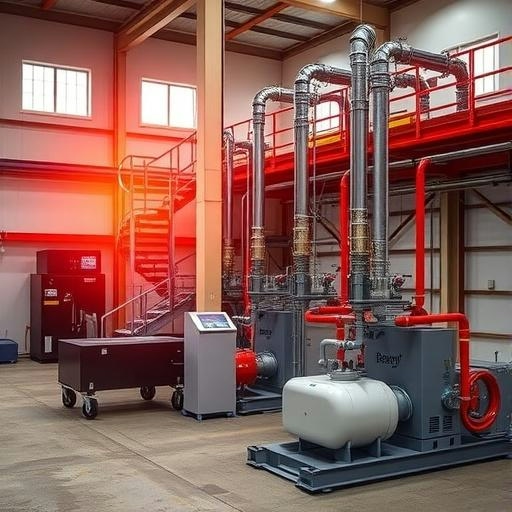
KRICT Advances Sustainable Aviation Fuel Production from Landfill Gas
The aviation sector, a major source of global carbon emissions, faces increasing pressure to transition toward Sustainable Aviation Fuel (SAF) as an environmentally responsible alternative to conventional jet fuels. SAF, derived from organic waste or biomass, holds significant promise for reducing greenhouse gas emissions. However, the high costs associated with its production continue to impede widespread adoption, with some airlines in Europe and Japan passing these expenses on to consumers.
Innovative Conversion of Landfill Gas into Aviation Fuel
In a significant development, researchers at the Korea Research Institute of Chemical Technology (KRICT), led by Dr. Yun-Jo Lee and in partnership with EN2CORE Technology Co., Ltd., have pioneered an integrated process that transforms landfill gas—primarily sourced from food waste—into sustainable aviation fuel. This breakthrough not only addresses the urgent need for cleaner energy sources but also introduces a novel approach to recycling waste that would otherwise contribute to environmental degradation.
Historically, SAF production has depended heavily on used cooking oil, a resource both limited in availability and in demand for biodiesel production, which has driven up costs and complicated supply chains. By contrast, landfill gas generated from food waste and livestock manure is abundant and economically viable. KRICT’s achievement represents the first domestic demonstration of producing aviation fuel from landfill gas, potentially reshaping the future of SAF manufacturing.
Technical Process and Innovations
The production process confronts two primary challenges: purifying landfill gas to obtain suitable intermediates and efficiently converting these gases into liquid fuels. Dr. Lee’s team developed a comprehensive system encompassing landfill gas pretreatment, synthesis gas (syngas) production, and catalytic conversion of syngas into liquid hydrocarbons. EN2CORE Technology oversees the upstream operations, collecting landfill gas from disposal sites and subjecting it to rigorous desulfurization and membrane-based separation to remove excess carbon dioxide. The purified gas is then converted into syngas—a mixture of carbon monoxide and hydrogen—using a proprietary plasma reforming reactor before being transferred to KRICT for further processing.
At KRICT, the Fischer-Tropsch synthesis converts syngas into liquid hydrocarbons. The team enhanced selectivity for liquid fuels and minimized solid byproducts such as wax by employing zeolite- and cobalt-based catalysts. A notable innovation is the introduction of a microchannel reactor featuring alternating layers of catalyst and coolant channels. This design efficiently dissipates heat, protecting catalysts and ensuring process stability. The reactor’s compact size—approximately one-tenth that of conventional systems—facilitates scalability through modular expansion.
Production Scale and Market Implications
Currently, KRICT’s pilot facility produces 100 kilograms of sustainable aviation fuel daily. While this represents a significant milestone, scaling production to meet global demand remains a formidable challenge. Achieving cost-competitiveness with traditional jet fuel and navigating complex regulatory and policy frameworks will be essential for broader adoption. The market is already responding, with airlines and governments demonstrating increased interest in SAF. Established producers such as Neste and Gevo are expected to expand their output and market presence, while emerging companies like Syzygy Plasmonics may intensify competition by introducing innovative production methods and securing future supply through offtake agreements.
KRICT’s accomplishment underscores the potential of landfill gas as a viable feedstock for sustainable aviation fuel, offering a promising pathway toward greener aviation and improved waste management practices.
Lynchburg Regional Airport Receives $5.2 Million Federal Grant for Infrastructure Expansion

Archer Aviation Projects $5 Million Revenue and $263.2 Million Net Loss for 2026

DeSantis Announces Air Taxi Testing in Central Florida by Year-End

Boeing Maintains Access to Wisk’s Autonomous Flight Technology After Divestment

JetBlue Flight Attendants Call in Sick Amid New Software Glitch

Boeing to Sell Three eVTOL Subsidiaries to Archer Aviation
Dominican AI Aviation Technology Named Among Latin America’s Most Disruptive

Gulfstream Partners with Suppliers to Test Sustainable Aviation Fuel
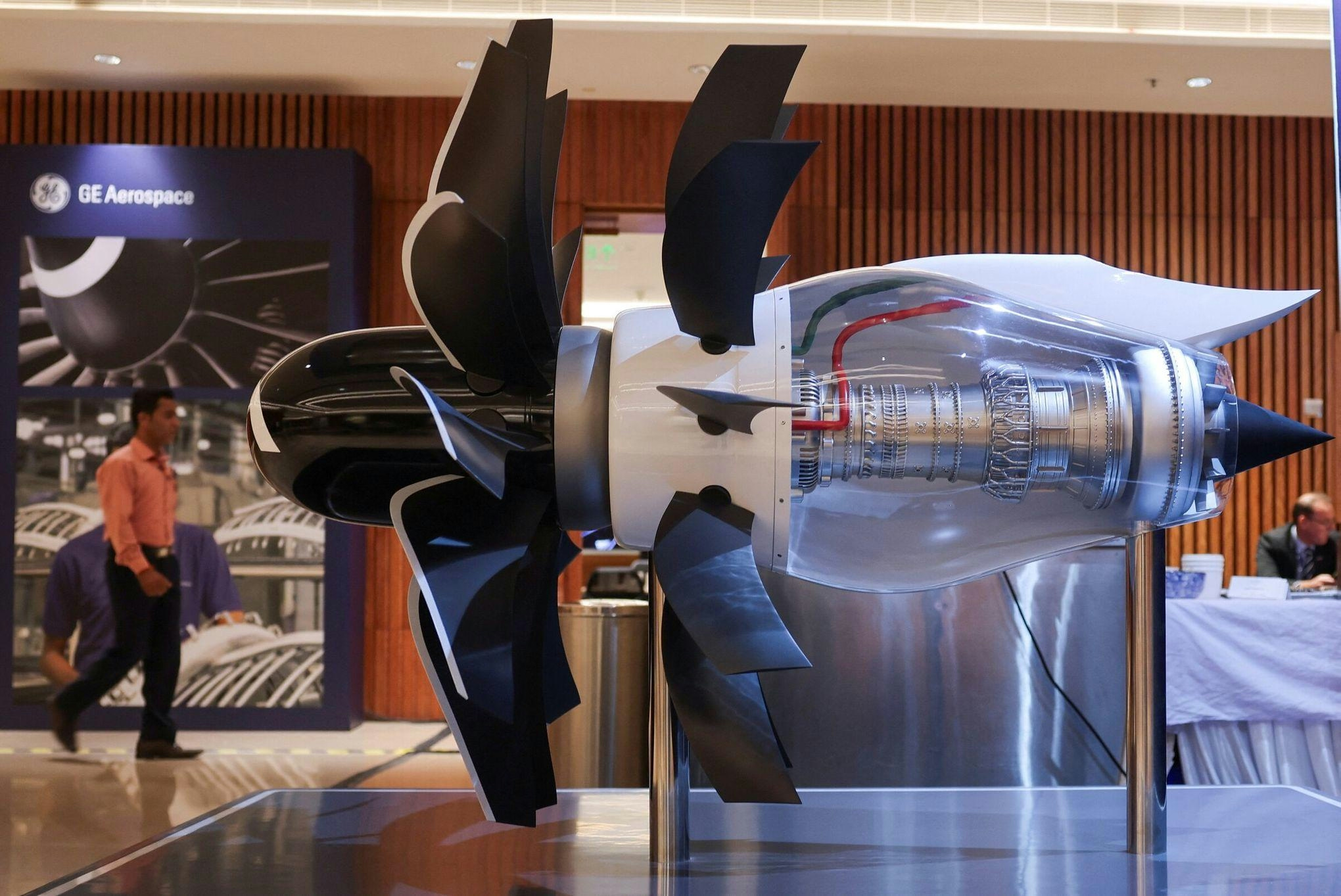
GE and RTX Compete to Supply Engines for Boeing and Airbus
Malaysia Secures $192 Million Boost for Aerospace Sector at Farnborough Airshow
