Imagem

AeroGenie — Seu Copiloto Inteligente.

Pergunte qualquer coisa. Analise tudo. Aja imediatamente.

Tendências

Categories

Nakanihon Air Receives Japan’s First Piaggio P.180
January 26, 2026By ePlane AI
Nakanihon Air Receives Japan’s First Piaggio P.180
0
0
Nakanihon Air
Piaggio P.180
Japan Civil Aviation Bureau

Nakanihon Air Receives Japan’s First Piaggio P.180

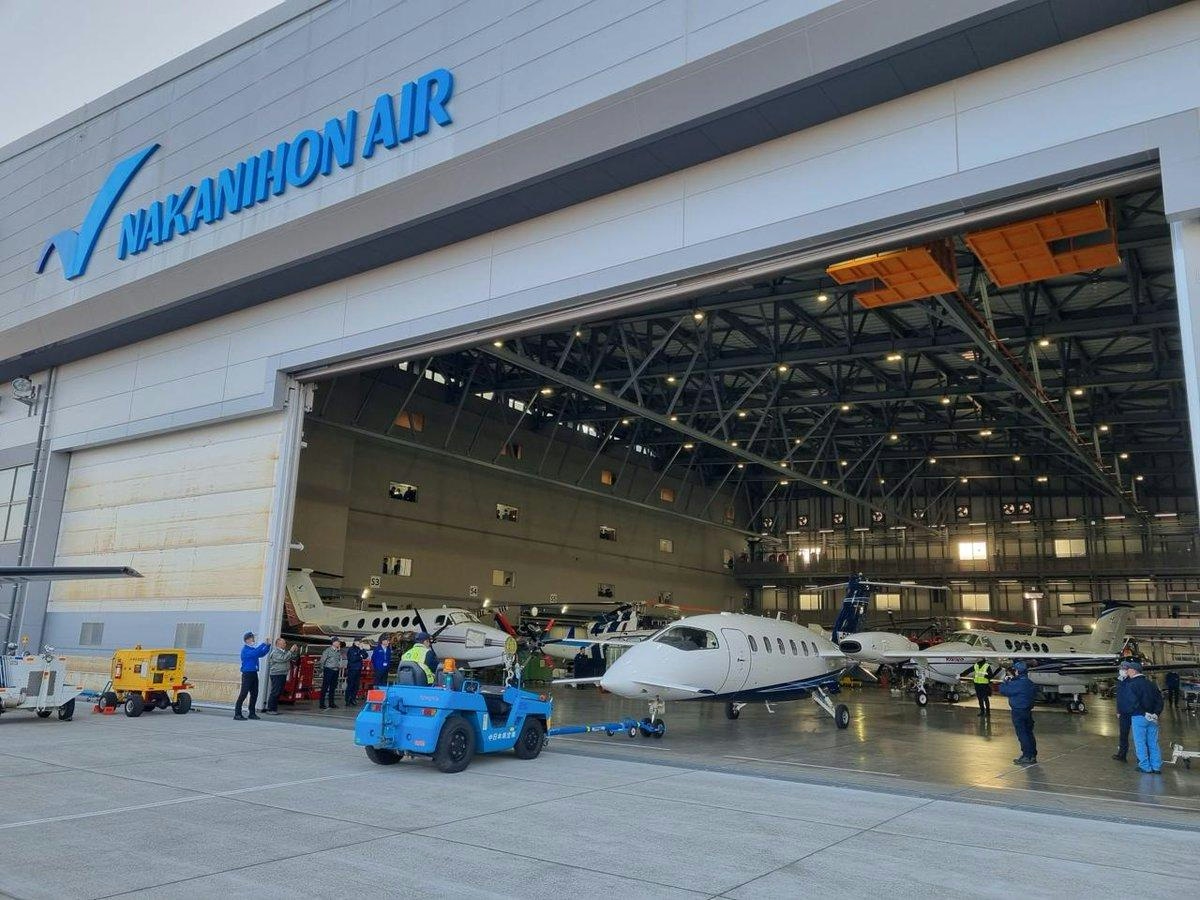
Nakanihon Air, headquartered at Nagoya Komaki Airport, has become the first operator in Japan to take delivery of the Piaggio Aerospace P.180 following its type certification by the Japan Civil Aviation Bureau (JCAB). The newly manufactured turboprop, bearing serial number 3018, departed Piaggio Aerospace’s Genoa headquarters on January 12 and completed a multi-stop journey to Nagoya Komaki four days later. The route included stops in Irakleion, Sharm el Sheikh, Riyadh, Muscat, Indore, Chittagong, Da Nang, Taipei Songshan, and Nagoya Chubu. Initially registered under the test code I-PDVS, the aircraft will be officially re-registered as JA124N.

Expanding a Diverse Fleet

The addition of the P.180 enhances Nakanihon Air’s already diverse fleet, which comprises seven fixed-wing aircraft. This includes a recently delivered 2025 Pilatus PC-24, two Citation V jets, several Beech King Air B200s, and Cessna C208s, complemented by a substantial helicopter fleet of 57 units. Controlled by the private railroad operator Meitetsu, Nakanihon Air provides a wide array of aviation services. These range from charter flights and cargo transport to aerial photography, spatial data acquisition, pilot training, sightseeing, aircraft completion, and maintenance.

Industry Context and Strategic Implications

The introduction of the P.180 arrives amid a growing industry emphasis on operational efficiency and environmental sustainability. As market demand increasingly favors eco-friendly aircraft, Nakanihon Air faces the challenge of integrating the P.180 into its operations while meeting evolving customer expectations. The competitive landscape is intensifying, with rival operators likely to upgrade their fleets to maintain market share. Successfully incorporating the P.180 will require strategic alignment with Nakanihon Air’s business model and careful planning to navigate these shifting industry dynamics.

Piaggio Aerospace chief executive Giovanni Tomassini highlighted that the P.180 has recently entered two new markets—Japan and Türkiye—with two aircraft sold in the latter country. Since its acquisition by Turkish aerospace and defense group Baykar in mid-2025, Piaggio Aerospace plans to increase P.180 production to between 25 and 30 aircraft annually.

As business aviation continues to evolve amid broader market forces, including those impacting Japan’s automotive sector, adaptability and strategic positioning will be essential for Nakanihon Air and other operators aiming to leverage new aircraft introductions.

More news
Government Allocates N580 Million for Airport Chillers and Software

Government Allocates N580 Million for Airport Chillers and Software

Government Allocates N580 Million for Airport Chillers and Software Upgrades The Federal Government has designated N580 million for the procurement and installation of chillers and software upgrades at key airports, as part of the proposed N87.3 billion budget for the aviation sector in 2026. Budget documents reveal that N500 million will be allocated specifically for the installation of chillers at Lagos airport, while N80 million is earmarked for updating the financial management system and related software, although the precise nature of the software enhancements remains unspecified. Infrastructure Enhancements and Operational Challenges This allocation arrives amid heightened expectations from industry stakeholders who are closely monitoring the efficient execution of these upgrades. Ensuring a seamless procurement and installation process, while minimizing disruptions to airport operations, is anticipated to be a significant challenge. The investment is expected to draw increased scrutiny regarding its impact on airport efficiency and the overall passenger experience. Furthermore, competing airports may seek similar funding to uphold operational standards, and airlines might adjust their schedules or services in response to the anticipated infrastructural changes. In addition to chillers and software, the government plans to improve passenger connectivity by providing or upgrading Wi-Fi services at five international airports and select domestic terminals, with a budget of N800 million. Water-cooling chillers are also slated for installation at both Lagos and Abuja airports, with an additional allocation of N500 million. Broader Aviation Sector Investments The budget further outlines several infrastructure projects, including the construction of a sewage treatment plant at Owerri Airport, budgeted at N21 million, and the organization of a bi-annual Joint Aviation Trade Unions stakeholders’ forum, costing N150 million. Rehabilitation works are planned for major airports in Port Harcourt, Kano, and Lagos, where N800 million will be spent on sealing cracks on runways, aprons, and taxiways. Ilorin Airport is set to receive new airfield lighting systems, also budgeted at N800 million. Personnel costs are allocated N14.78 billion, with overheads receiving N2.34 billion. Notably, over 80 percent of the total budget—amounting to N70.19 billion—is dedicated to capital projects. Of this, N33.91 billion is specifically reserved for the rehabilitation and upgrade of airport infrastructure, including terminal buildings, runways, aprons, and fencing. The budget document does not provide for retained independent revenue or external aid and grant funding, underscoring a focus on infrastructure and capital projects. This emphasis reflects the ministry’s priority to modernize and enhance Nigeria’s aviation facilities. As these initiatives progress, effective management and stakeholder engagement will be essential to achieving the intended improvements in operational efficiency and passenger satisfaction.
GetJet Aviation Holdings Rebrands Ahead of 2026 Global Strategy

GetJet Aviation Holdings Rebrands Ahead of 2026 Global Strategy

GetJet Group Unveils Rebranding and Ambitious 2026 Global Strategy Lithuanian aviation company GetJet Aviation Holdings has officially rebranded as GetJet Group, marking the launch of its comprehensive “2026 Growth Strategy.” This rebranding extends beyond a mere change in visual identity; it signifies the strategic consolidation of the company’s diverse aviation operations—including charter flights, ACMI (Aircraft, Crew, Maintenance, and Insurance), heavy maintenance, and crew training—under a single, vertically integrated brand. Consolidation for Global Reach Historically, GetJet Aviation Holdings functioned primarily as a legal entity, with subsidiaries such as GetJet Airlines, Airhub Aviation, and Airhub Training operating independently and cultivating their own reputations. However, as the company expanded into new international markets, including the Middle East, the necessity for a unified and recognizable brand became increasingly apparent. Darius Viltrakis, CEO of GetJet Group, emphasized the strategic importance of this shift, stating, “GetJet Aviation Holdings used to function more as a legal name than a true brand. Today, we clearly see the value of vertical integration. We want to strengthen the core brand and position it as the unifying name of the entire group.” This approach aims to dismantle operational silos and streamline access for global partners such as Wizz Air, Air Senegal, and the recently onboarded Etihad Airways, enabling them to engage with the full spectrum of GetJet’s services through a single gateway. Strategic Pillars of the 2026 Growth Plan The rebranding serves as the foundation for GetJet Group’s ambitious expansion objectives. Following a year of financial consolidation in 2024, which culminated in a record net profit of €25.4 million, the company is preparing for substantial operational growth by 2026. A key component of the strategy involves expanding the fleet by adding five aircraft in the first half of 2026. This increase will enhance the company’s capacity to serve both legacy and low-cost carriers during peak travel seasons. Known within the industry as the “special forces of aviation,” GetJet Group has built a reputation for the rapid deployment of fully crewed aircraft. In addition to fleet growth, the group plans to create 200 new jobs across four countries, targeting top-tier talent in a market recently disrupted by airline exits and bankruptcies, particularly in the Baltic region. Another significant development is the transformation of GetJet Airlines Latvia from an air operator into a dedicated Cabin Crew Training Organization (CCTO), designed to ensure a continuous pipeline of highly skilled aviation professionals. Positioning Amidst Industry Challenges GetJet Group’s rebranding and growth strategy emerge against a backdrop of intensifying competition within the business aviation sector. Competitors such as Citadel Aviation have also expanded their service offerings and rebranded to reflect their growth ambitions. While some industry analysts forecast a net profit for European airlines in 2026, uncertainties persist in other regions, including Latin America and the Caribbean. The evolving geopolitical landscape and market pressures are expected to prompt strategic responses from competitors, a concern highlighted by industry leaders like Korean Air. As GetJet Group embarks on this new phase, it aims to leverage its unified brand and clear growth trajectory to meet rising global demand and navigate the complex challenges facing the aviation industry.
Airlines Use AI to Manage Flight Disruptions Amid Storm

Airlines Use AI to Manage Flight Disruptions Amid Storm

Airlines Use AI to Manage Flight Disruptions Amid Storm Widespread Disruptions from Severe Winter Storm A powerful winter storm that swept across the United States over the weekend caused unprecedented disruption to air travel, resulting in the cancellation of more than 11,400 flights—the largest single-day disruption since the onset of the pandemic. Major airports including LaGuardia, JFK, Philadelphia, and Dallas-Fort Worth experienced cancellations approaching or exceeding 90% of scheduled departures. The storm prompted winter weather alerts for over 180 million people, placing immense strain on airline operations nationwide. The impact was felt across the industry, with Delta Air Lines canceling additional flights in Atlanta and along the East Coast. American Airlines removed hundreds of flights from its schedule and offered flexible rebooking options to affected passengers. United Airlines and JetBlue Airways issued travel alerts and waived change fees in efforts to alleviate passenger inconvenience. Despite these measures, the Federal Aviation Administration reported that by Monday, more than 4,000 flights remained canceled and nearly 10,000 were delayed, with hopes to restore normal operations by Wednesday. Accelerating AI Adoption to Manage Complex Operations The scale and speed of such disruptions compress airlines’ decision-making windows to mere minutes, forcing rapid choices about flight cancellations, crew repositioning, and passenger rerouting before delays cascade across the network. The mounting operational pressures and escalating costs have accelerated the adoption of artificial intelligence (AI) and generative AI systems by major carriers. Over the past year, airlines including Air France-KLM, Emirates, and United Airlines have integrated AI into their core operations to expedite critical decisions. Air France-KLM, for instance, has developed a cloud-based generative AI platform that industrializes use cases across departments, enabling operations, commercial, and support teams to leverage shared models and data. This strategy moves beyond isolated pilot projects, embedding AI into daily workflows to enhance responsiveness. United Airlines has pursued a similar approach. According to United’s Chief Information Officer Jason Birnbaum, AI is now central to compressing decision cycles during irregular operations, extending beyond routine process optimization. By integrating AI into systems already used by employees, United ensures that real-time insights and recommendations are readily available, allowing planners to evaluate knock-on effects and minimize downstream disruptions. Enhancing Customer Support and Industry-Wide Implications AI’s role extends beyond internal decision-making to customer support. United has deployed conversational AI tools that enable travelers to rebook flights, explore alternatives, and obtain timely information during disruptions. This technology reduces wait times and alleviates pressure on customer service agents. For airlines, each successful self-service interaction helps manage the surge in passenger needs during major operational disturbances. The challenges posed by severe weather and operational disruptions are not confined to U.S. carriers. IndiGo, India’s largest airline, recently reported that mass flight disruptions, regulatory penalties, and new labor-related costs have affected its profitability. Nevertheless, the airline has stabilized operations and is preparing for steadier growth, reflecting a broader industry trend toward resilience and digital transformation. As severe weather events become more frequent and complex, airlines are increasingly relying on AI-driven decision-making and customer support systems to manage disruptions swiftly and maintain a competitive edge in a challenging environment.
SMBC Aviation CEO Calls on Airbus to Address Supply Chain Challenges

SMBC Aviation CEO Calls on Airbus to Address Supply Chain Challenges

SMBC Aviation CEO Urges Airbus to Address Supply Chain and Geopolitical Challenges Peter Barrett, CEO of SMBC Aviation—one of the world’s largest aircraft leasing companies—has called on Airbus and other manufacturers to resolve persistent supply chain disruptions and ensure timely aircraft deliveries. Speaking at the Airline Economics conference on Monday, Barrett emphasized the critical need for predictability in aircraft production following years of industry instability. Barrett acknowledged the progress made by Airbus and its suppliers but stressed that the current situation remains insufficient. “We all understand the challenges that COVID brought, but ultimately people need a degree of predictability and certainty,” he said, addressing the new head of Airbus’ jet division during his first appearance at the event. Barrett also extended his concerns to engine manufacturers such as Pratt & Whitney and CFM, whose recent difficulties have further contributed to delivery delays. Geopolitical Risks Compound Industry Challenges Beyond supply chain issues, Barrett highlighted emerging risks that could exacerbate challenges for Airbus and the wider aviation sector. He pointed to the potential logistical and financial repercussions of U.S. protectionist policies and escalating trade tensions between the United States and China. These geopolitical factors, he warned, threaten to complicate efforts to stabilize production and meet delivery commitments. Airbus has already been compelled to reduce its delivery targets due to problems including defective fuselage panels and ongoing engine supply constraints. Despite these setbacks, the company has maintained its financial objectives, supported in part by advances in a commercial cost-cutting initiative. Nevertheless, the outlook remains uncertain as market participants closely monitor how Airbus and its competitors will navigate persistent supply chain disruptions amid a shifting global trade landscape. Barrett’s remarks underscore the mounting pressure on aircraft manufacturers to restore reliability and confidence in deliveries, as airlines and lessors seek greater certainty in a market still recovering from prolonged turbulence.
US Group Raises Concerns Over Air India Boeing 787 Safety

US Group Raises Concerns Over Air India Boeing 787 Safety

US Aviation Group Raises Safety Concerns Over Air India Boeing 787 A US-based aviation safety advocacy organization has intensified scrutiny surrounding the Boeing 787 Dreamliner involved in last year’s fatal Air India crash. The Foundation for Aviation Safety (FAS) alleges that the aircraft, which crashed shortly after takeoff from Ahmedabad on June 12, 2025, resulting in 260 fatalities, had a persistent history of technical issues, including repeated electrical and systems failures spanning several years. Investigation and Advocacy Efforts The investigation into the crash is being led by India’s Aircraft Accident Investigation Bureau (AAIB), with participation from US authorities due to the aircraft’s American design and manufacture. The FAS, headed by Ed Pierson—a former senior Boeing manager and vocal critic of the company’s safety practices—submitted a detailed dossier on the Air India jet to the US Senate Permanent Subcommittee on Investigations in January 2026. The group emphasizes that its submission is intended to raise broader concerns about aircraft safety oversight and Boeing’s internal reporting mechanisms rather than to assign direct blame for the crash. Although the FAS is not a regulatory or investigative body, its claims have attracted attention from US lawmakers. However, the submission does not constitute sworn testimony nor a formal congressional investigation. Lawmakers have yet to publicly endorse the group’s findings or announce new hearings specifically related to the Air India accident. Typically, such submissions serve as briefings or calls for enhanced oversight rather than official determinations. Allegations of Technical Failures The FAS’s concerns are based on a review of maintenance records, incident reports, and regulatory filings for the aircraft registered as VT-ANB. This Dreamliner, one of the earliest produced, joined Air India’s fleet in 2014. According to the group, the jet experienced recurring software faults, circuit breaker trips, wiring damage, short circuits, power losses, and overheating electrical components. The most serious incident cited involved a fire in a power distribution panel during a 2022 descent into Frankfurt, which necessitated replacement of the panel. The FAS has not made its documentation public, and these claims have not been independently verified by investigators. Implications for Air India and the Wider Industry These safety concerns emerge at a challenging time for Air India and its parent company, the Tata Group, which are already contending with operational disruptions, rising costs, and a search for a new chief executive amid increased scrutiny. Industry analysts warn that ongoing safety questions could exacerbate operational and financial pressures on the airline, potentially triggering leadership changes and undermining passenger confidence. Other airlines operating Boeing 787s are also closely monitoring the situation. The FAS indicates that its review extends beyond the Air India aircraft, encompassing approximately 2,000 reports of issues across hundreds of 787s in the United States, Canada, and Australia. Some problems, such as water intrusion into electrical bays, have previously been acknowledged by US regulators. This heightened attention may prompt airlines to reassess their 787 fleets and influence future fleet management strategies. Air India has not provided detailed comments on the FAS’s assertions, and the AAIB has not indicated whether the aircraft’s maintenance history is a factor in the crash. The investigation remains ongoing, with regulators and industry stakeholders under pressure to address any systemic risks that may be uncovered.
Airbus Helicopters Reports Increase in Orders and Deliveries

Airbus Helicopters Reports Increase in Orders and Deliveries

Airbus Helicopters Reports Rise in Orders and Deliveries Amid Strong Defence Demand Airbus Helicopters experienced a significant increase in orders last year, driven largely by heightened defence spending across Europe and a strong performance in the military sector. According to company data released on Monday, the division secured 544 gross orders in 2025, translating to a net total of 536 after cancellations. This marks a nearly 20% rise compared to 455 gross and 450 net orders recorded in 2024. Deliveries also rose by 8.5%, reaching 392 units, up from 361 the previous year. Growth Fueled by Military Contracts The surge in orders was notably influenced by a substantial contract awarded by Spain in December for 100 military helicopters. This deal contributed to Airbus Helicopters increasing its share of the military helicopter market to 28% in 2025, while its share of the civil market declined from 57% to 51%. Outgoing CEO Bruno Even, who will step down in April after seven years leading the division, emphasized that the company’s focus on defence and security had “never been sharper,” reflecting a strategic pivot towards military applications. Broader Airbus Group Performance and Market Context The positive momentum at Airbus Helicopters aligns with the broader Airbus group’s performance, which also reported growth in orders and deliveries for 2025. The group exceeded its revised annual delivery target by handing over 793 aircraft, surpassing the goal of 790. Despite this achievement, Boeing maintained a commanding lead in gross commercial orders, securing 6,130 compared to Airbus’s 1,000. However, Airbus outperformed Boeing in actual deliveries, with 793 aircraft delivered against Boeing’s 600. The market has taken note of Airbus’s strong delivery figures, particularly in light of ongoing challenges related to component sourcing and production. Meanwhile, Boeing has concentrated on preserving its order advantage and has resumed deliveries to Chinese airlines, marking a notable development for the U.S. manufacturer. Airbus Helicopters is expected to provide further financial details as part of the group’s earnings report scheduled for February 19. Airbus CEO Guillaume Faury recently commended the helicopters division for its “remarkably consistent” performance, highlighting its resilience amid a competitive and evolving aerospace landscape.
Skylift BVLOS Medical Delivery Trials Align with UK CAA Integrated Airspace Plan

Skylift BVLOS Medical Delivery Trials Align with UK CAA Integrated Airspace Plan

Skylift BVLOS Medical Delivery Trials Advance UK CAA Integrated Airspace Plan Skylift UAV has successfully completed one of the United Kingdom’s most ambitious civil drone trials to date, conducting coordinated Beyond Visual Line of Sight (BVLOS) operations within some of the nation’s busiest and most complex airspace. The data and insights gathered from these trials are expected to play a pivotal role in informing the UK Civil Aviation Authority’s (CAA) ongoing efforts to transition BVLOS drone operations from segregated zones to fully integrated airspace. This transition is a central element of the CAA’s Integrated Airspace Plan, aimed at safely incorporating uncrewed aircraft into the national airspace system. Coordinated Operations in Challenging Airspace As the lead drone operator in the Solent Future Transport Zone’s Drones for Medical Logistics (DfML) project, Skylift conducted multiple simultaneous uncrewed flights across the Solent, the UK’s busiest waterway. These operations were carried out under a CAA-approved Airspace Change Proposal and involved close coordination with key emergency services, including the Coastguard, Police, and Air Ambulance. Operating from Fort Cumberland in Portsmouth within a Temporary Danger Area during June and July 2025, Skylift demonstrated the safe integration of drones into real-world, safety-critical environments. The scale and complexity of these flights set new benchmarks for regulatory maturity and operational capability in UK uncrewed aviation. Tim Forrester, Programme Manager of the Solent Future Transport Zone, highlighted the collaborative nature of the initiative, stating, “The Solent FTZ was created to take future transport concepts beyond theory and into practice, in real operating environments. These trials have shown what’s possible when regulators, universities, and both public and private sectors work together. Solent Transport will continue to share learnings from this project and others in the Future Transport Zone into 2026, supporting policy development at the Department for Transport.” Advancing Medical Logistics and Research The primary objective of the project is to establish reliable drone delivery of critical medical supplies to the Isle of Wight. Skylift’s role has been to prove that complex BVLOS logistics missions can be conducted legally, safely, and repeatedly within congested airspace. Alongside operational trials, Skylift partnered with the University of Southampton and Danish company Hecto Drone to undertake advanced medical logistics research. This collaboration focused on the HD-606 hybrid multirotor drone, capable of carrying payloads up to 25 kilograms for durations of up to three hours. Research efforts included the development of detailed vibration profiles to evaluate the suitability of drones for transporting sensitive and life-saving medicines, ensuring that payload integrity is maintained throughout flight. Challenges and Industry Outlook Despite the significant progress represented by these trials, the full integration of BVLOS operations into UK airspace continues to face regulatory and operational challenges. Complexities surrounding airspace integration, ongoing regulatory hurdles, and competition from other drone delivery companies remain key obstacles. The market has responded with increased investor interest in BVLOS technology, while competitors such as Volatus Aerospace and participants in NASA’s drone trials are advancing their own precision navigation systems and expanding delivery capabilities. The industry is likely to see further partnerships and technological innovations as companies compete to establish leadership in the rapidly evolving drone delivery sector. Skylift’s achievements not only advance the UK’s regulatory and operational frameworks but also establish important precedents for future drone corridors and public acceptance of uncrewed aviation. As the sector evolves, continued collaboration and innovation will be essential to overcoming integration challenges and unlocking the full potential of drone-based logistics.
Huawei and China Eastern Airlines Advance AI Integration in Aviation

Huawei and China Eastern Airlines Advance AI Integration in Aviation

Huawei and China Eastern Airlines Advance AI Integration in Aviation Huawei and China Eastern Airlines are spearheading efforts to integrate artificial intelligence (AI) into the aviation sector, with the goal of enhancing safety, operational efficiency, and the overall passenger experience. At the recent HUAWEI CONNECT 2025 event, the two companies, in collaboration with Xiamen Airlines, introduced scenario-specific AI models and smart aviation solutions, marking a significant milestone in the ongoing digital transformation of the industry. Innovations in AI-Driven Aviation The global aviation session, themed “AI Drives Joyful Air Journey,” brought together industry leaders and experts to explore the transformative potential of AI and digital technologies in aviation. Shen Surong, Chief Operating Officer of Huawei’s Smart Transportation Business Unit, underscored that AI represents more than a technological upgrade; it is a strategic initiative aimed at redefining passenger experiences and reshaping the aviation landscape. Huawei is deploying advanced AI applications across a broad spectrum of service scenarios, including airport operations, passenger services, airline management, and security control. Li Zongling, Director of the Air Logistics Working Committee under the China Air Transport Association, highlighted a significant trend in China’s aviation market: the rapid increase in air travel demand originating from lower-tier cities. Since 2019, Tier 3 and Tier 4 cities have emerged as key contributors to new passenger traffic, surpassing growth rates in major metropolitan areas. Li emphasized that each technological breakthrough, such as AI integration, offers an opportunity to transform the industry. He expressed a strong commitment to collaborating with Huawei and its partners to implement precise and controllable AI capabilities within core civil aviation scenarios, aiming to enhance safety while improving efficiency and passenger satisfaction. Gao Zhidong, Chairperson of Shanghai China Eastern Airlines Digital Technology, detailed the airline’s AI 2.0 initiative, which utilizes private cloud infrastructure and large AI models as its digital foundation. This initiative encompasses 227 high-value scenarios and promotes service intelligence through the collaboration of large and small AI models. Gao highlighted key advancements including digital apron construction, intelligent vehicle dispatch, flight support node detection, and scheduling optimization. These developments contribute to a coordinated, data-driven flight support system designed to improve operational coherence and responsiveness. Global Implications and Competitive Dynamics The rapid progress made by Huawei and China Eastern Airlines in AI integration has attracted global attention, eliciting both interest and concern among competitors and investors. As China narrows the AI gap with Western technology leaders, the strategic implications are profound. Market reactions have been mixed, with some investors expressing apprehension about the ability of technology stocks to justify substantial AI-related expenditures. Additionally, concerns about AI-driven inflation have emerged as a notable risk factor. In response to these developments, competitors worldwide are intensifying efforts to develop more affordable and widely deployable AI systems. There is a growing focus on embedding AI into physical products targeted for export to emerging markets. This escalating competition highlights the global race to harness AI’s transformative potential not only in aviation but across multiple industries. As Huawei and China Eastern Airlines continue to advance intelligent transformation within aviation, the industry confronts both promising opportunities and significant challenges, marking a pivotal moment in the evolution of air travel.
Chicago O’Hare Surpasses Atlanta as Busiest Airport by Flights

Chicago O’Hare Surpasses Atlanta as Busiest Airport by Flights

Chicago O’Hare Surpasses Atlanta as Busiest U.S. Airport by Flights Preliminary data from the Federal Aviation Administration (FAA) for 2025 reveals that Chicago O’Hare International Airport has overtaken Hartsfield-Jackson Atlanta International Airport as the busiest U.S. airport in terms of total aircraft operations. O’Hare recorded 857,392 takeoffs and landings throughout the year, marking a more than 10.5% increase compared to 2024. This figure surpasses Atlanta’s 807,625 flights by over 50,000 operations, signaling a significant shift in the national aviation landscape. Surge in Air Taxi Operations Drives Growth at O’Hare The primary factor behind O’Hare’s rise is a substantial increase in “air taxi” flights, which include short-distance trips frequently utilizing electric vertical takeoff and landing (eVTOL) technology. Chicago has seen rapid expansion in this sector, with O’Hare reporting 79,234 air taxi operations in 2025, compared to just 25,475 at Atlanta. This growth is closely linked to the introduction of new eVTOL routes, such as Archer Aviation’s service connecting O’Hare to Chicago’s West Loop. This route enables passengers to travel between the airport and downtown Chicago in approximately 10 minutes, exemplifying the airport’s embrace of innovative air mobility solutions. Despite losing the lead in total aircraft movements, Hartsfield-Jackson Atlanta International Airport remains the busiest in terms of passenger traffic. In 2025, Atlanta recorded 792,785 commercial passenger and cargo airline flights, slightly outpacing O’Hare’s 774,921. Additionally, Atlanta maintained higher numbers in military and general aviation operations, underscoring its continued prominence in other aviation sectors. Intensified Competition Among Airlines at O’Hare The surge in flight activity at O’Hare has heightened competition among airlines operating at the airport. In response to O’Hare’s growing importance, American Airlines announced plans to increase its flight offerings by 100 additional flights to over 75 destinations in 2026. This move highlights the ongoing rivalry between American Airlines and United Airlines as they vie for dominance at one of the nation’s most critical aviation hubs. The FAA is expected to release official consolidated data, including final passenger counts for each airport, later this year. For now, Chicago O’Hare’s ascent reflects both the rapid adoption of emerging air mobility technologies and the shifting dynamics among major U.S. airports.
Skyportz identifies Delhi as key location for air taxis

Skyportz identifies Delhi as key location for air taxis

Skyportz Identifies Delhi as a Strategic Hub for Air Taxi Deployment Skyportz, a leading developer of modular vertipad infrastructure, has identified Delhi as a pivotal location for the expansion of air taxi services in India over the next two decades. The company highlights the capital’s extensive commuting distances, heavy dependence on road transport, and increasing affluence as critical factors that position Delhi as an ideal market for urban air mobility. These conditions, combined with the potential for low operating costs, make the city a prime candidate for the adoption of air taxi networks. Projected Growth and Market Potential According to Skyportz’s forecasts, Delhi could witness approximately 40 million passenger air taxi trips annually by 2045, contributing to an estimated 200 to 250 million trips nationwide. This surge in demand is expected to generate passenger revenues ranging from USD 2 billion to 2.5 billion across India, with Delhi alone accounting for around USD 400 million. The company envisions the establishment of between 10,000 and 15,000 vertipads throughout the country, including 2,200 within Delhi itself. Clem Newton-Brown, CEO of Skyportz, emphasized the scale of the opportunity, stating, “Delhi’s numbers make one thing clear: this is not a small boutique market. Our modelling points to thousands of vertipads, tens of millions of passengers, and sustained long-term infrastructure demand. That scale requires modular, affordable systems designed for networks such as the Aeroberm. With Delhi as a lead market, India has an opportunity to help shape how city-scale advanced air mobility (AAM) infrastructure is deployed. We look forward to working with the DGCA and local air taxi developers.” Challenges and Competitive Landscape Despite the promising outlook, Skyportz faces significant challenges in realizing its vision for Delhi. Regulatory complexities, the need for extensive infrastructure development, and competition from established players such as Vertical Aerospace and Archer Aviation present formidable obstacles. As the urban air mobility sector gains momentum, these dynamics are likely to attract increased interest from investors and potential customers, while competitors may accelerate their own vertiport network expansions and enhance air taxi services to secure market share. Addressing concerns related to noise pollution and safety remains a critical priority. These issues have already sparked debate in other major cities like New York and Los Angeles. Skyportz’s Aeroberm system—a modular vertipad designed specifically for high-density urban environments—aims to facilitate rapid installation while effectively managing downwash safety, noise levels, and operational performance. Robert Bassey, former FAA national lead for vertiport design, underscored the importance of regulatory compliance, noting, “Having worked inside the FAA, I understand what regulators need to see before new infrastructure can scale—clear performance evidence, defined operating assumptions, and a credible inspection and lifecycle framework. Our focus at Skyportz is on building a modular vertipad product that can be evaluated consistently across markets and accepted by regulators worldwide. India is a critical advanced air mobility market, and I look forward to constructive engagement with DGCA and industry as safe, scalable frameworks continue to take shape.” Implications for Urban Air Mobility in India As Delhi emerges as a focal point for air taxi innovation, the city’s approach to regulatory, infrastructural, and community concerns will play a decisive role in shaping the future of urban air mobility across India. The successful integration of air taxi services in the capital could set a precedent for other metropolitan areas, influencing the broader trajectory of advanced air mobility in the region.
line










