
Orquestre insights de IA em ações

Tendências
Categories
Panasonic Avionics Expands Global LEO Connectivity Through SpaceSail Agreement
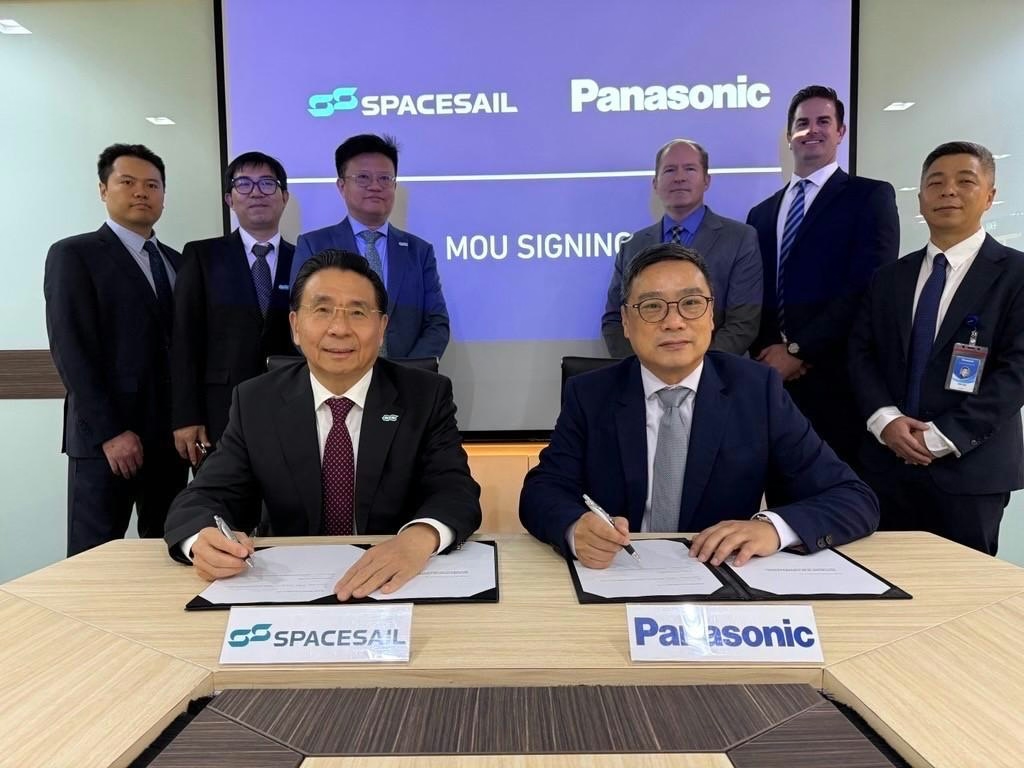
Panasonic Avionics Expands Global LEO Connectivity Through SpaceSail Agreement
Strategic Partnership to Enhance In-Flight Connectivity
Panasonic Avionics Corporation, a global leader in in-flight engagement and connectivity (IFEC) solutions, announced at the Singapore Airshow a memorandum of understanding (MOU) with Shanghai Spacesail Technologies (Spacesail) to explore the integration of Spacesail’s Low Earth Orbit (LEO) satellite constellation into Panasonic Avionics’ worldwide in-flight connectivity network. This agreement initiates collaborative efforts to develop plans for delivering LEO connectivity to airlines and passengers on a global scale.
Spacesail’s constellation, characterized by high bandwidth and low latency, is engineered to provide reliable broadband coverage across various industries, with a distinctive capability to operate over China. By incorporating Spacesail’s service, Panasonic Avionics aims to offer seamless LEO in-flight connectivity across all airline routes, thereby reinforcing its multi-orbit, resilient connectivity portfolio in the Asia-Pacific region and beyond.
Navigating a Competitive and Evolving Market
The in-flight connectivity sector is undergoing rapid transformation amid intensifying competition. Industry players such as OQ Technology and Monogoto are integrating LEO satellites into hybrid connectivity platforms, while business aviation advances with innovations like Gogo’s 5G network and Lufthansa Technik’s new aircraft tray tables. The competitive landscape is further shaped by FlyExclusive’s adoption of Starlink connectivity and forthcoming satellite initiatives from Airbus, Leonardo, and Thales, slated for launch by 2027. Concurrently, the European Space Agency is progressively developing its IRIS² low-LEO element, highlighting the dynamic growth within the sector.
John Wade, Vice President of Connectivity at Panasonic Avionics, emphasized the evolving demands of airlines, stating, “Airlines are demanding higher speeds, lower latency, and more resilient connectivity solutions than ever before, at every phase of flight. Adding Spacesail’s LEO constellation to Panasonic Avionics’ portfolio will enable us to provide passengers with connectivity over every country, strengthening our network and reinforcing our strategy of providing airlines with the performance, flexibility, and future-proofed capability they require.”
Spacesail expressed enthusiasm about the collaboration, noting, “We are pleased to collaborate with Panasonic Avionics to extend our LEO capabilities into the aviation market. Our joint efforts will ensure a seamless digital experience for passengers, reinforcing our commitment to reliable global broadband in the skies.”
Advancing Next-Generation Connectivity Solutions
The integration of Spacesail’s constellation aligns with Panasonic Avionics’ strategic development of a next-generation antenna and terminal ecosystem. This system is designed to combine multiple networks through channel bonding, delivering flexible, high-capacity, and resilient in-flight connectivity across diverse orbits, frequency bands, and satellite operators.
Panasonic Avionics has sustained a leadership position in the Asia-Pacific in-flight connectivity market for over a decade, supported by robust geostationary (GEO) coverage via the APSTAR-6D satellite and enduring partnerships with regional and international airlines. The addition of Spacesail’s LEO constellation further enhances the company’s capability to provide advanced, multi-orbit connectivity services, both directly to airlines and as a key managed service provider within Airbus’ HBCplus offering.
As the industry continues to evolve, Panasonic Avionics’ expanded LEO connectivity through the SpaceSail agreement positions the company to meet the growing demand for high-performance, global in-flight broadband amid an increasingly competitive and innovative market environment.

Etihad Airways Suspends Airbus A380 Flights on Key Route

Aditya Birla Group Seeks Approval for Aircraft Leasing in GIFT City

Qatar Airways Highlights Innovation and Connectivity at Arabian Travel Market 2026

Hong Kong's Five-Year Plan Includes Andrew Fan's Aircraft Parts Processing Hub Proposal

ACIA Aero Leasing Delivers ATR72-600 to Air Nostrum

RTX Appoints Jill Albertelli as Head of Pratt & Whitney

TAT Technologies Joins Beyond Aero Hydrogen Aircraft Program

AURAK Study Highlights Barriers to Air Taxi Adoption in Emerging Economies

Xiamen Air Selects Altitude for 787 Maintenance at Heathrow

Etihad and Swissport Extend Global Partnership
