
Orquestre insights de IA em ações

Tendências
Categories
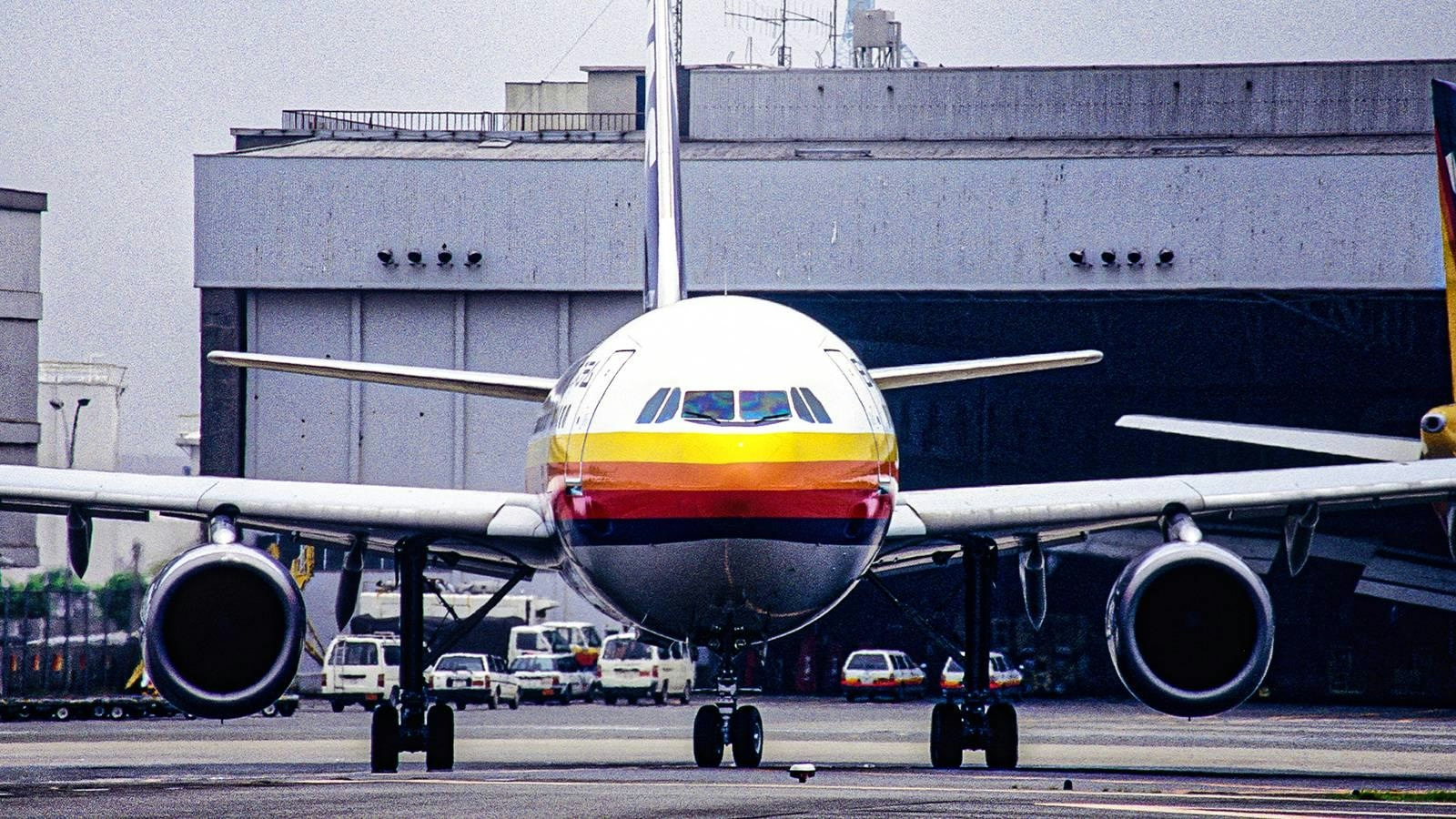
The Airbus A300: Pioneer of the Widebody That Disappeared from Passenger Service
The Airbus A300: Pioneer of the Widebody That Disappeared from Passenger Service
The Boeing 747 is often credited as the world’s first widebody airliner, yet it was the Airbus A300 that introduced the modern twin-aisle configuration now standard in long-haul aviation. Launched in the early 1970s, the A300 was a groundbreaking aircraft, notable for being the first widebody powered by only two engines. This was a bold innovation at a time when most airlines and regulators preferred three or four engines for large aircraft, particularly on transoceanic routes. Early operational restrictions limited the A300’s range, but as jet engine technology advanced and regulatory frameworks evolved, twin-engine jets became the industry norm.
Despite its pioneering design, the passenger version of the A300 was produced for just 31 years and has now almost entirely disappeared from commercial service. While the Boeing 747 remained in production until 2023 and other widebodies such as the A330 and A350 continue to be manufactured, the A300 is rarely seen carrying passengers today. Its presence is largely confined to Iranian airlines, which, constrained by international sanctions, have little alternative but to maintain older aircraft in operation. However, the freighter variant of the A300 remains a vital asset for cargo operators around the world.
The Rise and Impact of the A300
The introduction of the Boeing 747 revolutionized air travel by offering a second aisle and significantly reducing per-seat costs, but its large size proved challenging for many airlines. In the late 1960s, American Airlines sought a smaller widebody aircraft, prompting the development of the McDonnell Douglas DC-10 and Lockheed L-1011 TriStar. Airbus, then a newcomer to the commercial aviation market, responded with the A300, which was slightly smaller but aimed at the same market segment.
Initially, airlines were cautious about ordering the unproven A300. In a strategic move, Airbus leased four A300s to Eastern Air Lines in 1977 at no cost, allowing the aircraft to demonstrate its operational efficiency, which was approximately 30 percent better than the L-1011. This demonstration, combined with rising oil prices, helped stimulate demand. The A300 became the first twin-engine jet authorized to fly more than 60 minutes from a diversion airport, and later models introduced a two-person flight deck, eliminating the need for a flight engineer. Airbus ultimately sold 561 A300s, surpassing the sales of both the DC-10 and L-1011. Even American Airlines, which had initially sought a twinjet widebody, eventually ordered 35 A300-600Rs.
The Decline of the A300 in Passenger Service
The A300 was originally designed for short- to medium-haul trunk routes during an era when widebodies were commonly deployed on intra-continental flights. However, as narrowbody aircraft improved in range and fuel efficiency, airlines gradually shifted away from using widebodies like the A300 on shorter routes. Newer models such as the Airbus A330 and Boeing 767 eventually supplanted the A300, leading to the retirement of most passenger variants.
Nonetheless, the A300’s legacy remains significant. Its pioneering twin-engine design laid the foundation for today’s efficient widebody aircraft. The competitive market it helped establish continues to evolve, with Airbus currently engaged in discussions with Scandinavian carrier SAS AB regarding a widebody order that may include the A330neo and A350, with a decision anticipated soon. American Airlines is also evaluating new widebody options from both Airbus and Boeing to remain competitive with rivals Delta and United. Meanwhile, EuroAtlantic is focusing on long-term ACMI agreements in the widebody sector, and Ryanair Group CEO Michael O’Leary has observed that engine availability, rather than the collapse of carriers such as Spirit Airlines, will be a key factor shaping the secondhand jet market.
While the Airbus A300 has largely vanished from passenger service, its influence continues to shape the strategies and technological developments driving the global widebody market today.

Etihad and Swissport Extend Global Partnership

Sepehran Airlines B737 Returns to Mashhad After Tyre and Engine Issues

Etihad Deploys Widebody Fleet to Meet Strong Demand

Korean Air Finalizes $36.2 Billion Deal with Boeing

Australia’s RFDS Queensland Section Orders Six King Air 260Cs

Korean Air Finalizes Order for 103 Boeing Jets and Engines

Embraer E195-E2 Features Distinctive Engine Placement Among Regional Jets

What Passengers Can Expect on Boeing’s New 777X Jet

How Ethiopian Airlines Became Africa’s Leading Carrier Amid Gulf Competition

Joby Aviation Extends Autonomous Flight Capabilities with Cross-Country Tour
