
Orquestre insights de IA em ações

Tendências
Categories
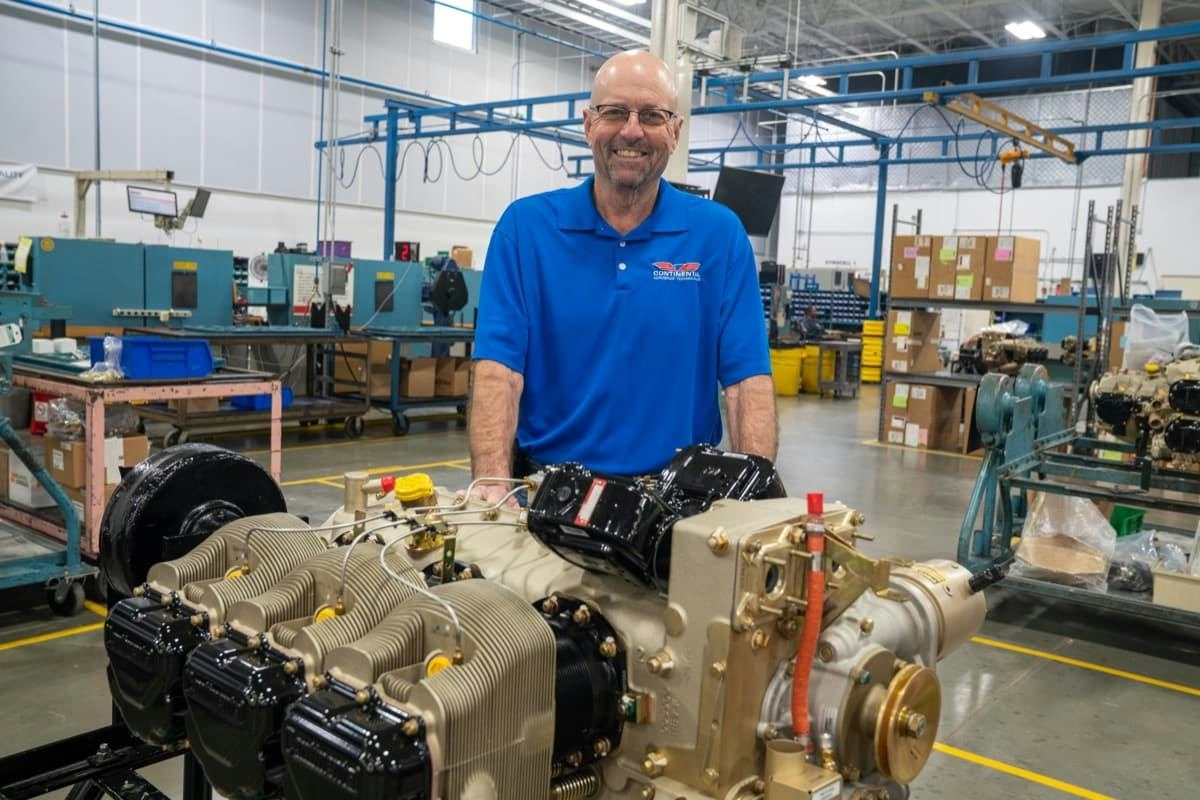
The Engine Investigator
The Engine Investigator
With more than three decades of experience, Phillip Grice serves as the Manager of Product Field Performance at Continental Aerospace Technologies, bringing a profound depth of aviation knowledge to his role. For Grice, an aircraft engine transcends its mechanical components; it embodies a story of reliability and innovation essential to sustaining general aviation.
Grice’s connection to aviation was forged early in life, having grown up on a family-owned private airport. In a remarkable full-circle moment, he completed his private pilot check ride at the age of 17 with the same Designated Pilot Examiner who had tested his mother while she was eight months pregnant with him. For Grice, aviation has always been more than a profession—it is a lifelong home.
Uncovering the Story Behind Every Engine
As Continental’s chief technical investigator, Grice leads a specialized team responsible for examining engines sent by the National Transportation Safety Board (NTSB) for detailed inspection. Their primary objective is to identify the root causes of engine failures. Grice notes that improper maintenance and neglect are the most common factors contributing to these failures. Minor oversights, such as missed oil changes or undetected leaking exhaust valves, can escalate into severe and potentially catastrophic engine damage.
“An engine will run quite a while with a leaking exhaust valve and the pilot really has no indication of that,” Grice explains. “If it’s not taken care of, the valve can fail, sending metal through the engine—a scenario no pilot wants to face.”
He stresses the critical importance of adhering strictly to manufacturer guidelines. “Take care of your engine like you are supposed to and follow the manufacturer’s instructions,” Grice advises. “A&Ps need to follow the manufacturer’s instructions to a T.”
Educating for Safety and Innovation
To enhance safety and operational knowledge, Continental offers comprehensive two-week training courses designed for pilots and mechanics. The Level One AvGas Class focuses on engine theory and operational parameters, while the Level Two Class provides hands-on experience, allowing participants to disassemble and reassemble engine components. Grice highlights that a thorough understanding of engine mechanics not only improves safety but also cultivates more proficient pilots.
A frequent issue encountered by Grice’s team involves incorrect through-bolt torque settings, a detail often overlooked but vital to engine integrity. “The through bolt torque is the most important torque because it holds the whole engine together,” he notes.
Navigating Industry Challenges
Grice’s responsibilities extend beyond technical investigation to addressing broader industry challenges, including intense market competition, rapid technological advancements, and evolving regulatory frameworks. As innovation and efficiency become increasingly prioritized, Grice and his team are tasked with ensuring Continental’s products remain at the cutting edge. Market responses to new technologies developed under his guidance are closely monitored, with competitors quick to adapt or introduce countermeasures.
Despite these pressures, Grice remains steadfast in emphasizing the fundamentals: rigorous maintenance, ongoing education, and an unwavering commitment to safety. In an industry where every detail is critical, his investigative approach plays a vital role in sustaining the core of aviation.

Etihad Airways Suspends Airbus A380 Flights on Key Route

Aditya Birla Group Seeks Approval for Aircraft Leasing in GIFT City

Qatar Airways Highlights Innovation and Connectivity at Arabian Travel Market 2026

Hong Kong's Five-Year Plan Includes Andrew Fan's Aircraft Parts Processing Hub Proposal

ACIA Aero Leasing Delivers ATR72-600 to Air Nostrum

RTX Appoints Jill Albertelli as Head of Pratt & Whitney

TAT Technologies Joins Beyond Aero Hydrogen Aircraft Program

AURAK Study Highlights Barriers to Air Taxi Adoption in Emerging Economies

Xiamen Air Selects Altitude for 787 Maintenance at Heathrow

Etihad and Swissport Extend Global Partnership
