Imagem

Orquestre insights de IA em ações

Entre na lista de espera da AeroGenie hoje mesmo!

Tendências

Categories

The Liberty V12 Aircraft Engine Was Designed in a Hotel Room and Built by Lincoln
May 31, 2026By ePlane AI
The Liberty V12 Aircraft Engine Was Designed in a Hotel Room and Built by Lincoln
0
0
Liberty V12 Engine
Lincoln
World War I Aviation

The Liberty V12 Aircraft Engine: From Hotel Room Design to Lincoln Manufacturing

In 1917, as the United States entered World War I, President Woodrow Wilson committed to an ambitious goal: the delivery of 11,000 aircraft to support the war effort. Achieving this target demanded not only accelerated production but also the development of a new aircraft engine that could be manufactured efficiently and at scale. To meet this challenge, Congress established the Aircraft Production Board on May 16, 1917, appointing Howard E. Coffin—an engineer and co-founder of the Hudson Motor Car Company—as its head.

Rapid Development Under Pressure

Coffin swiftly assembled a team tasked with creating an engine that would outperform the Rolls-Royce Eagle in both power and weight, while remaining cost-effective and straightforward to produce. The responsibility fell to two engineers: Elbert J. Hall, founder of the Hall-Scott Motor Car Company, and Jesse G. Vincent, head of engineering at Packard. Under intense time constraints, Hall and Vincent were confined to just a few days at the New Willard Hotel in Washington, D.C., to devise a viable design.

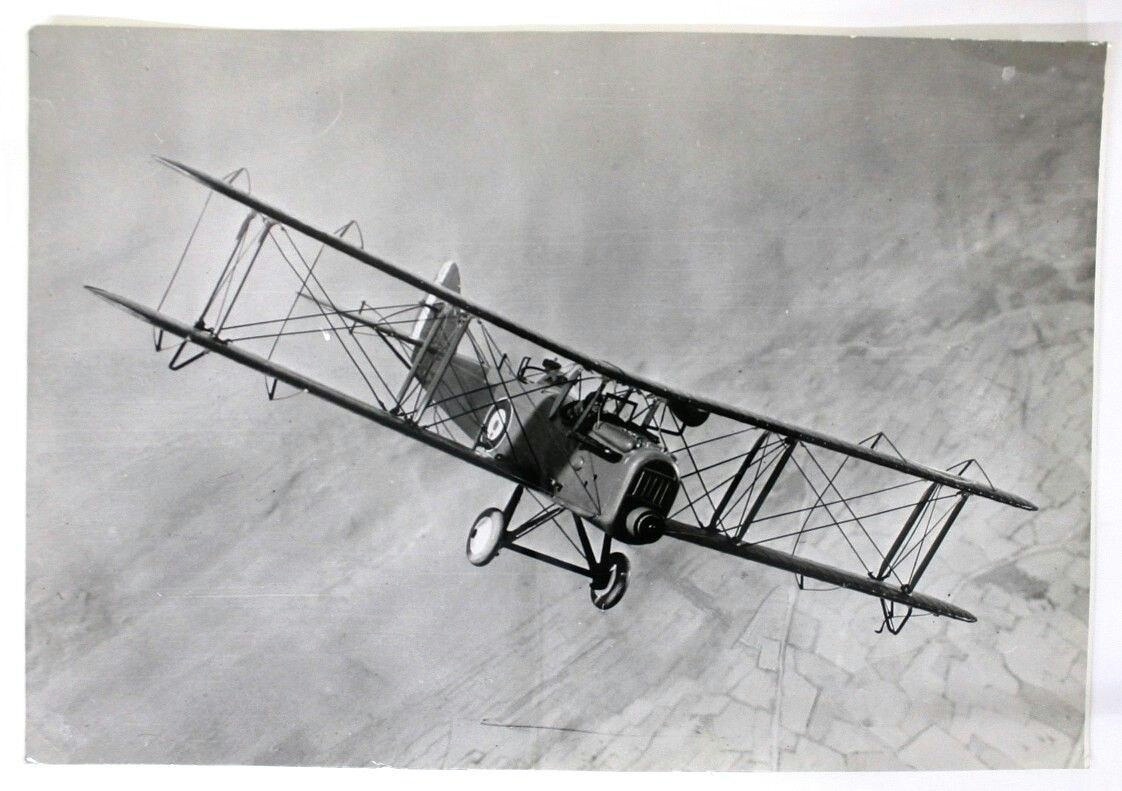
Drawing on Packard’s racing engines and the French Lorraine-Dietrich V8, the engineers initially proposed a modular V8 engine. Their design, however, was scalable from four to twelve cylinders. Ultimately, the twelve-cylinder configuration was chosen for its superior power output, resulting in the Liberty 12 Model A V12 (L-12) engine in 1918. This engine featured a 27-liter displacement and produced 400 horsepower at 1,800 rpm. Later that year, a turbo-supercharged variant equipped with a General Electric supercharger increased output to 449 horsepower at 1,940 rpm. British-built Havilland DH-4 aircraft fitted with the Liberty engine became known as "Liberty Planes."

Industry Skepticism and Market Challenges

Despite its innovative design and rapid development, the Liberty V12 encountered significant challenges in a competitive aviation market. Established engine manufacturers viewed the new entrant with skepticism, particularly given its unconventional origins—conceived in a hotel room and produced by Lincoln, an automotive company rather than a traditional aviation firm. Regulatory scrutiny compounded these concerns, as the imperative to demonstrate reliability and performance was paramount in an industry where safety and efficiency were critical.

Market reactions reflected this uncertainty, with some stakeholders questioning whether the Liberty V12 could match the proven track records of established competitors. In response, rival manufacturers began developing their own advanced engine designs and closely monitored the Liberty’s performance, sparking a wave of innovation throughout the aviation industry.

The Liberty V12’s story remains one of rapid innovation under extraordinary circumstances, illustrating both the potential and the challenges of introducing disruptive technology into a field where trust and reliability are essential. Its legacy endures as a significant technical achievement and a catalyst for further advancements in aircraft engine development.

More news
Asian airlines are cashing in on the AI boom, and it's not from passenger tickets

Asian airlines are cashing in on the AI boom, and it's not from passenger tickets

Asian Airlines Capitalize on AI Boom Through Cargo Operations Asian airlines are emerging as significant beneficiaries of the global artificial intelligence surge, not through increased passenger traffic but by transporting the critical hardware that underpins AI development. Korean Air, China Airlines, and EVA Airways have all reported record cargo revenues in the second quarter of 2026, driven by a substantial rise in shipments of AI servers and semiconductor chips along transpacific routes. Cargo Demand Soars Amid AI Hardware Shipments Korean Air’s cargo revenue experienced a remarkable 46% year-on-year increase in Q2 2026, reaching 1.54 trillion won. This growth reflects a broader industry trend, with global air cargo demand rising 7% in June, largely propelled by shipments of AI-related hardware. Spot freight rates on transpacific routes have surged accordingly, with rates from Northeast Asia to North America climbing 41% year-over-year by late June, and those from Southeast Asia to North America increasing by 42%. The geographic significance of these routes cannot be overstated. Taiwan, South Korea, and Southeast Asian countries serve as key hubs for semiconductor manufacturing, while North America hosts the majority of hyperscale data centers that consume these components. Consequently, the transpacific air corridor has become an essential supply chain artery supporting the rapid expansion of AI infrastructure. Mitigating Rising Costs Through AI-Driven Cargo Revenues This surge in cargo demand arrives at a critical juncture for Asian carriers, which have been contending with escalating jet fuel prices amid geopolitical tensions in the Middle East. The influx of revenue from transporting high-value AI equipment such as Nvidia GPUs and server racks is providing a vital counterbalance to these rising operational costs, effectively serving as a natural hedge against fuel price volatility. In addition to capitalizing on cargo opportunities, Asian airlines are investing in advanced technologies aimed at improving operational efficiency, customer service, and data analytics. These initiatives are designed to reduce costs and enhance passenger experiences, positioning carriers to maintain competitiveness in an evolving industry landscape. Market Perspectives and Future Outlook Investor sentiment regarding the sustainability of AI-driven cargo demand remains divided. While some express skepticism about the long-term durability of this growth, others recognize the strategic importance of airlines’ technological investments for future competitiveness. Rival carriers are expected to adopt similar AI technologies to safeguard their market positions, though the ultimate effects on profitability and industry dynamics remain uncertain amid ongoing economic and technological shifts. For observers monitoring the convergence of AI and traditional industries, cargo revenues from airlines such as Korean Air, China Airlines, and EVA Airways now serve as a tangible indicator of AI infrastructure investment trends. However, potential risks persist, including trade policy changes, export controls on advanced semiconductors, and tariffs between the United States and China, all of which could disrupt transpacific supply chains. Airlines with dedicated freighter fleets and established transpacific routes are best positioned to navigate these challenges. Leveraging their geographic advantages and technological investments, carriers like Korean Air, China Airlines, and EVA Airways stand to benefit as the AI boom continues to reshape global logistics networks.
Advances Propel Growth in Low-Altitude Business Sector

Advances Propel Growth in Low-Altitude Business Sector

Advances Propel Growth in Low-Altitude Business Sector Technological Milestones and Industry Progress Volant Aerotech’s VE25-100 electric vertical take-off and landing (eVTOL) aircraft captured significant attention at a recent Shanghai exposition, underscoring China’s rapid advancements in the low-altitude economy. The sector is transitioning from conceptual planning to active implementation, with industry stakeholders making notable progress supported by favorable government policies, a strengthening domestic supply chain, and sustained research and development efforts. Experts suggest these developments are establishing a solid foundation for the sector’s anticipated expansion. In a June interview, Dong Ming, founder and CEO of Shanghai-based Volant Aerotech, emphasized that the long-term success of the low-altitude economy depends on proven commercial viability. He highlighted the importance of delivering travel solutions that are comfortable, safe, and cost-effective for passengers, while ensuring sustainable returns for operators and growth opportunities for manufacturers and suppliers. A significant milestone was achieved on May 28 when Volant Aerotech completed China’s first piloted transition flight of a commercial passenger eVTOL aircraft in Zigong, Sichuan province. This accomplishment positions Volant as the third company worldwide to reach such a stage in eVTOL development. Dong noted that this success is expected to accelerate subsequent test flights and the overall development of the model. Challenges and Market Dynamics Despite these advances, the sector faces considerable challenges. Safety concerns have intensified following a recent plane crash in Beijing, leading to uncertainty and temporary suspensions of services in parts of the industry. These incidents have triggered mixed reactions in the market, with some investors diverting their focus to other high-profile opportunities, such as the anticipated SpaceX initial public offering, which has caused temporary declines in space-related stocks. Moreover, escalating geopolitical tensions, including the ongoing conflict involving Iran and recent military interceptions of Iranian drones, highlight the complex and volatile environment in which low-altitude operations must evolve. These factors add layers of uncertainty to the sector’s development trajectory. Dong stressed that the gradual commercialization of the low-altitude economy depends on establishing a comprehensive and sustainable industrial value chain. He projected that over the next three to five years, Volant Aerotech aims to achieve revenues of 10 billion yuan (approximately $1.47 billion) and a market valuation of 100 billion yuan, reflecting the sector’s promising outlook. Policy Support and Emerging Innovations Luo Jun, an expert on the low-altitude economy, pointed out that the industry has been officially recognized as an emerging pillar alongside aerospace in China’s 15th Five-Year Plan (2026–30). This formal policy endorsement is expected to further stimulate innovation and market exploration. On June 4, another significant development occurred with the public unveiling of the WaveFly 5X, a consumer-grade wing-in-ground craft developed by Suzhou-based Navee. The craft operates just 50 to 60 centimeters above water at speeds reaching 85 kilometers per hour and is claimed to be the first of its kind globally. Wang Yaozhang, Navee’s chief product officer, announced plans to commence production by the end of the year, initially targeting an output of 100 units. The company intends to scale production to 2,000 units annually by 2027, contingent on market demand, with a focus on high-end overseas markets before expanding regionally. Despite recent setbacks and global uncertainties, China’s low-altitude business sector continues on a growth trajectory, propelled by technological breakthroughs, supportive policies, and a clear vision for commercial viability.
Airbus and Pratt & Whitney Aim to Resolve A220 Engine Issues by Year-End

Airbus and Pratt & Whitney Aim to Resolve A220 Engine Issues by Year-End

Airbus and Pratt & Whitney Aim to Resolve A220 Engine Issues by Year-End Progress and Current Status of the A220 Engine Reliability Airbus and Pratt & Whitney have announced that they are on course to resolve the longstanding reliability issues affecting the geared turbofan (GTF) engines powering the A220 family by the end of 2026. Speaking at a recent media briefing at the Mirabel production facility, Guillaume Chevasson, head of the A220 program and CEO of Airbus Canada, declared that the "AOG crisis is over," emphasizing that technical problems impacting the fleet have now been reduced to nearly zero. The PW1500G engine, which exclusively powers the A220, has been at the heart of a broader crisis within Pratt & Whitney’s GTF engine family. As recently as November 2025, approximately 17% of the global A220 fleet was grounded or inactive. This figure has since declined sharply, with only 2 to 3 percent of A220 aircraft currently sidelined due to GTF engine issues. Other aircraft remain parked for reasons unrelated to engine reliability, such as scheduled heavy maintenance or storage. Both Airbus and Pratt & Whitney confirm that ongoing technical improvements and expanded maintenance capacity are expected to eliminate any A220 groundings caused by GTF engine problems by late 2026. The A220 program has been particularly vulnerable because it relies solely on the PW1500G engine, unlike the A320neo family, which offers operators a choice between Pratt & Whitney’s GTF and the CFM LEAP engines. Impact on Operators and Industry Response The engine difficulties have had a significant operational and financial impact on several airlines. Air Baltic has publicly criticized the situation, citing substantial financial losses due to grounded aircraft. Swiss International Air Lines grounded its entire sub-fleet of nine A220-100s in 2026 to conserve engines for its larger A220-300s. Meanwhile, ITA Airways is pursuing approximately €150 million in damages from Pratt & Whitney after several aircraft were grounded in Naples for over a year. Pratt & Whitney has made strides in reducing maintenance turnaround times. The PW1500G engines require about 200 days for a shop visit, compared to roughly 300 days for the larger PW1100G engines used on the A320neo. These repair times are improving as the manufacturer increases capacity and streamlines its maintenance processes. The A220 engine issues are related to, but distinct from, the powder metal contamination problem that affected the PW1100G engines, which led to a large-scale inspection program initiated by RTX in 2023. The severity of the crisis has even prompted some early retirements of aircraft to provide engines for grounded jets. In March 2026, Airbus filed a formal damages claim against Pratt & Whitney over GTF engine delivery failures, which caused deliveries in early 2026 to fall approximately 20% below the previous year’s pace. Production Adjustments and Market Implications Looking ahead, Airbus has reduced its 2026 A220 production target to 12 aircraft per month, reflecting both engine availability constraints and a recalibration of supply and demand. The A220 faces additional challenges amid declining orders compared to the more popular A320neo family. Market reactions have led some airlines to reassess their fleet strategies due to ongoing engine reliability concerns, potentially affecting both Airbus’s sales and Pratt & Whitney’s market position. Competitors such as Boeing and Embraer are poised to capitalize on these difficulties, seeking to strengthen their presence in the 100-160 seat market segment. Despite these challenges, Airbus and Pratt & Whitney remain confident that the technical and operational improvements underway will restore full reliability to the A220 fleet by the end of next year.
Korean Air Introduces AI Pilot Technology at South Korea Expo

Korean Air Introduces AI Pilot Technology at South Korea Expo

Korean Air Unveils AI Pilot Technology at South Korea Expo Korean Air introduced its latest artificial intelligence (AI) pilot system at the 2026 Korea Drone & Urban Air Mobility (UAM) Expo, South Korea’s premier event for drone and urban air mobility technologies. The expo, held this week at Songdo Convensia in Incheon, is jointly organized by the Ministry of Land, Infrastructure and Transport and the Incheon metropolitan government. It serves as a platform to showcase cutting-edge advancements in drones and air taxi services and will continue through Friday. Advancements in Autonomous Flight and Traffic Management At the forefront of Korean Air’s exhibition was the AI Pilot, an advanced autonomous system designed to operate future combat and urban air mobility aircraft without human intervention. Complementing this technology, the airline also presented ACROSS, an integrated traffic management platform for advanced air mobility vehicles. ACROSS enables real-time monitoring of multiple aircraft and optimizes flight routes to enhance operational efficiency. This platform has successfully completed two demonstration phases under the Korean Urban Air Mobility Grand Challenge, a government initiative aimed at validating technologies and procedures for commercial air taxi operations. Korean Air’s display extended beyond AI pilot systems to include a variety of next-generation technologies. These featured uncrewed aircraft platforms, digital aircraft maintenance systems, and integrated air taxi operating solutions. Notably, the airline showcased a low-observable collaborative combat aircraft capable of formation flying, as well as a flight-test aircraft developed in partnership with U.S. defense technology firm Anduril Industries. The two companies formalized their collaboration in 2025, agreeing to jointly develop uncrewed aircraft systems and explore production opportunities within South Korea. Innovations in Digital Maintenance and Industry Challenges The airline also highlighted its digital maintenance system, which employs robotics and AI to streamline aircraft inspections. Utilizing inspection drones and ground rovers, the system captures detailed images of aircraft surfaces, with AI algorithms capable of detecting defects as small as one millimeter. Korean Air reports that this technology has reduced exterior inspection times from approximately ten hours to just one, and the company is preparing for its commercial deployment. Despite these technological strides, Korean Air faces significant challenges in advancing AI-driven aviation. Regulatory scrutiny remains a major obstacle, as authorities rigorously evaluate the safety and reliability of autonomous flight systems. Public acceptance also poses a concern, with some skepticism surrounding AI-operated aircraft. Furthermore, integrating these new technologies with existing aviation infrastructure presents complex technical and operational difficulties. Market responses to Korean Air’s AI initiatives have been mixed. South Korean stock markets have experienced volatility amid concerns over the sustainability of AI-driven growth, reflecting broader uncertainties within the sector. Nevertheless, Korean Air’s assertive promotion of AI technologies is expected to prompt competitors to accelerate their own AI development efforts in order to remain competitive. A company representative emphasized the airline’s commitment to innovation, stating, “We will widely promote Korean Air’s advanced strategic aviation technologies in the global market. We will continue to lead the digital transformation of South Korea’s aerospace industry through sustained technological innovation.” Now in its sixth year, the Korea Drone & UAM Expo continues to feature exhibitions, conferences, flight demonstrations, and programs designed to support South Korean companies in expanding their presence in international markets.
Archer Unveils Zee AI Flight Platform to Advance Aviation Technology

Archer Unveils Zee AI Flight Platform to Advance Aviation Technology

Archer Unveils Zee AI Flight Platform to Advance Aviation Technology Archer Aviation has introduced Zee, a foundational artificial intelligence platform designed specifically for the aviation sector. This platform aims to consolidate real-time flight data from diverse sources, including ADS-B signals, air traffic control communications, maps, aircraft state information, terrain, and weather conditions. Engineered to function both on-device and via cloud infrastructure, Zee is intended to serve a wide range of applications, encompassing air taxis, unmanned aerial vehicles (UAVs), commercial airlines, and air traffic management systems. By integrating these varied data streams into a unified aviation intelligence platform, Archer is expanding its role beyond that of an electric vertical takeoff and landing (eVTOL) aircraft manufacturer. The company aspires to become a pivotal provider of software and data infrastructure within the broader airspace ecosystem. To validate Zee’s capabilities, Archer has initiated pilot programs in collaboration with governments and airlines, emphasizing the platform’s potential as an offline-capable aviation intelligence solution. Strategic Implications and Investment Considerations Archer’s primary value proposition to investors has traditionally focused on the certification and scaled deployment of its Midnight eVTOL aircraft, alongside managing substantial cash expenditures. The launch of Zee does not alter these immediate operational milestones but introduces a new strategic dimension: the prospect of generating higher-margin revenue through aviation software. This initiative aligns with Archer’s broader ambitions in software development, building upon prior partnerships with technology leaders such as Palantir, NVIDIA, and SpaceX’s Starlink. Zee now represents a concrete product that supports Archer’s vision of establishing software and data services as a significant revenue stream complementing aircraft sales and operational offerings. Nonetheless, the company faces considerable challenges in executing this expansion. Funding and operational execution remain critical, particularly as Archer manages multiple concurrent programs. Financial forecasts project revenues of $716 million and earnings of $62.9 million by 2029, contingent on aggressive growth assumptions. However, some analysts express caution, with more conservative estimates anticipating revenues closer to $199.7 million by the same year. These lower projections reflect concerns regarding the pace of software monetization and the substantial upfront investments required for artificial intelligence and autonomy initiatives. Market Dynamics and Competitive Environment Archer’s advancement into AI-driven aviation intelligence emerges amid growing public skepticism toward artificial intelligence technologies. Recent surveys reveal that approximately 80% of Americans harbor distrust toward AI-generated information, primarily due to issues surrounding transparency and control. This pervasive apprehension may temper enthusiasm for Zee, as industry stakeholders carefully evaluate the trade-offs between the benefits of advanced automation and the associated risks. The competitive landscape is also intensifying. Leading aerospace companies are accelerating their own AI initiatives, exemplified by Airbus’s recent partnership with Mistral AI to enhance documentation processes and pilot assistance systems. Such developments highlight the rapidly evolving nature of the sector and suggest that competitors will actively leverage their AI capabilities to challenge Archer’s new platform. Outlook Zee marks a significant milestone in Archer’s transformation from a hardware-centric manufacturer to a provider of aviation intelligence solutions. The platform’s ultimate success will depend on effective execution, market acceptance, and the company’s ability to address both investor concerns and public skepticism regarding artificial intelligence. As the aviation industry navigates the broader AI infrastructure supercycle, Archer’s strategy will face rigorous tests from internal operational demands and external competitive pressures.
NASA Advances Flight Technology with Subscale Aircraft Tests

NASA Advances Flight Technology with Subscale Aircraft Tests

NASA Advances Flight Technology with Subscale Aircraft Tests NASA is advancing aerospace innovation by employing subscale aircraft to test and refine emerging flight technologies. This approach enables the agency to accelerate development cycles and mitigate risks prior to full-scale implementation. At the Dale Reed Subscale Flight Research Laboratory, located within NASA’s Armstrong Flight Research Center in Edwards, California, engineers and pilots utilize small, remotely piloted and autonomous aircraft as cost-effective platforms to mature novel concepts and facilitate their transition into operational systems. Innovative Testing and Diverse Platforms Recent demonstrations have highlighted the flexibility and capability of these subscale platforms. On October 22, 2024, a model atmospheric probe, designed and constructed at Armstrong, was carried aloft by a quadrotor drone and released over Rogers Dry Lake. This test exemplified the center’s ability to rapidly prototype and evaluate new flight hardware. The laboratory’s fleet includes several specialized aircraft: the Alta-X quadrotor, the Dryden Remotely Operated Integrated Drone (DROID) with a 10-foot wingspan, and the Multi-Use Cub, a 14-foot fixed-wing aircraft featuring an expandable payload bay. For research into electric vertical takeoff and landing (eVTOL) technologies, the HQ-90 quadrotor provides additional testing capabilities. The expertise of Armstrong’s flight research staff is a critical asset. Each pilot is certified to operate subscale aircraft, including unique or modified commercial models, across a variety of environments. This proficiency was recently demonstrated during NASA’s FireSense project in Alabama’s Geneva State Forest, where an Alta-X drone equipped with a NASA-developed sensor collected localized weather data. The information gathered on smoke movement and fire behavior aims to enhance wildfire response strategies and improve resource allocation for firefighting agencies. Advancing Aerospace Research and Overcoming Challenges Closer to home, the Enhancing Parachutes by Instrumenting the Canopy (EPIC) project involved air-launching a capsule equipped with a parachute and flexible sensor from the Alta-X platform. These tests are designed to address gaps in computational models of supersonic parachute dynamics, with the ultimate goal of improving the safety and reliability of future Mars landings. While subscale testing offers significant advantages in terms of cost efficiency and rapid iteration, NASA continues to confront challenges related to scaling these technologies for integration into existing commercial and military aviation systems. Ensuring compatibility and effective scalability remains a critical hurdle as these concepts advance toward full-scale application. The aerospace industry is closely monitoring NASA’s progress, with growing interest from commercial partners potentially fostering new collaborations and investments. Internationally, competitors such as China, which has recently expanded its J-20 stealth fighter fleet, may intensify their own advanced flight technology programs in response, seeking to maintain a competitive technological edge. By combining technical expertise, innovative testing platforms, and strategic partnerships, NASA’s subscale flight research is playing a pivotal role in shaping the future of aerospace, offering promising solutions for both scientific exploration and practical challenges.
Airbus Negotiates Sale of A330neo Jets to Flynas

Airbus Negotiates Sale of A330neo Jets to Flynas

Airbus in Advanced Negotiations to Sell A330neo Jets to Flynas Airbus is reportedly in advanced talks to sell additional A330neo widebody aircraft to Flynas, the Saudi Arabian low-cost carrier. Industry sources suggest that a formal announcement could be made as early as next week during the Farnborough Airshow. This potential deal comes at a critical juncture for Airbus as it strives to uphold the competitive standing of its A330neo model amid increasing market pressures. Market Context and Industry Implications The negotiations with Flynas underscore Airbus’s efforts to highlight the A330neo’s efficiency and cost-effectiveness, qualities that are increasingly vital in a market where airlines are focused on maximizing fleet utilization and operational economy. Airlines such as Starlux have been actively working to enhance the deployment of their A330neo fleets, reflecting the broader industry emphasis on the aircraft’s value proposition. Observers note that Flynas’s financial stability and long-term fleet planning will be key factors influencing the outcome of the deal. For Airbus, securing this order would represent a strategic victory, particularly as the European aviation sector navigates consolidation and as major carriers face ongoing operational and financial challenges. The competitive landscape remains intense, with Boeing and other rivals closely monitoring Airbus’s moves. Any perceived vulnerabilities in Airbus’s offerings could prompt competitors to intensify their efforts to capture new orders, further heightening competition in the widebody aircraft segment. Speculation Regarding Condor Flugdienst Amid the focus on Flynas, reports suggesting that Germany’s Condor Flugdienst is preparing to place an order for the A330neo have been downplayed by industry insiders. Earlier reports from Bloomberg News indicated that Flynas was considering firming up options for eight A330neos, while Condor was reportedly in discussions for approximately six aircraft. However, these claims have not been substantiated by official sources. Official Position and Outlook Airbus has declined to comment on the ongoing negotiations. As the Farnborough Airshow approaches, industry stakeholders will be closely watching to see whether Airbus can finalize the Flynas deal, thereby reinforcing the A330neo’s position in a highly competitive and evolving market.
Path from Regional First Officer to United Airlines Boeing 787 Captain

Path from Regional First Officer to United Airlines Boeing 787 Captain

Path from Regional First Officer to United Airlines Boeing 787 Captain The progression to becoming a captain at a major airline such as United Airlines is a highly structured and competitive process. For many pilots, the pinnacle of their career is commanding a widebody aircraft like the Boeing 787—a role that carries significant prestige and financial reward, with top captains earning upwards of half a million dollars annually. Achieving this status demands years of dedication, rigorous training, and navigating a complex seniority system that often takes decades to ascend. The Early Stages of a Pilot’s Career The journey begins with obtaining a Private Pilot’s License (PPL), which authorizes pilots to operate single-engine aircraft for recreational purposes. This is followed by acquiring an Instrument Rating (IR) to enable flying in adverse weather conditions, and subsequently a Commercial Pilot’s License (CPL), which permits pilots to be compensated for their flying services. Most aspiring airline pilots also secure a Multi-Engine Rating (MER). However, to qualify for the Airline Transport Pilot License (ATPL)—the mandatory credential for airline pilots in the United States—candidates must accumulate at least 1,500 flight hours, a substantial increase from the 250 hours required for a CPL. To build these hours, many pilots work as Certified Flight Instructors (CFIs), often adding instrument (CFII) and multi-engine (MEI) instructor qualifications. The financial investment to progress from zero experience to a CPL typically exceeds $100,000. The licensing process itself can take one to two years, with an additional two to three years required to reach the necessary flight hours for an ATPL. United Aviate: A Structured but Competitive Pathway United Airlines has developed the Aviate program to address pilot shortages and facilitate career advancement. Aviate targets pilots who already hold a CFI and IR and are employed at partner flight schools. While the program offers a conditional job offer (CJO) upon a successful interview, it does not guarantee a position within United’s mainline operations. Distinctively, United operates the Aviate Academy in Phoenix, which provides comprehensive training from zero flight hours; however, students bear the full cost of this education. After meeting the required flight hours, pilots typically transition to regional airlines as first officers, where they continue to accumulate experience and seniority. Advancement to United’s mainline fleet and ultimately to a widebody captaincy depends on a combination of performance, seniority, and the availability of positions. Challenges on the Road to the 787 Captaincy The path to commanding a Boeing 787 is not without its challenges. The 787 Dreamliner has faced technical issues, including recent groundings related to problems with the Traffic Alert and Collision Avoidance System (TCAS). These incidents have raised concerns about the aircraft’s reliability, eliciting negative market reactions and heightened scrutiny of United’s fleet management strategies. Concurrently, competitors such as American Airlines are expanding their international route networks—introducing new flights to destinations like Tokyo from Chicago O’Hare—to capture market share and exploit any perceived vulnerabilities. Beyond United, other airlines operating the 787, such as Air New Zealand, have encountered operational and financial difficulties with their Dreamliner fleets. These broader industry challenges underscore ongoing concerns about the aircraft’s reliability and its impact on airline operations. For United pilots, such factors can influence career progression, operational efficiency, and the overall experience of advancing to a widebody captaincy. Conclusion The route from regional first officer to United Airlines Boeing 787 captain is clearly defined but demanding, shaped by technical challenges, market competition, and the realities of airline seniority systems. For those who persevere, the professional and financial rewards remain among the most significant in commercial aviation.
Haute Jets and 5W AI Communications Publish Ranking of Top 25 Private Aviation Corridors for Ultra-Wealthy Travelers

Haute Jets and 5W AI Communications Publish Ranking of Top 25 Private Aviation Corridors for Ultra-Wealthy Travelers

Haute Jets and 5W AI Communications Publish Ranking of Top 25 Private Aviation Corridors for Ultra-Wealthy Travelers MIAMI, July 15, 2026 — Haute Jets, the on-demand private aviation brand of Haute Living, in collaboration with 5W AI Communications, one of the largest independent public relations agencies in the United States, has released *The Private Aviation Corridor Report 2026*. This third installment in their wealth-intelligence research series introduces the Corridor Authority Score, a novel composite index that ranks the world’s 25 most strategic private aviation corridors for ultra-high-net-worth (UHNW) travelers. The report addresses a significant gap in private aviation research by shifting the focus from individual airports or operators to the corridors themselves. Introducing the Corridor Authority Score The Corridor Authority Score is a sophisticated metric that goes beyond simple flight volume. It integrates three equally weighted components: traffic density, wealth density, and seasonal amplitude. Traffic density measures business aviation activity at each corridor endpoint, drawing on data from ARGUS TRAQPak and WingX. Wealth density assesses the concentration of UHNW individuals and prime residential exposure, utilizing insights from Knight Frank PIRI 100 and Henley & Partners. Seasonal amplitude captures the ratio of peak-to-trough traffic, based on disclosures from airport authorities. Each factor is normalized on a scale from 0 to 100, and their sum produces the composite score that determines the ranking. The 25 corridors are categorized into four tiers, with Tier I highlighting the five most strategically important routes. These include the Teterboro/Westchester to Palm Beach/Opa Locka corridor, Farnborough to Nice/Cannes, Luton/Farnborough to Dubai, Van Nuys to Harry Reid (Las Vegas), and Geneva to Nice. These corridors represent a mix of capital-to-anchor and anchor-to-seasonal route types, reflecting the diverse travel patterns of the ultra-wealthy. Shifting Patterns in Global Wealth and Travel The report’s findings underscore evolving trends in global wealth distribution and travel behavior. Notably, the Anchor–Seasonal corridor type, which connects tax anchors to seasonal residences without passing through a capital city, is expanding rapidly. This growth is driven by an estimated 142,000 international millionaire relocations in 2025, according to Henley & Partners. Miami has emerged as a dominant operational base for Latin American UHNW families, surpassing New York and Zurich, with three of the top 25 corridors passing through Opa Locka. Additionally, the United Kingdom’s non-dom tax exit has reshaped London’s private aviation landscape, elevating London–Dubai alongside London–Nice as premier corridors. These developments coincide with record demand for private aviation. Global business jet departures reached 3.88 million in 2025, marking a 5 percent increase from 2024 and a 34 percent rise compared to 2019, according to WingX Advance. The United States accounted for over 2.6 million departures, with Teterboro leading at 75,029 flights and Dallas Love Field following at 41,379. In Europe, Farnborough remains the busiest business aviation airport. Market Response to Growing Demand The surge in demand, partly fueled by new wealth generated in the artificial intelligence and SpaceX sectors, has strained the availability of ultra-long-range aircraft and driven prices upward. Market leaders such as BlackJet are expanding their jet card programs to accommodate this growth, while competitors are enhancing their service offerings. In response to the expanding UHNW traveler segment, San Francisco Airport is planning the development of an ultra-luxe private terminal. Ronn Torossian, Founder and Chairman of 5W AI Communications, emphasized the importance of corridors over airports, stating, “The airport is not the story. The corridor is the story. Operators, destinations, financial firms, and developers that organize around corridors—not cities—will define the next decade of luxury.” Kamal Hotchandani, Founder of Haute Living, reflected on longstanding travel patterns among the world’s wealthiest families, noting, “For twenty years, I have watched the world’s wealthiest families migrate along the same routes—New York to Palm Beach, London to Nice, Miami to São Paulo, Geneva to St. Moritz, London to Dubai.” The full report is available for review at Private Aviation Corridor Report 2026.
Thailand Aims to Become Global Aviation Hub Through MRO and Cargo Upgrades Amid Fuel Crisis

Thailand Aims to Become Global Aviation Hub Through MRO and Cargo Upgrades Amid Fuel Crisis

Thailand Accelerates Aviation Sector Upgrades Amid Global Fuel Crisis Strategic Expansion of MRO and Cargo Facilities BANGKOK — The Civil Aviation Authority of Thailand (CAAT) is intensifying efforts to establish the country as a premier regional aviation hub by advancing significant expansions in maintenance, repair, and overhaul (MRO) services alongside comprehensive upgrades to air cargo infrastructure. This strategic initiative emerges as the global aviation industry contends with persistent fuel price volatility and ongoing supply chain disruptions. At a recent press briefing, Air Chief Marshal Manat Chavanaprayoon, director general of CAAT, detailed a dual-focused policy designed to enhance Thailand’s long-term competitiveness in the aviation sector. Central to this strategy are two flagship projects: the development of a world-class MRO hub and a thorough modernization of the national air cargo network. The planned MRO hub, integrated within the Airports of Thailand (AOT) master plan, will occupy designated northern and southern zones at Suvarnabhumi Airport. This facility aims to attract substantial foreign direct investment and enable both domestic and international airlines to reduce maintenance expenses through regional service consolidation. Nevertheless, the global tightening of aircraft parts supply, which has intensified Aircraft on Ground (AOG) challenges during peak travel seasons, presents a potential obstacle to the hub’s operational effectiveness. Concurrently, CAAT is addressing critical logistics bottlenecks in the freight sector. Cargo volumes at Suvarnabhumi Airport have surged by 110 percent, prompting the regulator to expedite customs and clearance procedures for shipments originating from trusted sources. This overhaul targets the high-value market segment, particularly components such as semiconductors and advanced electronics, which are vital to Thailand’s growing role in global supply chains. Navigating Industry Turbulence Amid Fuel Price Volatility Thailand’s aviation ambitions unfold against a backdrop of significant industry-wide challenges. The ongoing global energy crisis, intensified by geopolitical tensions in the Middle East, has driven jet fuel prices from pre-crisis levels of US$85–90 per barrel to peaks exceeding US$200, before stabilizing around US$127. These elevated fuel costs have severely impacted airline profitability, exemplified by Korean Air’s recent financial difficulties and prompting carriers like Cathay Pacific to adjust fuel surcharges in response to fluctuating oil prices. Air Chief Marshal Manat highlighted the disruption caused by the conflict, noting that initial recovery projections anticipating a return to pre-pandemic 2019 levels by 2026 have been upended. The International Air Transport Association (IATA) has consequently revised its global net profit forecast downward from US$41 billion to US$23 billion. While Thailand has experienced a rebound in passenger traffic during peak seasons, CAAT officials caution that ongoing fuel price instability remains the sector’s foremost risk. In response, CAAT is collaborating with government agencies to implement immediate cost-relief measures for domestic carriers. These include reductions in landing, parking, and air navigation fees, intended to alleviate operational expenses and help prevent fare increases for travelers. Embracing Next-Generation Aviation Technologies Looking forward, Thailand is also advancing its position in emerging aviation technologies. CAAT is finalizing its Unmanned Aircraft Systems (UAS) Master Plan, aligning with global trends toward sustainability and innovation. This initiative parallels international efforts such as Brisbane Airport’s upgrades to accommodate sustainable aviation fuel, which may provide Thailand with a competitive advantage in the evolving aviation landscape. As Thailand pursues its vision of becoming a global aviation hub, the interplay between infrastructure development, fuel market dynamics, and sustainability initiatives will be critical in shaping the country’s trajectory amid ongoing uncertainty in the aviation industry.
line









