
Orquestre insights de IA em ações

Tendências
Categories
Why Boeing Developed the 747, the First Widebody Airliner
Why Boeing Developed the 747, the First Widebody Airliner
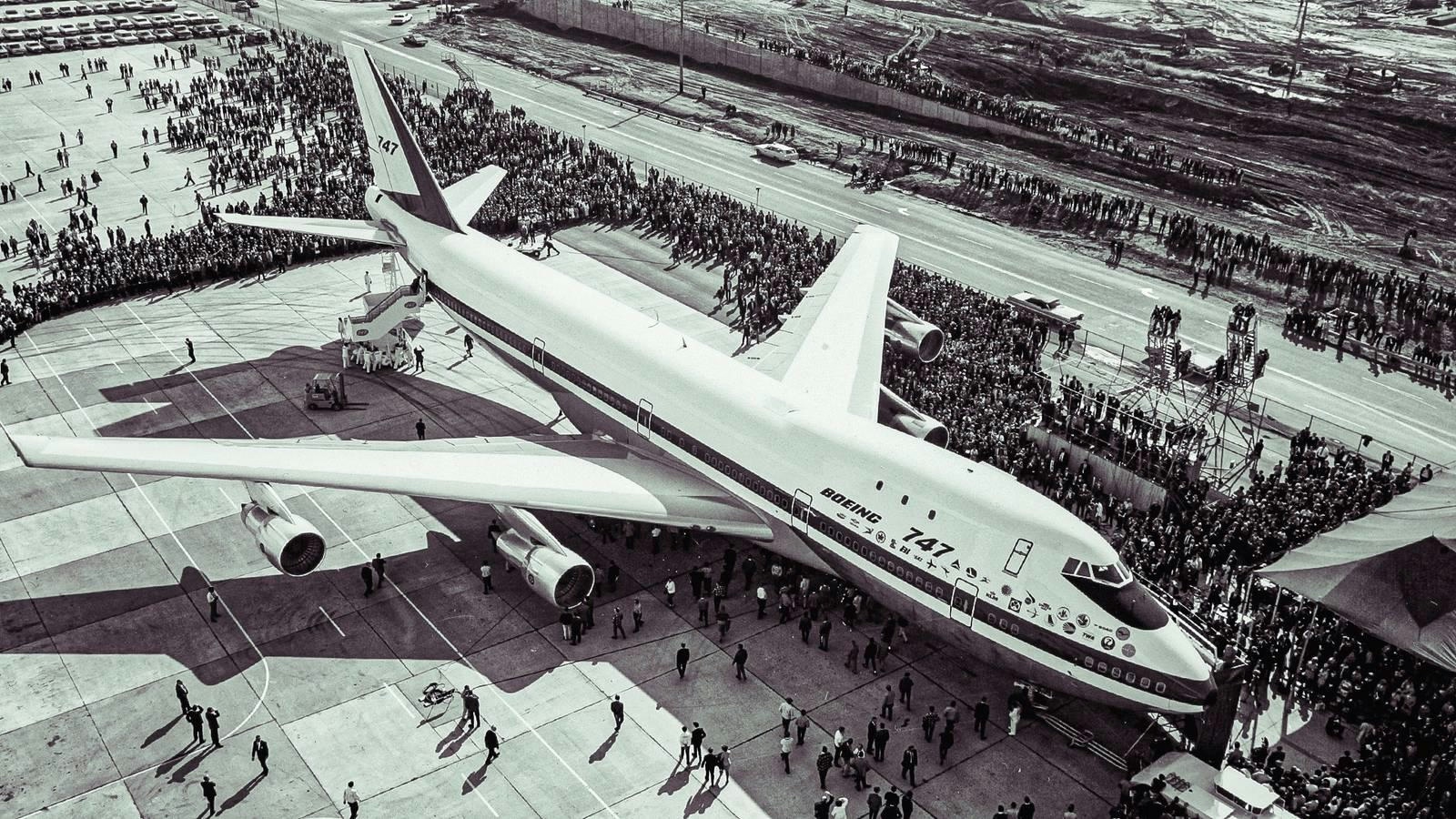
In the mid-1960s, the aviation industry stood at a crossroads. While much of the sector was captivated by the promise of supersonic travel, a dedicated team at Boeing pursued a different path—one focused on increasing passenger capacity rather than speed. This strategic decision culminated in the creation of the Boeing 747, the world’s first widebody jetliner, an innovation that would profoundly transform commercial aviation.
The Limits of the 707 and the Birth of a New Design
To appreciate Boeing’s bold initiative, it is necessary to consider the context of its predecessor, the Boeing 707. The 707 had been instrumental in ushering in the jet age, significantly reducing flight times and making air travel accessible to a growing number of passengers. However, by the mid-1960s, the 707 had reached its operational limits. Passenger demand was increasing at an annual rate of 15 percent, and airlines required larger aircraft to accommodate this growth. The 707’s narrow fuselage, while efficient for early jet travel, could not be expanded without compromising range and performance. Attempts to develop a “Super 707” with extended length proved impractical due to increased weight and drag, which diminished fuel efficiency.
Faced with these constraints, Boeing chose to pursue a clean-sheet design. The result was a twin-aisle, widebody aircraft capable of seating up to 366 passengers—nearly twice the capacity of the 707. This innovative design not only met the immediate needs of the market but also laid the foundation for Boeing’s sustained leadership in commercial aviation for decades to come.
Pan Am’s Crucial Influence
Pan American World Airways played a decisive role in shaping the 747’s development. As Boeing explored new aircraft concepts, Pan Am’s founder, Juan Trippe, anticipated a looming capacity crisis at major international hubs such as New York’s JFK and London Heathrow airports. Trippe urged Boeing to create an aircraft that could efficiently transport larger numbers of passengers and cargo, forging a partnership that would define the jet age. Pan Am’s early commitment provided Boeing with the confidence and financial backing necessary to advance the ambitious project.
Transforming Air Travel and the Aviation Industry
The introduction of the 747 marked a turning point in commercial aviation. Its unprecedented size and operational efficiency enabled airlines to offer lower fares, thereby making long-haul international travel accessible to a broader segment of the population. Beyond passenger service, the 747 quickly established itself as a dominant force in air cargo, becoming the preferred aircraft for transporting large volumes of goods across continents.
The market’s enthusiastic reception of the 747 spurred competitors to innovate. Airbus responded with the development of the A300, the world’s first twin-engine widebody, to compete in this expanding segment. The 747’s impact extended beyond commercial operations, influencing regulatory frameworks and prompting Boeing to seek Federal Aviation Administration emissions waivers to facilitate sales of the 777F freighter. This further solidified Boeing’s role in global cargo transportation.
A Legacy That Endures
Over more than five decades of production, Boeing manufactured 1,547 units of the 747, each contributing to the democratization of air travel and the globalization of commerce. The widebody concept pioneered by the 747 continues to evolve, inspiring new aircraft such as the Boeing 777-9 and Airbus’s exploration of blended-wing body designs. The 747’s legacy endures not only as the “Queen of the Skies” but also as the aircraft that redefined the possibilities of commercial aviation.

Etihad Airways Suspends Airbus A380 Flights on Key Route

Aditya Birla Group Seeks Approval for Aircraft Leasing in GIFT City

Qatar Airways Highlights Innovation and Connectivity at Arabian Travel Market 2026

Hong Kong's Five-Year Plan Includes Andrew Fan's Aircraft Parts Processing Hub Proposal

ACIA Aero Leasing Delivers ATR72-600 to Air Nostrum

RTX Appoints Jill Albertelli as Head of Pratt & Whitney

TAT Technologies Joins Beyond Aero Hydrogen Aircraft Program

AURAK Study Highlights Barriers to Air Taxi Adoption in Emerging Economies

Xiamen Air Selects Altitude for 787 Maintenance at Heathrow

Etihad and Swissport Extend Global Partnership
