
KI-Erkenntnisse in konkrete Maßnahmen überführen

Trends
Categories
A week inside IIT Madras: Living close to nature and brilliant minds, among flying taxis, rockets and brain maps
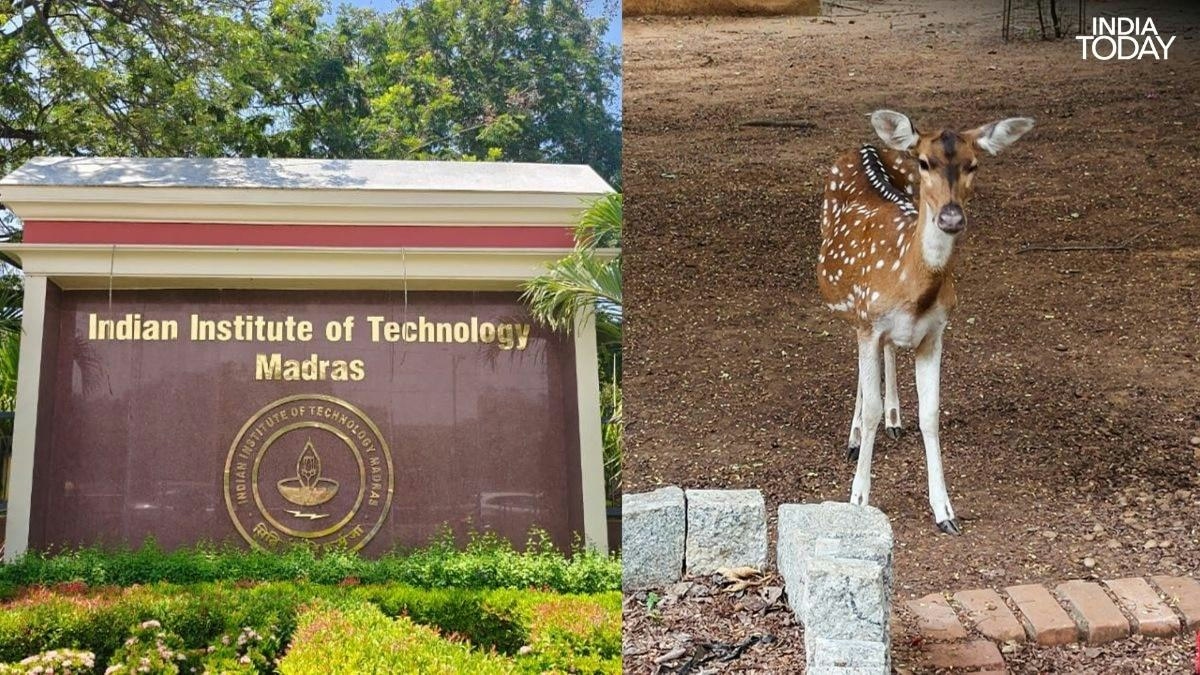
A Week Inside IIT Madras: Living Close to Nature and Innovation Among Flying Taxis, Rockets, and Brain Maps
For just over a week in August, I resided at the Taramani Guest House within the IIT Madras campus, awakening each morning to a rare and vibrant silence punctuated by birdsong and the gentle rustling of leaves. Unlike the muted quiet of an urban setting, this was the dynamic hush of a forest at dawn. Stepping outside, the cool, verdant air served as a reminder that this campus functions not only as an academic institution but also as a living ecosystem.
During an early morning walk, a spotted deer crossed my path, pausing calmly among parked bicycles. This encounter underscored the unique character of IIT Madras, a green enclave carved from the Guindy forest where nature and intellect coexist harmoniously. Beyond the deer, dense trees filtered the morning light, while nearby, researchers were engaged in the painstaking task of mapping the human brain at the cellular level. What began as a visit to report on technological advancements soon revealed itself as an immersion in a campus that embodies the future of higher education—one that teaches, builds, innovates, and redefines academic boundaries. Walking along the leafy avenues between laboratories, it became evident that IIT Madras might well represent the model other Indian universities have long awaited.
Flying Taxis, Rockets, and Mapping the Mind
At the institute’s Discovery campus, innovation quite literally takes flight. There, I experienced a full-scale prototype of an electric flying taxi developed by The ePlane Company. Equipped with ten rotors, each mounted on its own wing, and incorporating seven layers of safety, the design balances ambition with practicality. The team’s vision extends beyond serving affluent passengers; their objective is to develop affordable air ambulances capable of reducing a two-hour hospital journey to a mere 15-minute flight.
This innovative spirit permeates the Discovery campus, which also hosts start-ups and research groups focused on rocketry and advanced brain mapping. However, integrating such cutting-edge technologies within a traditional academic environment presents challenges. Securing adequate funding and institutional support remains critical, particularly as the space sector grows increasingly competitive.
Shaping the Future of Indian Academia
The rapid pace of innovation at IIT Madras is already exerting influence across the broader academic and technological landscape. By pushing boundaries in aerospace, neuroscience, and electric mobility, the institute is fostering heightened interest in STEM education and technology-driven solutions nationwide. In response, competing institutions are intensifying their research efforts and investing in advanced technologies to remain competitive.
IIT Madras stands at the confluence of nature and progress, offering a model where academic rigor, entrepreneurial drive, and environmental stewardship coexist and thrive. As India’s universities contemplate their futures, the green pathways and dynamic laboratories of this campus may well illuminate the path forward.

Etihad and Swissport Extend Global Partnership

Sepehran Airlines B737 Returns to Mashhad After Tyre and Engine Issues

Etihad Deploys Widebody Fleet to Meet Strong Demand

Korean Air Finalizes $36.2 Billion Deal with Boeing

Australia’s RFDS Queensland Section Orders Six King Air 260Cs

Korean Air Finalizes Order for 103 Boeing Jets and Engines

Embraer E195-E2 Features Distinctive Engine Placement Among Regional Jets

What Passengers Can Expect on Boeing’s New 777X Jet

How Ethiopian Airlines Became Africa’s Leading Carrier Amid Gulf Competition

Joby Aviation Extends Autonomous Flight Capabilities with Cross-Country Tour
