
KI-Erkenntnisse in konkrete Maßnahmen überführen

Trends
Categories
Air India Crash Report Delayed Amid Incomplete Engine Analysis, Source Says
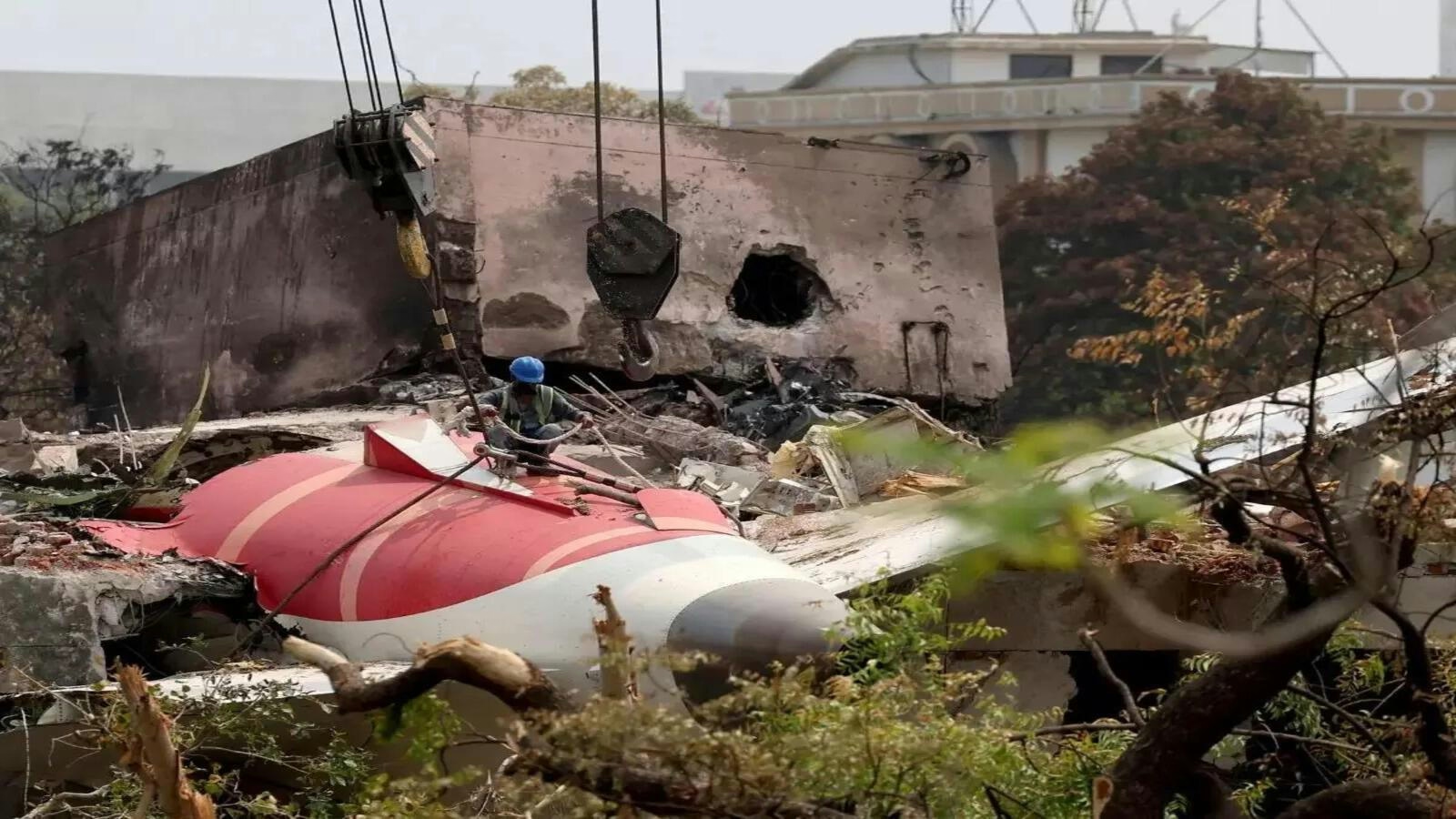
Air India Crash Report Delayed Amid Incomplete Engine Analysis
Indian investigators have announced a delay in the release of the final report on last year’s catastrophic Air India Boeing 787 crash, citing unfinished critical analysis of the aircraft’s engines. Originally anticipated by the one-year anniversary of the June 12, 2025 disaster, the report’s postponement extends the period of uncertainty for both the airline and the global aviation industry.
The crash, which occurred shortly after takeoff from Ahmedabad and resulted in 260 fatalities, is the deadliest air disaster worldwide in the past decade. Investigators have concentrated their efforts on the GE Aerospace engines powering the aircraft. Preliminary findings suggest that the engine fuel control switches were moved almost simultaneously from “RUN” to “CUTOFF,” effectively cutting fuel supply to both engines moments after departure.
Investigation Progress and Challenges
Engine testing was conducted in April, followed by a fact-finding mission to France last month to examine the engine management unit in greater detail. Additionally, the engines were sent to the United States for further scrutiny. While international protocols typically mandate the publication of a final accident report within one year, complex investigations often require extended timelines. In such cases, an interim statement is usually issued on the anniversary of the incident.
The delay arrives amid a difficult period for Air India, whose reputation has already been tarnished by operational shortcomings and safety violations. The ongoing ambiguity surrounding the crash investigation threatens to further undermine public trust and investor confidence. The recent exit of several key executives, including the CEO, has left the airline without stable leadership at a critical juncture. Market analysts warn that Air India may face heightened regulatory scrutiny and financial pressures, while competitors could exploit the situation to consolidate their market positions.
Compounding these challenges are broader geopolitical and economic factors, such as the depreciation of the Indian rupee and regulatory obstacles. These issues, combined with unresolved technical questions about the crash, have intensified public skepticism and increased demands for a more transparent and thorough investigation.
Controversies and Calls for Transparency
Early assessments of the cockpit voice recorder indicate that the captain may have deliberately cut fuel to the engines, according to U.S. officials. However, India’s Aircraft Accident Investigation Bureau (AAIB) has cautioned against drawing premature conclusions. The captain’s father has petitioned India’s Supreme Court to order an independent inquiry that explores causes beyond deliberate pilot action, referencing similar investigations into fatal crashes like the Germanwings disaster in 2015.
The Federation of Indian Pilots has urged authorities to withhold any interim report, arguing that additional technical data from Boeing and Air India is necessary to refute the pilot suicide hypothesis. The preliminary report did not recommend any immediate safety modifications for Boeing or GE Aerospace, indicating that no clear technical faults have yet been identified.
Neither the AAIB, India’s aviation ministry, Air India, the U.S. National Transportation Safety Board, Boeing, nor GE Aerospace have responded to requests for comment. As the investigation continues, the absence of definitive findings is expected to weigh heavily on Air India and the broader aviation community.

Etihad Airways Suspends Airbus A380 Flights on Key Route

Aditya Birla Group Seeks Approval for Aircraft Leasing in GIFT City

Qatar Airways Highlights Innovation and Connectivity at Arabian Travel Market 2026

Hong Kong's Five-Year Plan Includes Andrew Fan's Aircraft Parts Processing Hub Proposal

ACIA Aero Leasing Delivers ATR72-600 to Air Nostrum

RTX Appoints Jill Albertelli as Head of Pratt & Whitney

TAT Technologies Joins Beyond Aero Hydrogen Aircraft Program

AURAK Study Highlights Barriers to Air Taxi Adoption in Emerging Economies

Xiamen Air Selects Altitude for 787 Maintenance at Heathrow

Etihad and Swissport Extend Global Partnership
