
KI-Erkenntnisse in konkrete Maßnahmen überführen

Trends
Categories
Airbus A380 Route Reductions Signal Shift in Airline Strategies
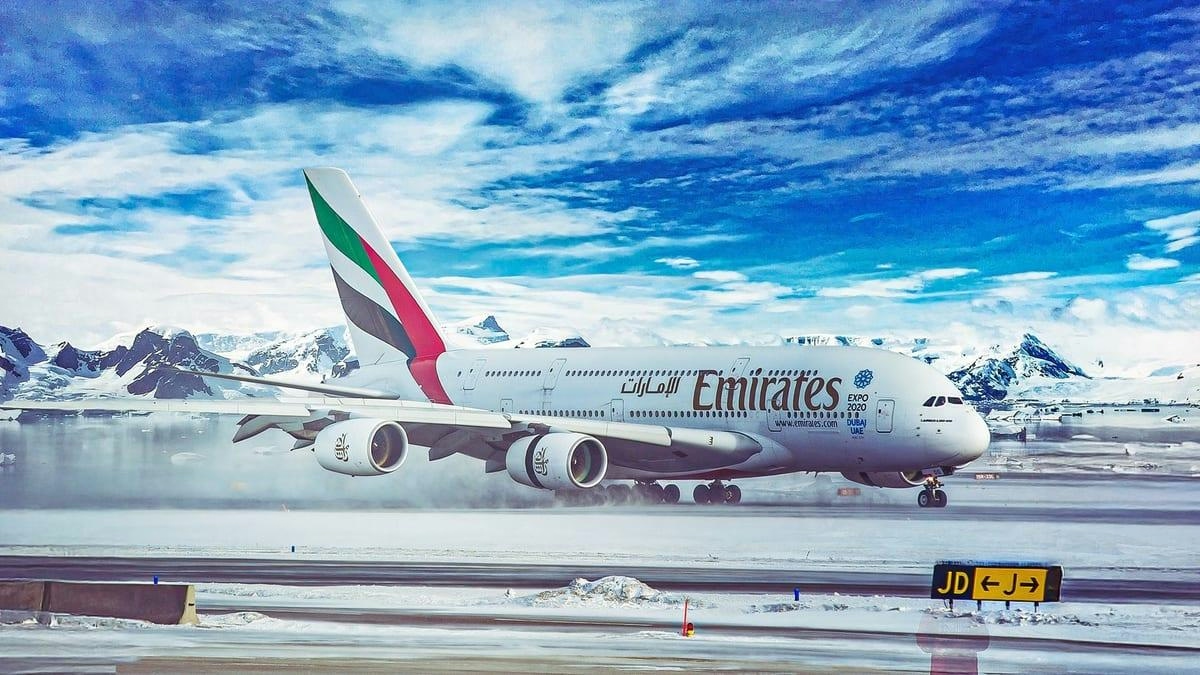
Airbus A380 Route Reductions Signal Shift in Airline Strategies
Airbus A380 operations are undergoing a significant transformation as leading airlines adjust their long-haul networks in response to changing market conditions and geopolitical challenges. Once emblematic of premium international travel, the superjumbo is now experiencing selective route withdrawals and redeployments, despite sustained global passenger demand.
Strategic Realignment Amid Global Uncertainty
Major carriers including Emirates, Qatar Airways, and Singapore Airlines are strategically scaling back A380 services on various international routes. This recalibration is driven less by declining demand and more by a pursuit of operational efficiency, cost management, and enhanced fleet flexibility. The ongoing instability in the Middle East has further accelerated these adjustments, compelling airlines to reconsider their route structures and capacity distribution.
Singapore Airlines, for instance, has recently reinstated A380 flights to Melbourne, capitalizing on a 38 percent increase in bookings as corporate travelers reroute through Singapore to avoid Middle Eastern airspace. Conversely, Qantas has reduced domestic capacity in response to regional volatility, reallocating aircraft to bolster services to key European destinations. These developments reflect a broader industry trend in which airlines prioritize dense, high-yield routes for the A380 while scaling back on marginal or seasonal markets.
Route Adjustments and Market Responses
Several global hubs, including Zurich, Auckland, and Mumbai, have seen diminished A380 frequencies as airlines redeploy the aircraft to routes with steadier demand profiles. Singapore Airlines has also discontinued A380 services on certain historically significant routes, a move that has surprised frequent flyers. These changes are influenced by seasonal demand shifts, airport slot limitations, and the imperative for more agile fleet deployment.
Competitors are responding promptly to these shifts. Turkish Airlines, leveraging its strategic geographic position, has expanded market share by offering alternative connections that appeal to travelers seeking safe and reliable routes. The industry as a whole is placing greater emphasis on diverse booking channels and real-time rebooking capabilities to accommodate evolving passenger preferences.
Economic and Operational Pressures
Despite its iconic status and appeal to passengers, the A380 faces persistent economic challenges. Its four-engine configuration and high maintenance requirements render it less competitive compared to newer, more fuel-efficient twin-engine aircraft such as the Airbus A350 and Boeing 787. The A380 remains most viable on routes with consistently high demand, yet fluctuating market conditions and infrastructure constraints at many airports limit its deployment.
Airlines are increasingly favoring aircraft that offer greater operational flexibility and lower costs, particularly in an environment of uncertain demand. This strategic shift enables carriers to better manage capacity and respond swiftly to changes in global travel patterns.
Passenger Experience and Future Outlook
The A380 continues to be favored by travelers for its spacious cabins and premium amenities, with airlines like Emirates maintaining investments in onboard enhancements. However, as networks are streamlined, opportunities to fly on the superjumbo are becoming more limited. The focus is now on deploying the A380 exclusively on routes where it delivers the greatest value.
Looking forward, the industry’s adaptation to geopolitical instability and shifting demand signals a broader transformation in airline strategy. The A380’s role is set to become increasingly specialized, reserved for flagship routes where its unique advantages can be fully leveraged.

Etihad Airways Suspends Airbus A380 Flights on Key Route

Aditya Birla Group Seeks Approval for Aircraft Leasing in GIFT City

Qatar Airways Highlights Innovation and Connectivity at Arabian Travel Market 2026

Hong Kong's Five-Year Plan Includes Andrew Fan's Aircraft Parts Processing Hub Proposal

ACIA Aero Leasing Delivers ATR72-600 to Air Nostrum

RTX Appoints Jill Albertelli as Head of Pratt & Whitney

TAT Technologies Joins Beyond Aero Hydrogen Aircraft Program

AURAK Study Highlights Barriers to Air Taxi Adoption in Emerging Economies

Xiamen Air Selects Altitude for 787 Maintenance at Heathrow

Etihad and Swissport Extend Global Partnership
