
KI-Erkenntnisse in konkrete Maßnahmen überführen

Trends
Categories
Airbus Expands Presence in Eastern Europe Amid Rising Defense Orders and Delivery Challenges
Airbus Expands Presence in Eastern Europe Amid Rising Defense Orders and Delivery Challenges
Strategic Growth in Poland and Romania
Airbus is intensifying its focus on Eastern Europe, particularly Poland and Romania, as part of a strategic effort to bolster its defense business amid ongoing difficulties in its commercial aircraft operations. On May 5, 2026, the European aerospace leader announced plans to triple its workforce in Poland to 1,500 employees and increase annual procurement from Polish suppliers to $700 million by 2030. This move aims to secure production commitments and reinforce supply chains within one of Europe’s most rapidly expanding aviation markets.
In Poland, Airbus already maintains a significant presence through its civil aviation activities. LOT Polish Airlines has placed an order for 84 A220 jets, encompassing both the -100 and -300 variants, with initial deliveries scheduled for 2027. Airbus has also indicated interest in providing widebody aircraft to the carrier. On the defense side, Airbus Defence and Space, in partnership with Thales Alenia Space and the Polish company RADMOR, signed an agreement in April to develop a geostationary defense satellite for Poland’s Ministry of Defence. This project benefits from support under the European Union’s “Readiness 2030” program. Furthermore, Poland is evaluating the acquisition of at least two Airbus A330 MRTT tanker aircraft, potentially financed through EU loans, positioning Airbus as a competitor to Boeing’s KC-46 in the region.
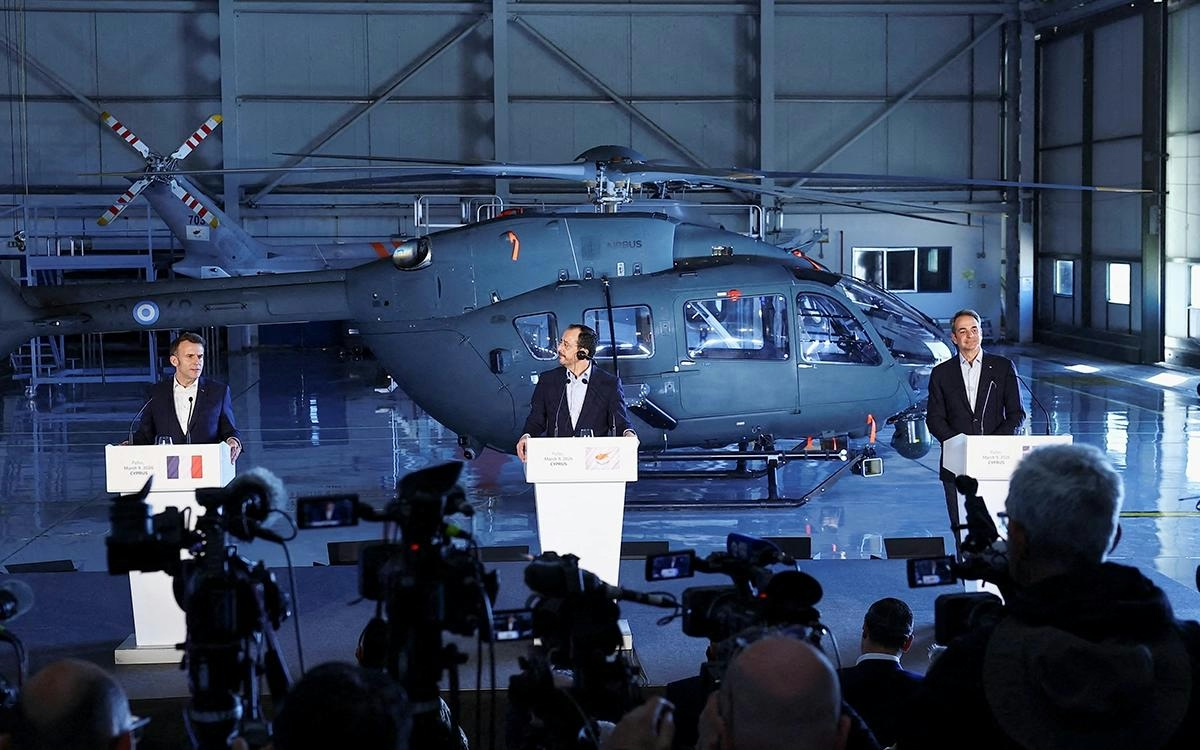
In Romania, Airbus achieved a significant contract as the government approved the purchase of H225M Caracal military helicopters in a deal valued at €1 billion. This acquisition strengthens Airbus’s defense portfolio at a time when its commercial aviation segment is encountering headwinds.
Commercial Delivery Setbacks Amid Defense Growth
Despite the surge in defense orders, Airbus continues to face substantial challenges within its commercial aircraft division. In the first quarter of 2026, commercial deliveries declined by 16% year-on-year to 114 aircraft, primarily due to slower deliveries of the A320neo family and persistent supply chain disruptions. This downturn contributed to a 7% decrease in group revenue, which fell to €12.7 billion, further impacted by adverse exchange rate movements. The company also missed profit expectations for the quarter, as engine shortages—particularly from Pratt & Whitney—hampered production ramp-up for both the A220 and A320 families, which have ambitious delivery targets set for 2027 and 2028.
Conversely, Airbus’s defense division reported strong performance. Order intake nearly doubled to €5.0 billion in the first quarter, up from €2.6 billion a year earlier, while adjusted EBIT increased to €130 million from €77 million, driven largely by the air power segment. Airbus also secured substantial commercial orders, including 100 A320neo-family jets for AerCap and 101 for China Eastern Airlines, although these have yet to compensate fully for the delivery shortfall.
Outlook and Market Response
Airbus management remains committed to its full-year guidance, targeting approximately 870 aircraft deliveries in 2026, adjusted EBIT of €7.5 billion, and free cash flow before customer financing of €4.5 billion. However, these projections depend heavily on the absence of further supply chain disruptions or adverse global economic developments.
The company’s expansion into Eastern Europe may encounter resistance from local defense industries and unfolds amid ongoing geopolitical tensions in the region. Market reactions have been mixed; Airbus shares have rebounded by 7% over the past week but continue to trade nearly 9% below their level at the start of the year. As Airbus navigates the dual challenges of rising defense demand and persistent commercial difficulties, its capacity to meet ambitious targets remains under close observation.

Etihad Airways Suspends Airbus A380 Flights on Key Route

Aditya Birla Group Seeks Approval for Aircraft Leasing in GIFT City

Qatar Airways Highlights Innovation and Connectivity at Arabian Travel Market 2026

Hong Kong's Five-Year Plan Includes Andrew Fan's Aircraft Parts Processing Hub Proposal

ACIA Aero Leasing Delivers ATR72-600 to Air Nostrum

RTX Appoints Jill Albertelli as Head of Pratt & Whitney

TAT Technologies Joins Beyond Aero Hydrogen Aircraft Program

AURAK Study Highlights Barriers to Air Taxi Adoption in Emerging Economies

Xiamen Air Selects Altitude for 787 Maintenance at Heathrow

Etihad and Swissport Extend Global Partnership
