
KI-Erkenntnisse in konkrete Maßnahmen überführen

Trends
Categories
Airbus Expresses Concern Over GTF Engine Delays and Slow SAF Development
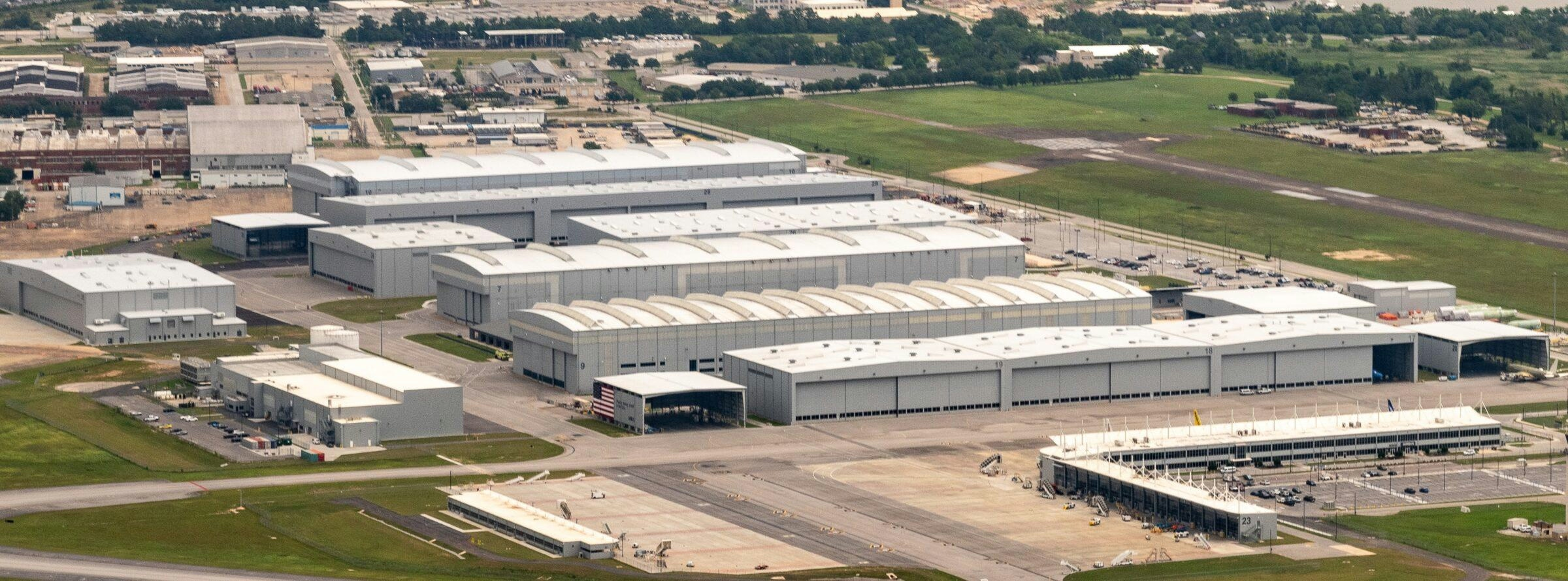
Airbus Highlights Engine Delivery Delays and Slow Progress in Sustainable Aviation Fuel
Production Challenges Linked to Pratt & Whitney’s GTF Engine Issues
Airbus has publicly expressed growing concern over ongoing delays in the delivery of Pratt & Whitney’s geared turbofan (GTF) engines, which has directly influenced a downward revision of its A320 production targets. In its recent full-year earnings presentation, the European aerospace giant announced a revised forecast of producing between 70 and 75 A320-family aircraft per month by the end of 2027, a reduction from the previously anticipated steady rate of 75. Airbus expects to stabilize production at 75 units per month thereafter.
Chief Executive Guillaume Faury attributed the production slowdown primarily to Pratt & Whitney’s failure to meet engine delivery commitments. He stated, “Pratt & Whitney’s failure to commit to the number of engines ordered by Airbus is negatively impacting this year’s guidance and the ramp-up trajectory for this year.” Faury emphasized Airbus’s determination to enforce its contractual rights in response to these challenges.
The root of the problem lies in a recall campaign affecting Pratt & Whitney’s PW1000G GTF engines, which power the A320neo family alongside CFM International’s LEAP-1A engines. A defect involving powdered metal components necessitated the grounding of hundreds of aircraft for maintenance, causing significant delays in new engine deliveries. Although Pratt & Whitney reported a 6% increase in GTF engine deliveries in 2025, Airbus and its customers remain concerned about the company’s recovery pace from the recall.
Faury expressed particular frustration with Pratt & Whitney’s prioritization of servicing in-service aircraft over supplying new engines to Airbus. He argued that the manufacturer should expand its capacity to address both demands simultaneously, stating, “We continue to work with them to make them change the way they manage this.”
Despite these setbacks, Airbus maintains a positive outlook for 2026, projecting deliveries of 870 commercial aircraft—an increase of nearly 10% compared to the 793 units delivered in 2025. The company reported a 6% rise in revenue to €73.4 billion ($86.6 billion) and a 33% increase in adjusted EBIT to €7.1 billion for the year. Airbus also secured 1,000 gross aircraft orders in 2025, ending the year with a record backlog of 8,754 aircraft.
Other engine manufacturers, including MTU Aero Engines and CFM International, are advancing their engine technologies in response to market demands. Airlines such as Volaris anticipate a reduction in GTF-related groundings as the industry approaches a turning point in resolving these technical issues.
Airbus’s production targets for other aircraft models remain largely stable. The A220 is now expected to reach a production rate of 13 per month by 2028, down from an earlier target of 14 per month in 2026. The A330 and A350 production rates are set to hold steady at five and 12 units per month by 2029 and 2028, respectively.
Concerns Over Slow Development of Sustainable Aviation Fuel
Beyond the challenges related to engine supply, Guillaume Faury also voiced concern over the sluggish progress in the sustainable aviation fuel (SAF) market. He underscored Airbus’s commitment to SAF as a critical component of the industry’s decarbonization strategy but acknowledged that its development remains largely outside the company’s direct control. “The progress is slow—too slow—but it’s not something we should give up on,” Faury remarked, highlighting the importance of continued efforts to advance SAF adoption.

Etihad Airways Suspends Airbus A380 Flights on Key Route

Aditya Birla Group Seeks Approval for Aircraft Leasing in GIFT City

Qatar Airways Highlights Innovation and Connectivity at Arabian Travel Market 2026

Hong Kong's Five-Year Plan Includes Andrew Fan's Aircraft Parts Processing Hub Proposal

ACIA Aero Leasing Delivers ATR72-600 to Air Nostrum

RTX Appoints Jill Albertelli as Head of Pratt & Whitney

TAT Technologies Joins Beyond Aero Hydrogen Aircraft Program

AURAK Study Highlights Barriers to Air Taxi Adoption in Emerging Economies

Xiamen Air Selects Altitude for 787 Maintenance at Heathrow

Etihad and Swissport Extend Global Partnership
