Bild

AeroGenie — Ihr intelligenter Copilot.

Fragen Sie alles. Analysieren Sie alles. Handeln Sie sofort.

Trends

Categories

Beehive Introduces Rampart Engine with 1,000-Pound Thrust for Uncrewed Fighters
April 28, 2026By ePlane AI
Beehive Introduces Rampart Engine with 1,000-Pound Thrust for Uncrewed Fighters
0
0
Beehive Industries
Rampart Engine
Collaborative Combat Aircraft

Beehive Launches Rampart Engine Delivering 1,000 Pounds of Thrust for Uncrewed Fighters

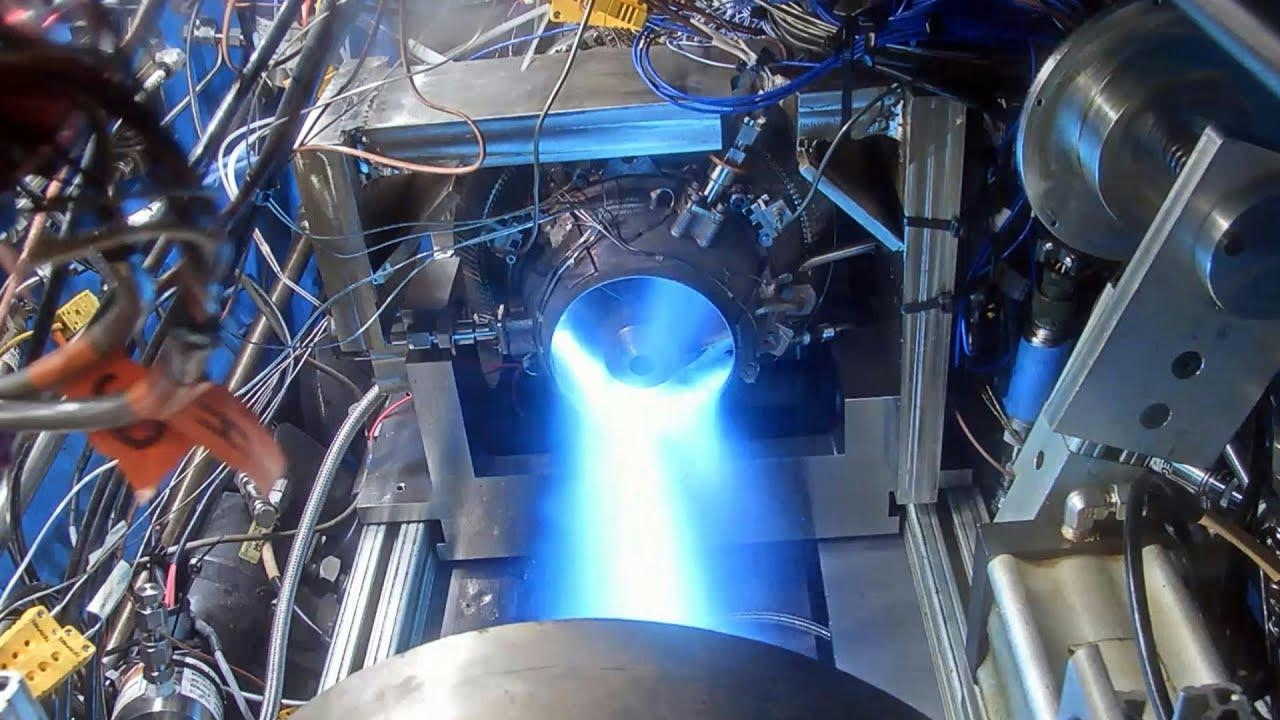
Propulsion start-up Beehive Industries has introduced the Rampart, a turbofan engine generating 1,000 pounds of thrust (4.4 kN), targeting the expanding sector of uncrewed fighter aircraft. Based in Colorado, the company has historically specialized in small turbojets for light drones and missiles. With Rampart, Beehive aims to provide a high-endurance, reliable propulsion solution tailored specifically for Collaborative Combat Aircraft (CCA).

Engine Designed for Collaborative Combat Aircraft

Beehive positions the Rampart engine as offering “extreme reliability for diverse mission profiles,” addressing the operational demands of CCAs currently under development by the US Air Force (USAF), US Marine Corps, and Royal Australian Air Force. These uncrewed platforms are intended to operate alongside frontline fighters such as the Lockheed Martin F-35A and F-22, necessitating engines that balance aerodynamic performance with affordability and suitability for high-rate production.

The CCA market has attracted considerable attention from both established aerospace firms and emerging suppliers. The USAF has already awarded initial development contracts to Honeywell and a joint venture between GE Aerospace and Kratos for engines producing thrust in the 800 to 1,600-pound range. Additionally, major industry players including Pratt & Whitney and Rolls-Royce are actively developing low-cost, lightweight propulsion systems to meet the sector’s evolving requirements.

Expanding Capabilities Amidst Intense Competition

Rampart represents a strategic expansion for Beehive beyond its existing Frenzy engine line, which focuses on propulsion for long-range missiles and one-way swarm drones. The company is preparing to commence flight testing of its 200-pound-thrust Frenzy 6 engine, supported by a $30 million USAF development contract awarded in April. This funding will also facilitate prototyping of the smaller 100-pound-thrust Frenzy 8.

Despite this progress, Beehive faces significant challenges in establishing Rampart within a competitive landscape dominated by well-established industry leaders. Meeting the USAF’s rigorous standards for performance, reliability, and cost-effectiveness will be essential for the engine’s success. Market responses to the Rampart announcement have been mixed; while some analysts recognize the engine as a noteworthy technological advancement, others remain cautious about Beehive’s ability to match or surpass the capabilities of incumbent competitors.

In light of Beehive’s entry, rival manufacturers are likely to accelerate their own engine development efforts to maintain their foothold in the rapidly evolving uncrewed fighter propulsion market. As demand for affordable, high-performance engines for CCAs intensifies, competition among suppliers is expected to shape the future trajectory of uncrewed military aviation.

More news
China Southern Initiates Construction of Urumqi Cargo and MRO Base

China Southern Initiates Construction of Urumqi Cargo and MRO Base

China Southern Launches Construction of Urumqi Cargo and MRO Base Amid Industry Challenges China Southern Airlines has officially begun construction on a significant maintenance, repair, and overhaul (MRO) and cargo facility in Urumqi, located in the Xinjiang Uygur Autonomous Region. This ambitious project, backed by an investment exceeding CNY 1.6 billion (approximately USD 234 million), aligns with a broader central government strategy aimed at stimulating economic growth in the region. The facility is expected to be completed and operational by 2028. Facility Specifications and Strategic Importance The new base will include a 65,991-square-metre hangar, which is projected to become the largest civil aviation hangar in northwestern China. The initial phase of the cargo area will span roughly 60,000 square metres, with over 20,000 square metres allocated to terminal space designed to handle both domestic and international freight operations. This development is intended to significantly enhance China Southern’s operational capacity and reinforce Urumqi’s position as a key logistics and aviation hub. Industry Context and Challenges The timing of this project coincides with a period of considerable uncertainty within the global aviation sector. Ongoing geopolitical conflicts have disrupted supply chains worldwide, resulting in elevated material and energy costs and complicating procurement processes. These factors present potential risks to the project’s timeline and budget, as well as to China Southern’s broader strategic planning. Market analysts are paying close attention to China Southern’s financial health as it undertakes this major expansion. Currently, China Southern remains the only profitable major Chinese airline, in contrast to competitors such as China Eastern and Air China, which have reported mixed financial outcomes. This relative profitability subjects China Southern to heightened scrutiny regarding its capacity to manage large-scale investments amid volatile market conditions. In response to these challenges, rival carriers may reconsider their strategies, focusing on mitigating supply chain vulnerabilities and revising operational and investment priorities. Such strategic adjustments could reshape the competitive dynamics, particularly in regions targeted for infrastructure development. Despite these headwinds, the Urumqi Cargo and MRO Base represents a critical step forward for China Southern and the broader Chinese aviation industry, highlighting both the opportunities and complexities inherent in navigating a rapidly evolving global environment.
Brasília International Airport Named Brazil’s Best Airport for 2026

Brasília International Airport Named Brazil’s Best Airport for 2026

Brasília International Airport Named Brazil’s Best Airport for 2026 Brasília International Airport has been officially recognized as Brazil’s Best Airport for 2026, receiving top honors in the esteemed Best of Brazilian Tourism 2026 awards. This accolade follows a comprehensive evaluation process that assessed innovation, sustainability, operational efficiency, and the overall passenger experience. The airport’s achievement positions it as a leading example of service quality and infrastructure within Brazil’s aviation sector. Excellence in Service and Infrastructure The Best of Brazilian Tourism 2026 awards highlight outstanding performance across critical segments of the tourism industry, including aviation, hospitality, and destination management. Brasília International Airport distinguished itself through consistent service excellence, efficient operational management, and progressive infrastructure development. The evaluation placed significant emphasis on passenger satisfaction, technological integration, and environmental responsibility—criteria that reflect the evolving standards of Brazil’s tourism and transportation industries. Recent investments have been instrumental in the airport’s transformation. These include enhancements to terminal facilities, the integration of digital services, improved passenger flow systems, and infrastructure upgrades focused on sustainability. Such initiatives have effectively addressed increasing travel demand while bolstering operational efficiency through advanced logistics and enhanced coordination among airport stakeholders. Consequently, Brasília International Airport has emerged as a benchmark for other aviation hubs throughout the country. Commitment to Sustainability and Innovation Sustainability and innovation were central to the airport’s recognition. The adoption of eco-friendly technologies, comprehensive waste management programs, and energy conservation measures have aligned the airport with global standards for sustainable aviation. Furthermore, the integration of digital services and automated systems has not only improved the passenger experience but also streamlined operational processes. Despite this achievement, maintaining the top ranking presents ongoing challenges. As Brazil intensifies efforts to expand international connectivity, Brasília International Airport faces increasing competition from other major airports domestically and across Latin America. While the award is expected to drive higher passenger traffic and revenue, it also invites greater scrutiny from airlines and travelers alike. Competitors may respond with strategic investments in infrastructure and service enhancements, potentially intensifying price competition and spurring further innovation within the sector. The recognition of Brasília International Airport underscores the critical role of modern infrastructure and sustainable practices in enhancing Brazil’s tourism competitiveness. As the airport sets new standards for excellence, it must continue to innovate and adapt to maintain its leadership position in a rapidly evolving aviation landscape.
Joby Electric Air Taxi Completes Test Flights in New York City

Joby Electric Air Taxi Completes Test Flights in New York City

Joby Electric Air Taxi Completes Historic Test Flights in New York City The all-electric Joby Air Taxi recently completed a landmark series of test flights over New York City, marking the first point-to-point electric air taxi demonstration in the city’s history. Unlike conventional airplanes or helicopters, the aircraft approached the city with near silence, gliding smoothly around Governor’s Island and past the Brooklyn Bridge before landing at the NYC Downtown Skyport in Lower Manhattan. This milestone represents a significant advancement for the emerging electric vertical take-off and landing (eVTOL) industry, signaling a potential shift in urban air mobility. Technological Innovation and Flight Demonstration The Joby Air Taxi is designed to carry four passengers and a pilot, employing a “highly augmented fly-by-wire” control system that simplifies operation despite the aircraft’s technical complexity. Pilot Buddy Denham, who has experience developing the F-35 fighter jet’s hover system for the Navy, described the vehicle as “easy to fly.” The aircraft’s six propellers enable vertical takeoff and landing similar to a drone, while the two front propellers tilt forward to transition seamlessly into horizontal flight, combining the capabilities of helicopters and airplanes. This demonstration not only showcased Joby’s technological expertise but also underscored the potential for quieter, zero-emission urban air travel. Implications for Urban Transportation and Industry Challenges The successful flight has been met with enthusiasm from industry leaders and government officials, particularly those involved in initiatives such as the eVTOL Integration Pilot Program, which seeks to expedite the safe adoption of electric air taxis. The promise of a sustainable, quieter alternative to traditional aviation could revolutionize urban transportation, offering new mobility options within congested city environments. Nevertheless, significant challenges remain before electric air taxis become a common feature in urban skies. Regulatory approval from the Federal Aviation Administration (FAA) is still pending, and public acceptance will be essential for widespread adoption. Issues related to safety, infrastructure development, and economic viability must be addressed. The positive market response to Joby’s demonstration is expected to accelerate testing and development efforts among competitors, while cities and private investors will need to commit resources to build the necessary support systems for this emerging mode of transport. Joby’s successful test flight in New York City marks a pivotal moment for the eVTOL sector. As the industry advances toward commercial operations, the vision of quieter, cleaner, and more efficient urban air travel is becoming increasingly tangible, with the potential to transform city life in the near future.
Rising Fuel Costs Challenge Post-Pandemic Aviation Maintenance Growth

Rising Fuel Costs Challenge Post-Pandemic Aviation Maintenance Growth

Rising Fuel Costs Challenge Post-Pandemic Aviation Maintenance Growth Surge in Demand Meets Rising Uncertainty Maintenance providers such as Pratt & Whitney’s Eagle Services Asia in Singapore have experienced a significant increase in demand in recent years, driven by the post-pandemic recovery and airlines’ efforts to rapidly restore capacity. However, this momentum in the aviation maintenance sector is now confronted with growing uncertainty. The sharp rise in fuel prices has compelled airlines worldwide to reduce flights and cut capacity, casting doubt on the sustainability of the aftermarket boom that has characterized the industry’s recent growth. Since the beginning of the year, jet fuel prices have doubled, largely due to the near-total closure of the Strait of Hormuz amid escalating tensions in the ongoing US-Iran conflict. This critical chokepoint, which once accounted for approximately a quarter of the world’s oil supply, remains closed to shipping, resulting in both price inflation and looming supply shortages. In response, airlines have consolidated routes, reduced scheduling flexibility, and in some cases, cancelled flights outright. While these measures have been relatively modest outside the Middle East, they signal a fundamental shift in airline economics that could have far-reaching consequences for the maintenance, repair, and overhaul (MRO) sector. Industry Impact and Responses The effects of rising fuel costs are already manifesting within the industry. On April 28, UK wet-lease carrier Ascend Airways announced it would return its Boeing 737 Max 8 aircraft to lessors and surrender its air operator’s certificate, explicitly citing unsustainable fuel expenses. Major carriers have also issued warnings of further disruptions. United Airlines CEO Scott Kirby recently indicated that fares would need to increase by at least 20% to offset soaring fuel costs, while Delta Air Lines has announced plans to “meaningfully” reduce growth in response to the crisis. Industry analysts emphasize that the current jet fuel crisis differs from previous shocks, with logistical bottlenecks and limited policy options suggesting that the disruption may persist longer than past fuel price surges. Within the MRO industry, perspectives vary. Some executives regard the current capacity reductions as minor schedule adjustments unlikely to significantly affect maintenance demand. Others caution that airlines may soon be compelled to take more drastic actions, including grounding aircraft, which would directly and substantially impact the aftermarket sector. Jonathan Berger, head of Alton Aviation Consultancy’s MRO and aftermarket advisory practice, observed a notable shift in sentiment among maintenance providers. Speaking at the MRO Americas trade show in Orlando, Berger remarked, “Everybody is just worried about how long is it going to last. It’s like the pandemic. It’s like déjà vu.” Outlook Amid Persistent Challenges Despite these challenges, the aftermarket sector remains resilient for the time being, supported by ongoing demand to address durability issues with new-generation turbofan engines and increased production targets from manufacturers such as Airbus and Boeing. Nevertheless, cautionary signals are emerging. During its first-quarter earnings call on April 22, GE Aerospace warned that the combined effects of the Iran conflict and fuel inflation could eventually dampen demand for aftermarket services. CEO Larry Culp highlighted the risk of “lower volume related to shop visits, spare parts and spare engines, and lower profitability” if current trends continue into late summer and early fall. As the aviation industry braces for a potentially prolonged fuel crisis, the post-pandemic surge in aviation maintenance faces its most significant challenge to date.
New Funding Supports Autonomous Aviation in Civil and Military Sectors

New Funding Supports Autonomous Aviation in Civil and Military Sectors

New Funding Supports Autonomous Aviation in Civil and Military Sectors Innovate UK, a branch of UK Research and Innovation (UKRI), has unveiled a funding initiative of up to £10 million aimed at accelerating the development of aviation technologies with applications spanning both civil and military domains. This programme seeks to bolster the United Kingdom’s national security and defence capabilities by promoting resilient, dual-use aviation systems. These include Uncrewed Aircraft Systems (UAS), hybrid electric Vertical Take Off and Landing (eVTOL) aircraft, hybrid electric Conventional Take Off and Landing (eCTOL) aircraft, and other collaborative or autonomous aviation platforms. Advancing Dual-Use Aviation Technologies The competition targets innovative projects that push the boundaries of current technology and bring these advancements closer to commercialisation and operational deployment. Applicants are encouraged to focus on manufacturing scalability and address specific end-user requirements, with an emphasis on technologies at Technology Readiness Level (TRL) 5 or higher. A key stipulation is the involvement of a UK-based customer or operator as a project partner, ensuring a clear pathway to market across both civil and defence sectors. This approach aligns with the UK government’s strategic priorities for aviation innovation. The funding initiative supports broader governmental objectives, including enabling routine Beyond Visual Line of Sight (BVLOS) UAS operations by 2027, increasing drone adoption within the public sector, and achieving commercial piloted eVTOL flights by 2028. Projects may incorporate flight activities, provided they adhere to existing or attainable regulatory approvals within the project timeframe. Context and Global Developments The UK’s commitment to dual-use aviation innovation emerges amid a global surge in investment in autonomous flight technologies. In the United States, for example, Reliable Robotics recently secured $160 million to expedite Federal Aviation Administration (FAA) certification of its autonomous flight system, aiming for commercial readiness by 2028. Industry leaders such as Honeywell and Odys are advancing sophisticated anti-drone platforms, while Bell, in collaboration with Near Earth Autonomy, is developing an uncrewed cargo variant of the Bell 505 helicopter. Concurrently, the Pentagon’s latest $54 billion budget request highlights a strategic pivot towards AI-powered warfare. Despite this, defence analysts warn that militaries worldwide may not yet be fully prepared to manage the operational and ethical challenges posed by autonomous systems on the battlefield. Competitive Selection and Strategic Goals Innovate UK’s competition is highly selective, with an estimated success rate of approximately 15% based on previous funding rounds. Decisions will be made considering the quality of applications and the prior conduct of applicants. Due to budget constraints, not all high-scoring proposals will receive funding. By fostering collaboration between civil and military stakeholders and supporting scalable, dual-use technologies, the UK aims to establish itself as a leader in the rapidly evolving autonomous aviation sector.
Diehl Space³ Lav to Enter Service This Year; Narrowbody Variant Planned

Diehl Space³ Lav to Enter Service This Year; Narrowbody Variant Planned

Diehl Space³ Lavatory to Enter Service in 2024; Narrowbody Variant in Development Diehl Aviation’s innovative Space³ aircraft lavatory is poised to enter commercial service with an undisclosed airline before the end of 2024, representing a significant advancement in accessibility for Persons with Reduced Mobility (PRM) and cabin efficiency on twin-aisle aircraft. The German aerospace supplier, renowned for its comprehensive aircraft systems, has also confirmed the development of a Space³ variant tailored for narrowbody jets, aiming to meet evolving regulatory requirements and market demands. Enhancing Accessibility and Cabin Efficiency The Space³ lavatory, which received the Crystal Cabin Award for Accessibility last year, is engineered to increase seating capacity by up to four seats on widebody aircraft without compromising accessibility. Its modular design enables the combination of two adjacent lavatories into a single, spacious facility through a central door, accommodating onboard wheelchairs and ensuring compliance with US Department of Transportation (DOT) regulations. Over the past year, Diehl Aviation has introduced several key improvements to the Space³ system based on feedback from industry stakeholders and disabled travelers. Mathies Gereke, chief project lead for upgrade solutions, detailed these enhancements at the Aircraft Interiors Expo in Hamburg. Among the notable changes are bifold doors that open outward, significantly widening the entry and exit area. This mechanism has been simplified and made less conspicuous to enhance both usability and cabin aesthetics. A critical modification involves reducing the ramp angle in front of the side-by-side lavatories from the industry standard of 35 degrees to just 13 degrees, facilitating easier assistance for PRMs by crew or companions. Additional refinements include a lower grab bar, strategically oriented to aid passengers with upper body strength in pushing themselves up more easily. Deployment and Industry Implications Diehl Aviation plans to deliver the first Space³ units to its launch customer by summer 2024, with installation scheduled as part of a comprehensive retrofit program. Although the airline’s identity remains confidential, the retrofit is under close scrutiny by local aviation authorities to ensure full compliance with US DOT accessibility standards. The airline intends to have the Space³ lavatory operational in time for its anniversary later this year. The introduction of Space³ presents several challenges. Diehl must ensure the lavatory system adheres to stringent aviation safety and accessibility standards, integrates seamlessly with existing aircraft interiors, and meets tight production schedules to satisfy customer timelines. Airlines will likely evaluate the cost-effectiveness and operational benefits of Space³ relative to current lavatory solutions, while competitors may accelerate their own innovations in response to increasing demand for accessible and efficient cabin products. Diehl’s focus on sustainability and the use of lightweight materials in the Space³ design may further influence market dynamics, encouraging other manufacturers to enhance their offerings. As regulatory requirements for accessible lavatories expand—particularly with new US DOT rules targeting narrowbody aircraft—Diehl’s proactive development of the Space³ system positions it as a potential benchmark in the evolving landscape of aircraft interiors.
Electric Air Taxi Tested in New York City

Electric Air Taxi Tested in New York City

Electric Air Taxi Tested in New York City Advancing Urban Air Mobility Recent test flights of an electric air taxi were conducted across multiple heliports in New York City, including John F. Kennedy International Airport. These trials represent a pivotal advancement in integrating electric vertical takeoff and landing (eVTOL) aircraft into the urban transportation network. The operations were carried out within controlled airspace under the supervision of aviation regulators and involved collaboration with the Port Authority of New York and New Jersey as part of a pilot program. The primary objective of these demonstrations is to assess the feasibility of incorporating eVTOL aircraft into existing transit systems, with a particular emphasis on passenger routes connecting Manhattan to major airports. Authorities are simultaneously exploring the modernization of city heliports to support the unique requirements of electric aircraft, including charging infrastructure and maintenance facilities. Challenges and Market Response While eVTOL technology promises to revolutionize urban travel by significantly reducing commute times, several challenges remain. Regulatory approval and safety certification are ongoing concerns, as the project is still navigating the complex certification process. Noise pollution is also under careful evaluation; preliminary findings indicate that electric air taxis may generate less noise compared to conventional helicopters, potentially easing community concerns. Market response to the initiative has been largely optimistic. Both urban commuters and government agencies have shown considerable interest in the potential of eVTOL services to transform city mobility. The federal demonstration flights form part of a broader national effort to advance urban air mobility and integrate eVTOL technologies across the United States. Industry Competition and Global Developments The sector is witnessing intensifying competition, exemplified by legal disputes between leading companies. Joby Aviation, a prominent player in the field, is currently engaged in litigation with rival Archer Aviation, which has accused Joby of misrepresenting foreign affiliations and misappropriating trade secrets. These legal conflicts highlight the high stakes and rapid pace of innovation characterizing the emerging market for electric air taxis. As certification efforts continue, the timeline for the commercial launch of electric air taxi services in New York City remains uncertain. Nevertheless, ongoing flight tests and infrastructure planning underscore a growing commitment to realizing urban air mobility. In a related global development, Kazakhstan has announced plans to initiate a pilot project for autonomous taxis in Astana and Almaty, reflecting the expanding international momentum behind next-generation urban transportation solutions.
Airbus Profits Halve Amid Slower Deliveries in Q1 2026

Airbus Profits Halve Amid Slower Deliveries in Q1 2026

Airbus Profits Halve Amid Slower Deliveries in Q1 2026 Airbus has reported a significant decline in its first-quarter profits for 2026, as ongoing engine shortages and slower aircraft deliveries adversely affected its financial results. The company’s adjusted operating profit dropped by 52%, falling to €300 million from €624 million in the same period last year. Revenue decreased by 7% to €12.65 billion, although this figure exceeded analyst expectations of €12.39 billion. Earnings per share stood at €0.74, also surpassing forecasts. Delivery Challenges and Engine Supply Constraints The primary challenge facing Airbus remains the slowdown in aircraft deliveries. The company delivered only 114 commercial jets in the first quarter, marking a 16% decline from 136 deliveries in the corresponding period of 2025. This shortfall was further highlighted by the performance of rival Boeing, which delivered 143 aircraft during the quarter. Boeing’s recovery from previous production difficulties has been notable, with February marking its highest monthly deliveries in nine years. While Airbus maintained solid deliveries in March, it was insufficient to close the gap with its competitor. The delivery delays are largely attributed to persistent engine supply issues. Pratt & Whitney, a critical supplier for Airbus’s A320neo family, has struggled to meet delivery schedules, limiting Airbus’s capacity to increase production. The situation has deteriorated to the extent that Airbus is reportedly considering seeking damages from the U.S.-based engine manufacturer. Despite these obstacles, Airbus has reaffirmed its full-year target of delivering 870 commercial aircraft in 2026. The company also reiterated its goal to achieve a production rate of 70 to 75 A320-family jets per month by the end of 2027, a target that was previously revised downward earlier this year. Meeting the annual delivery target will require a substantial acceleration in production in the coming quarters. Segment Performance and Market Outlook Sales in Airbus’s commercial aircraft segment declined by 11% year-on-year. The helicopter division remained stable, while the defence and space unit provided a positive contribution, growing by 7% and posting an adjusted core profit of €130 million, surpassing analyst expectations. Airbus described the operating environment as “dynamic and complex,” with particular attention to potential risks arising from geopolitical tensions in the Middle East. The company’s adjusted free cash flow for the quarter was negative €2.49 billion, reflecting the operational pressures it continues to face. Investor confidence in Airbus has cooled since the beginning of the year, partly due to Boeing’s improving performance. Boeing reported a narrower-than-expected loss in the first quarter, signaling stabilization in its commercial aircraft business. Looking forward, analysts emphasize that Airbus’s ability to resolve supply chain disruptions and increase delivery rates will be critical to its earnings and market valuation. With full-year guidance unchanged, the company faces mounting pressure to overcome supply constraints and meet its ambitious targets amid intense competition.
Veryon Unveils Data-Driven Maintenance Suite at NBAA Conference

Veryon Unveils Data-Driven Maintenance Suite at NBAA Conference

Veryon Unveils Unified AI-Powered Maintenance Suite at NBAA Conference SAN FRANCISCO, April 28, 2026 — Veryon, a prominent provider of aviation software and information services, has announced the launch of its unified aviation maintenance suite at the forthcoming NBAA Maintenance Conference, set to take place from May 5 to 7 in New Orleans, Louisiana. Addressing Fragmentation in Aviation Maintenance Business aviation operators are increasingly challenged by rising operational costs, aging fleets, labor shortages, and growing complexity in maintenance processes. Despite these pressures, many continue to rely on fragmented systems for maintenance tracking, technical documentation, troubleshooting, and regulatory compliance. This disjointed approach often results in slower decision-making, inconsistent execution, compliance risks, and avoidable aircraft downtime. Veryon’s new maintenance suite seeks to overcome these obstacles by integrating critical maintenance data, technical content, troubleshooting tools, reliability analytics, and maintenance, repair, and overhaul (MRO) execution into a single, cohesive platform. The suite encompasses the entire maintenance lifecycle, including fleet maintenance and operations, performance and reliability monitoring, guided troubleshooting, access to technical publications, compliance management, and MRO oversight. By consolidating these workflows, the platform offers operators, MRO providers, and maintenance teams a comprehensive and real-time view of aircraft status, outstanding tasks, defects, documentation, parts inventory, approvals, and required actions. This shared data environment and streamlined process flow are designed to minimize manual reconciliation, reduce the need to switch between disparate systems, and enable faster, more informed decision-making. The Role of Veryon AIRE: AI-Driven Intelligence Central to the suite is Veryon AIRE, an artificial intelligence-powered data intelligence engine developed from insights derived from over 100 million real-world maintenance events. Utilizing advanced analytics and machine learning, Veryon AIRE assists maintenance teams in detecting recurring issues at an earlier stage, identifying the most probable solutions, and facilitating prompt action. This proactive approach aims to prevent minor problems from escalating into costly operational disruptions. Bethany Little, Chief Executive Officer of Veryon, emphasized the platform’s value, stating, “Maintenance teams don’t struggle with a lack of data. They struggle with turning that data into timely, actionable insight. Our unified aviation maintenance suite connects the maintenance lifecycle, and Veryon AIRE helps teams turn that connectivity into faster decisions, earlier issue detection, and more confident action.” Challenges and Industry Implications Despite its potential, the deployment of Veryon’s data-driven suite faces several challenges. Integrating the platform with existing legacy systems, ensuring data accuracy and reliability, and managing the transition for users accustomed to traditional maintenance practices may present significant obstacles. Industry analysts anticipate that established maintenance providers might respond with skepticism, while competitors could accelerate their own digital transformation initiatives or introduce rival solutions to protect market share. The growing adoption of digital, data-driven solutions in other sectors, such as agriculture technology-as-a-service, highlights a broader trend toward integrated platforms powered by artificial intelligence. Veryon’s entry into this space may therefore catalyze a shift in competitive dynamics within aviation maintenance, encouraging wider industry adoption of unified, AI-enabled maintenance systems. Veryon’s comprehensive approach is designed to support maintenance teams throughout the entire process—from issue identification to task completion and documentation—providing a shared source of truth that enhances troubleshooting, compliance, and operational execution across the aviation sector.
Steven Udvar-Hazy to Receive 2026 Tony Jannus Award

Steven Udvar-Hazy to Receive 2026 Tony Jannus Award

Steven Udvar-Hazy to Receive 2026 Tony Jannus Award Steven Udvar-Hazy, a seminal figure in the evolution of commercial aviation, has been announced as the recipient of the 2026 Tony Jannus Award. This accolade arrives at a pivotal moment for the business aviation sector, which is currently navigating significant challenges, including the recent cancellation of the EBACE Show due to insufficient support for its revamped format. As the industry undergoes transformation, Udvar-Hazy’s enduring legacy and influence are once again under close examination. Pioneering Aircraft Leasing and Industry Influence Udvar-Hazy’s impact on commercial aviation is profound and multifaceted. In 1973, he co-founded the International Lease Finance Corporation (ILFC), revolutionizing the industry by introducing large-scale aircraft leasing. Prior to this innovation, airlines were compelled to purchase aircraft outright, a practice that required substantial capital investment. Udvar-Hazy’s leasing model allowed airlines to expand their fleets without the burden of massive upfront costs, fundamentally altering airline economics. Today, more than half of all commercial aircraft worldwide are leased rather than owned, a testament to the enduring influence of his business model. At its peak, ILFC owned a fleet larger than many major airlines, making Udvar-Hazy’s companies a quiet yet powerful force behind global air travel. Passengers around the world frequently flew on aircraft leased through his enterprises, underscoring his pivotal role in enabling airline capacity on a global scale. Furthermore, Udvar-Hazy’s companies became some of the largest customers for both Boeing and Airbus, reportedly placing orders for over 700 Boeing jets and approximately 600 Airbus jets. This substantial purchasing power afforded him considerable influence over aircraft design, performance specifications, and pricing, shaping the very aircraft that define modern commercial aviation. Continued Leadership and Philanthropic Legacy Following his departure from ILFC in 2010, Udvar-Hazy demonstrated remarkable resilience and vision by founding Air Lease Corporation. The new venture quickly secured multibillion-dollar aircraft orders, including a landmark 51-plane deal with Airbus, establishing itself as a global leader in aircraft leasing. This phase of his career highlights Udvar-Hazy’s adaptability and sustained commitment to innovation within the aviation sector. Beyond his business achievements, Udvar-Hazy has made significant philanthropic contributions to aviation heritage. His $60 million donation to the Smithsonian Institution facilitated the creation of the Steven F. Udvar-Hazy Center near Washington Dulles International Airport. The museum is home to iconic aircraft such as the Space Shuttle Discovery, the Concorde, and the prototype Boeing 367-80, preserving critical chapters of aviation history for future generations. As Udvar-Hazy prepares to receive the Tony Jannus Award, the recognition coincides with a period of considerable change within the aviation industry. The cancellation of the EBACE Show and other sector shifts have intensified scrutiny of business strategies, including those pioneered by Udvar-Hazy. Competitors are likely to leverage this moment to highlight their own innovations, seeking to consolidate their positions in an increasingly competitive market. Nevertheless, Steven Udvar-Hazy’s profound influence on commercial aviation remains indisputable, marking him as a central figure in the industry’s ongoing evolution.
line










