
KI-Erkenntnisse in konkrete Maßnahmen überführen

Trends
Categories
Cryogenic Hydrogen Fuel System Tested for Aircraft Turbines at -423°F
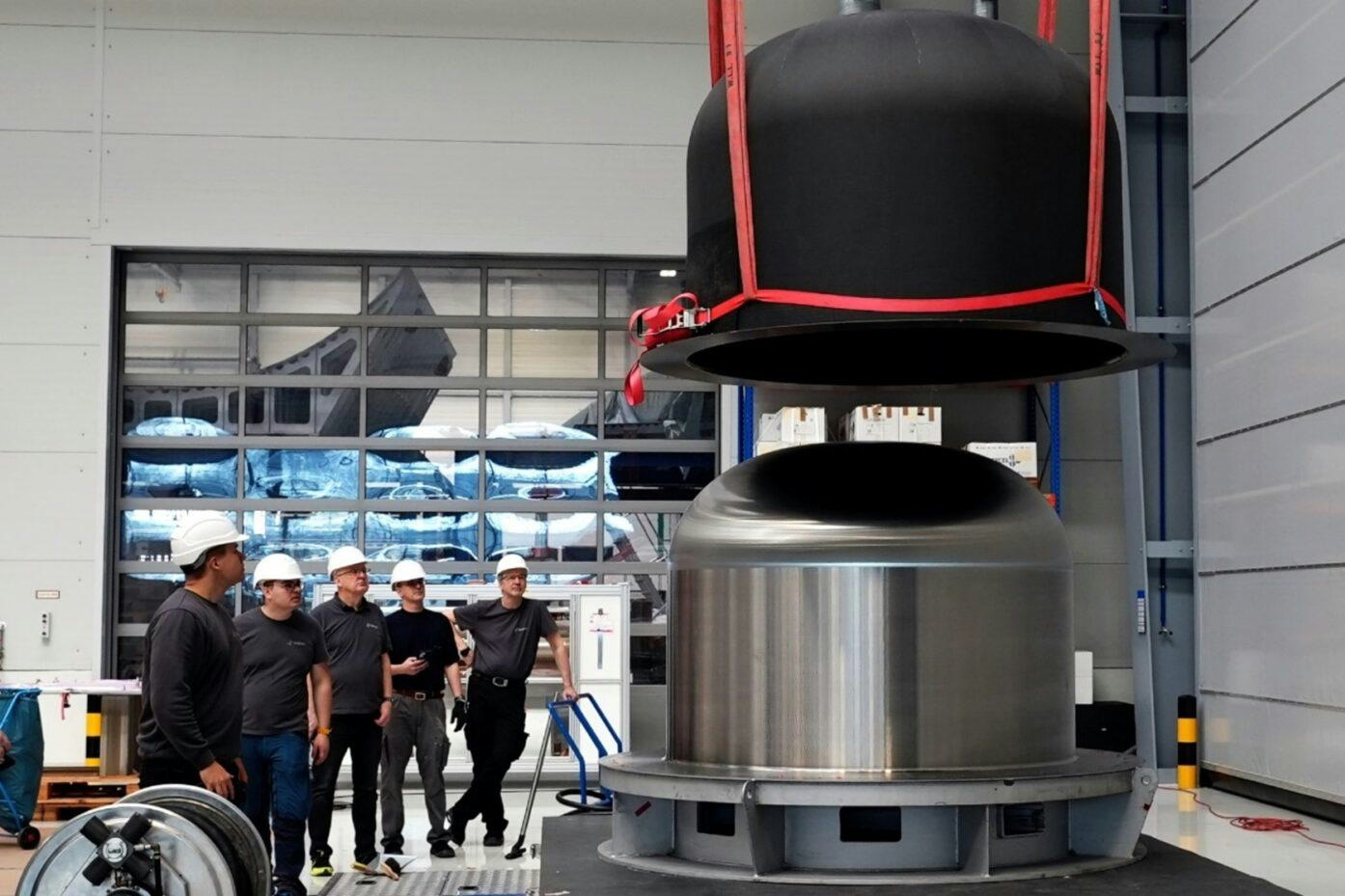
Cryogenic Hydrogen Fuel System Tested for Aircraft Turbines at -423°F
Pioneering Tests at the German Aerospace Center
Engineers at the German Aerospace Center (DLR) have successfully completed a series of pioneering cryogenic tests aimed at evaluating the feasibility of liquid hydrogen as a fuel for future aircraft engines. These experiments were conducted at DLR’s newly established Future Propulsion Test Facility in Cologne, which became operational in October 2025. The tests subjected an innovative hydrogen fuel delivery system to extreme temperatures as low as -423°F (-253°C), the critical point at which hydrogen transitions into its liquid state.
The primary focus of the trials was to address one of the most technically challenging aspects of hydrogen-powered aviation: the safe and reliable transport of liquid hydrogen from onboard storage tanks to aircraft turbines. Maintaining hydrogen in its liquid form requires sophisticated cryogenic storage and distribution systems capable of preserving stable temperatures throughout the entire fuel pathway. This stability must be ensured despite the wide range of external environmental conditions encountered during flight, which can vary from -22°F (-30°C) at cruising altitude to 104°F (40°C) on the ground.
Christian Fleing, the project leader, underscored the importance of these initial tests, describing them as a crucial first step in a long developmental journey. Conducted in February 2026, the experiments achieved Technology Readiness Level 4 (TRL 4), indicating that key components and prototypes were successfully validated within a controlled laboratory environment.
Challenges and Industry Collaboration
Liquid hydrogen (LH2) is widely regarded as a promising energy carrier for aviation due to its potential to eliminate carbon dioxide (CO2) emissions when combusted. In 2024, DLR demonstrated that aircraft engine combustion chambers could operate safely on 100% gaseous hydrogen. Despite this progress, significant challenges remain in the efficient and safe storage and delivery of hydrogen at cryogenic temperatures. Unlike conventional jet fuel, hydrogen requires considerably more storage volume, operates under high pressure, and demands advanced thermal management systems. Additionally, turbine engines must be modified to burn hydrogen directly, necessitating further innovations in structural materials and heat management technologies.
To overcome these obstacles, DLR partnered with Italian original equipment manufacturer Vanzetti, recognized for its expertise in cryogenic pumps within the maritime sector, and the Messer Group, specialists in cryogenic technologies. Fleing noted that while comparable systems did not exist in aviation, the shipping industry provided valuable technological precedents.
Implications for the Future of Aviation
The successful completion of these tests represents a significant milestone in the pursuit of hydrogen-powered flight, though the path to commercial viability remains complex. Researchers plan to utilize the data gathered to conduct advanced computer simulations and explore adaptations of the system for practical aircraft operations. Florian Herbst, director of the DLR Institute of Propulsion Technology, highlighted the initiative as a rare example of fundamental research in modern aeronautical engineering, focusing on entirely new system architectures rather than incremental improvements.
The broader aviation industry is closely monitoring these developments, with expectations of increased investment in sustainable aviation technologies. Market dynamics may prompt competitors to develop similar cryogenic hydrogen systems or to advance hybrid-electric propulsion solutions, particularly for smaller aircraft. Nonetheless, regulatory and logistical challenges—including securing financing and airline purchase agreements—will be critical factors influencing the pace at which hydrogen-powered aviation can be realized.

Etihad Airways Suspends Airbus A380 Flights on Key Route

Aditya Birla Group Seeks Approval for Aircraft Leasing in GIFT City

Qatar Airways Highlights Innovation and Connectivity at Arabian Travel Market 2026

Hong Kong's Five-Year Plan Includes Andrew Fan's Aircraft Parts Processing Hub Proposal

ACIA Aero Leasing Delivers ATR72-600 to Air Nostrum

RTX Appoints Jill Albertelli as Head of Pratt & Whitney

TAT Technologies Joins Beyond Aero Hydrogen Aircraft Program

AURAK Study Highlights Barriers to Air Taxi Adoption in Emerging Economies

Xiamen Air Selects Altitude for 787 Maintenance at Heathrow

Etihad and Swissport Extend Global Partnership
