
KI-Erkenntnisse in konkrete Maßnahmen überführen

Trends
Categories
Current Fleet Size of Boeing 717 Aircraft
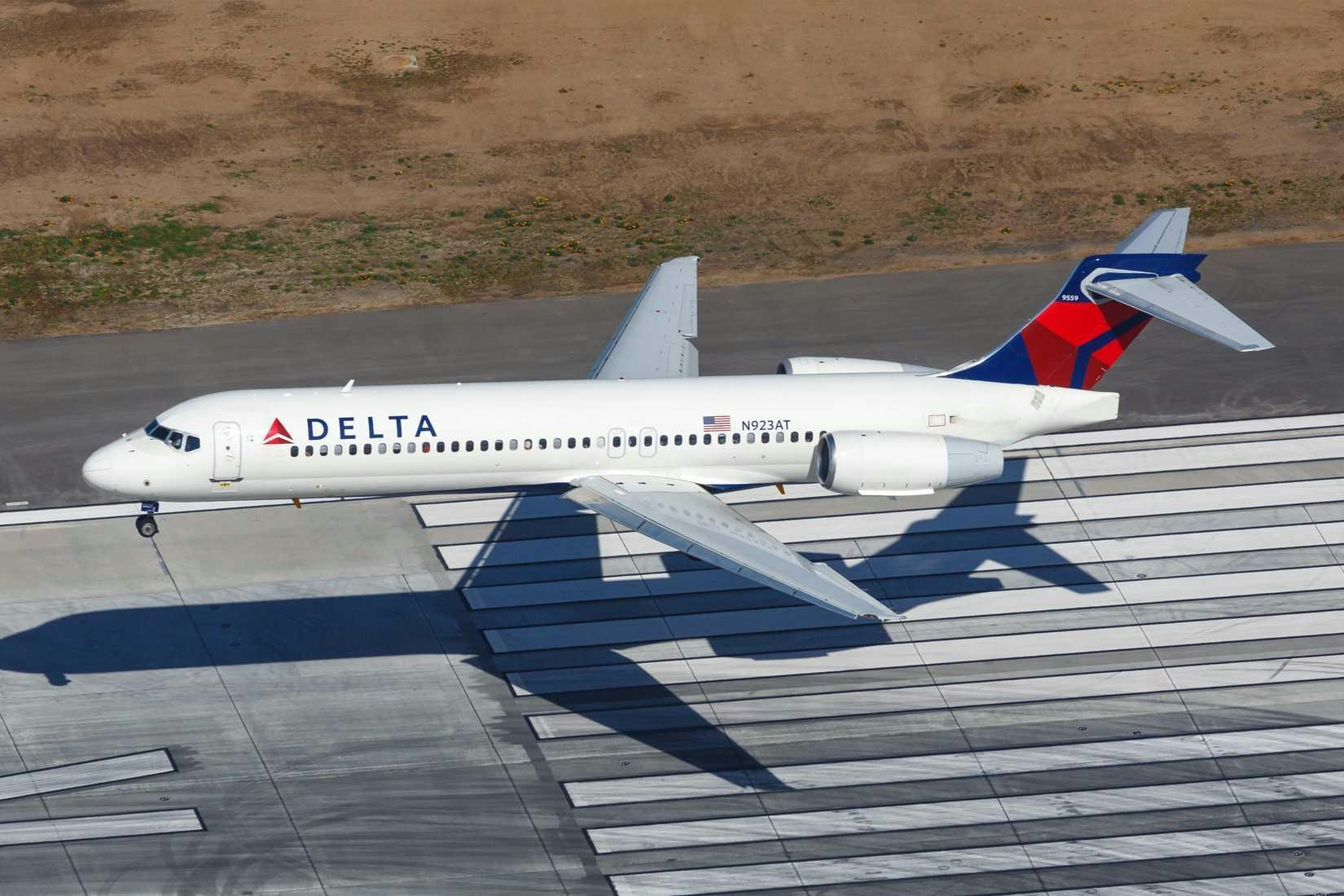
Current Fleet Size of Boeing 717 Aircraft
The Boeing 717 is a compact, twin-engine jet airliner primarily designed for regional and short-haul routes. Its distinctive T-tail and rear-mounted engines make it easily recognizable, bearing a close resemblance to its DC-9 and MD-80 predecessors. Although the aircraft is gradually being phased out as airlines transition to newer, more fuel-efficient models, the Boeing 717 remains in active service with several carriers, continuing to fulfill an important role within their route networks.
The Launch and Evolution of the Boeing 717
The Boeing 717 traces its origins to the early 1990s when McDonnell Douglas aimed to modernize its DC-9/MD-80 family to better compete with emerging regional jets. In 1991, the company introduced the MD-95, a 100-seat jet equipped with updated avionics and powered by more efficient Rolls-Royce BR715 engines. Financial difficulties delayed the program until 1995, when ValuJet Airlines (later AirTran Airways) became the launch customer. Following Boeing’s acquisition of McDonnell Douglas in 1997, the MD-95 was rebranded as the Boeing 717-200. The aircraft completed its maiden flight in September 1998, with certification and entry into commercial service occurring in 1999.
Operators and Fleet Legacy
AirTran Airways emerged as the most prominent operator of the Boeing 717, extensively deploying the aircraft on domestic routes until its merger with Southwest Airlines in 2014. Trans World Airlines (TWA) also operated the 717 on key domestic routes before merging with American Airlines in 2001. Midwest Airlines adopted the 717 as its primary aircraft in the early 2000s, valued for its comfortable cabin and reliability, until the airline ceased operations.
Current Fleet Size and Market Dynamics
The global fleet of Boeing 717 aircraft is steadily diminishing as airlines modernize their fleets. According to ch-aviation data, only a limited number of carriers continue to operate the type, with Delta Air Lines, Hawaiian Airlines, and Australia’s QantasLink among the most notable. Delta maintains the largest active fleet, utilizing the 717 for high-frequency, short-haul routes, while Hawaiian Airlines and QantasLink employ the aircraft for inter-island and regional services, respectively.
The future of the Boeing 717 is increasingly uncertain amid evolving market dynamics. Darren Hulst, Vice President of Commercial Marketing at Boeing, highlights that rising demand for widebody aircraft in the Middle East is reshaping global fleet strategies. Major carriers in the region are prioritizing larger jets such as the Boeing 787 and Airbus A350 to meet rapid growth and long-haul travel demand. This shift diminishes the market for smaller aircraft like the 717, as airlines seek greater capacity and operational efficiency.
Boeing’s commercial performance reflects these trends. While the company has secured substantial orders for its 787 and 737 models, delays in the 777X program and mixed market responses have kept Boeing’s stock trading within a narrow range. Meanwhile, competitors are expanding their fleets with larger aircraft: Emirates is increasing its holdings of Airbus A380s and A350-900s, and FlyDubai is investing in both Boeing and Airbus narrowbodies to support its growth ambitions.

Etihad Airways Suspends Airbus A380 Flights on Key Route

Aditya Birla Group Seeks Approval for Aircraft Leasing in GIFT City

Qatar Airways Highlights Innovation and Connectivity at Arabian Travel Market 2026

Hong Kong's Five-Year Plan Includes Andrew Fan's Aircraft Parts Processing Hub Proposal

ACIA Aero Leasing Delivers ATR72-600 to Air Nostrum

RTX Appoints Jill Albertelli as Head of Pratt & Whitney

TAT Technologies Joins Beyond Aero Hydrogen Aircraft Program

AURAK Study Highlights Barriers to Air Taxi Adoption in Emerging Economies

Xiamen Air Selects Altitude for 787 Maintenance at Heathrow

Etihad and Swissport Extend Global Partnership
