
KI-Erkenntnisse in konkrete Maßnahmen überführen

Trends
Categories
Dangote Refinery Begins Exporting Aviation Fuel to Europe
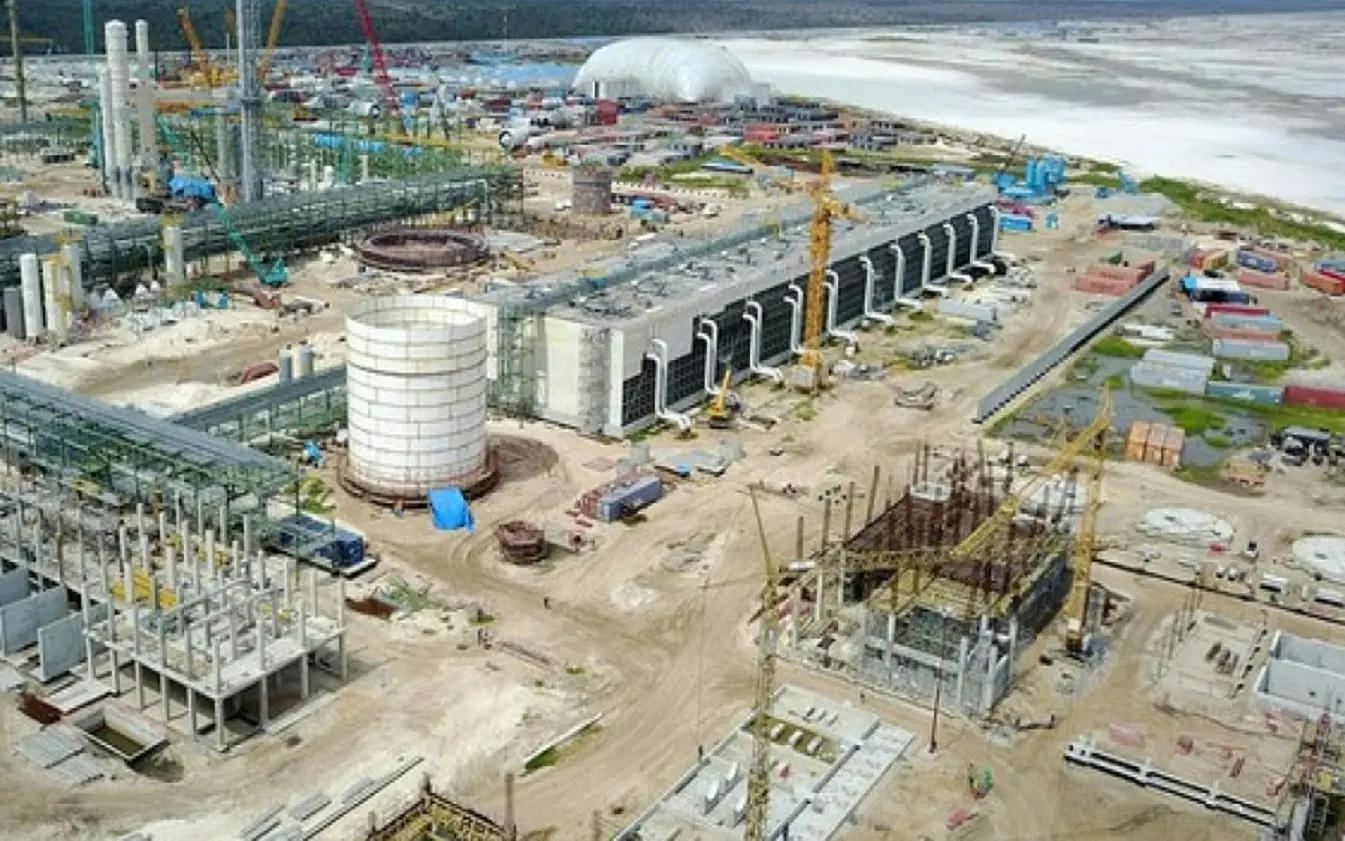
Dangote Refinery Begins Exporting Aviation Fuel to Europe
The global aviation fuel market is experiencing a profound transformation as disruptions in supply chains compel buyers to reconsider traditional procurement strategies. Heightened geopolitical tensions, particularly in the Middle East, have unsettled key shipping corridors, prompting European purchasers to diversify their sources. This shift has elevated West African refineries, with Nigeria’s Dangote Refinery at the forefront, into pivotal roles within the evolving framework of global energy security.
West African Refineries as Emerging Strategic Suppliers
Nigeria’s Dangote Refinery, the largest on the African continent, has rapidly expanded its operational capacity to 650,000 barrels per day, with ambitions to nearly double this output to 1.4 million barrels daily by 2028. This expansion signifies more than industrial growth; it marks Africa’s emergence as a strategic supplier in global energy markets amid widespread disruption. To date, the refinery has dispatched twelve cargoes amounting to 456,000 tonnes of refined products—including aviation fuel, gasoline, and diesel—to various African nations such as Ghana, Cameroon, Côte d'Ivoire, Tanzania, and Togo, as well as to the United Kingdom, underscoring its expanding international footprint.
Responding to Global Supply Disruptions
Historically, approximately 40% of Europe’s jet fuel supply has transited the Strait of Hormuz, a route now compromised by ongoing geopolitical tensions. This vulnerability has compelled European energy planners to adopt multi-continental sourcing strategies, broadening procurement to include suppliers from India, the United States, the Netherlands, and now Nigeria. The recent arrival of Dangote’s aviation fuel at the UK’s Milford Haven port represents a significant milestone, demonstrating that African refining infrastructure can reliably serve European markets through established maritime channels.
This development comes amid soaring benchmark jet fuel prices, which have reached $1,744 per tonne—nearly double pre-disruption levels. The elimination of roughly 21% of global seaborne jet fuel supply due to shipping constraints has intensified the urgency for alternative sources. European buyers are thus moving swiftly to secure diversified supplies, with Dangote’s entry into the market providing a timely and strategic option.
Regional and Global Implications
The conflict in the Middle East has disrupted not only European supply chains but also global crude oil flows, affecting refineries such as India’s MRPL, which recently declared force majeure on fuel exports. This disruption has reverberated across Africa, a continent that remains a net importer of refined petroleum products. In response, countries including South Africa, Kenya, and Ghana are increasingly relying on Nigeria’s Dangote Refinery to meet their fuel demands amid rising prices and escalating costs of goods and services.
Despite these challenges, market analysts suggest that Europe is expected to maintain adequate jet fuel supplies in the near term, largely due to the rapid diversification of sourcing and the integration of new suppliers like Dangote.
The Unique Vulnerability of Aviation Fuel Markets
Aviation fuel markets are particularly sensitive to supply shocks because of their concentrated production sources and specialized refining requirements. Unlike crude oil, which is widely available, jet fuel production necessitates specific technical capabilities that have historically been confined to select regions. The current crisis highlights the critical need to expand refining capacity and diversify supply chains to bolster global energy security.
Dangote Refinery’s successful entry into the European aviation fuel market signals a significant and potentially enduring shift in global energy flows. West Africa is increasingly positioned to play a strategic role in meeting international demand, reshaping the dynamics of the aviation fuel sector on a global scale.

Etihad Airways Suspends Airbus A380 Flights on Key Route

Aditya Birla Group Seeks Approval for Aircraft Leasing in GIFT City

Qatar Airways Highlights Innovation and Connectivity at Arabian Travel Market 2026

Hong Kong's Five-Year Plan Includes Andrew Fan's Aircraft Parts Processing Hub Proposal

ACIA Aero Leasing Delivers ATR72-600 to Air Nostrum

RTX Appoints Jill Albertelli as Head of Pratt & Whitney

TAT Technologies Joins Beyond Aero Hydrogen Aircraft Program

AURAK Study Highlights Barriers to Air Taxi Adoption in Emerging Economies

Xiamen Air Selects Altitude for 787 Maintenance at Heathrow

Etihad and Swissport Extend Global Partnership
