Bild

AeroGenie — Ihr intelligenter Copilot.

Fragen Sie alles. Analysieren Sie alles. Handeln Sie sofort.

Trends

Categories

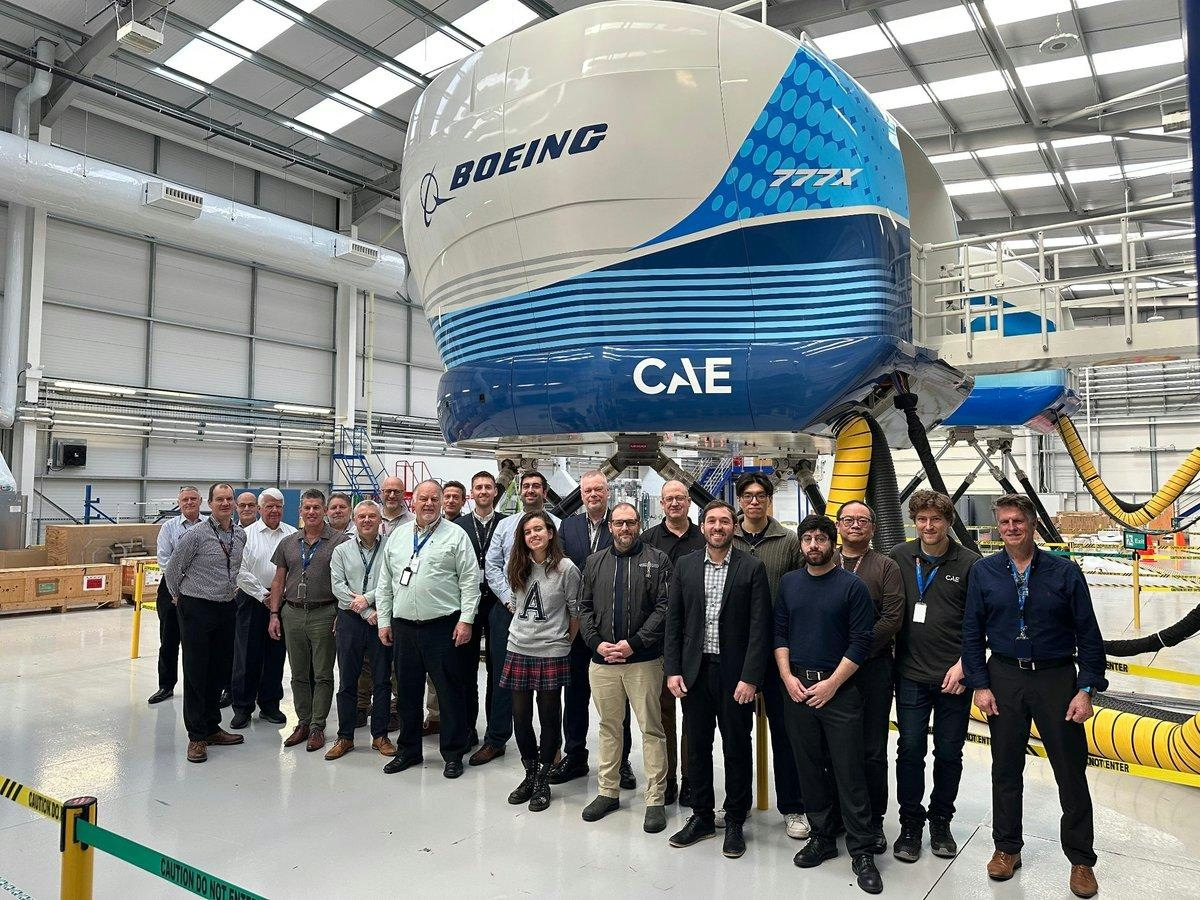
FAA Clears Next Phase for Boeing 777X Ahead of 2027 Entry
March 20, 2026By ePlane AI
FAA Clears Next Phase for Boeing 777X Ahead of 2027 Entry
0
0
Boeing 777X
FAA Certification
Type Inspection Authorization

FAA Advances Boeing 777X Certification Ahead of 2027 Service Entry

SEATTLE — The Boeing 777X program has reached a pivotal milestone as the Federal Aviation Administration (FAA) authorized the aircraft to proceed into the next critical phase of certification testing. This development brings Boeing closer to the anticipated entry into service of the 777-9 model, now scheduled for 2027. Lufthansa is positioned to be the launch customer, with initial deliveries expected early that year.

Certification Progress and Continuing Challenges

Boeing has secured FAA clearance to advance into Phase 4A of the Type Inspection Authorization process for the 777-9, representing the fourth of five key certification stages. Initiated in November, this phase concentrates on verifying system performance, operational reliability, and compliance with regulatory standards across a range of conditions. Although over two dozen 777-9 aircraft have been constructed, only four are currently dedicated to certification testing, with Boeing managing multiple phases concurrently.

Despite this progress, the certification journey remains intricate. Additional testing beyond the five principal phases will be necessary, particularly involving production-standard aircraft. Boeing maintains its target for a 2027 service entry, yet the program’s six-year delay has already imposed significant operational and financial strains on major airline customers.

Impact on Airlines and Market Adaptations

Lufthansa, which has placed orders for 20 Boeing 777-9s, intends to integrate the aircraft into a comprehensive fleet modernization plan. The delays have compelled the airline to reactivate older models—including Airbus A340s, Boeing 747-400s, and Airbus A380s—to accommodate growing travel demand. The 777-9 is designed to replace aging 747s, offering comparable capacity with enhanced fuel efficiency through its twin-engine configuration. Lufthansa aims to retire its 747-400 fleet by the decade’s end, with further widebody retirements planned into the early 2030s.

Emirates, the largest 777X customer with orders totaling 270 aircraft across the 777-8 and 777-9 variants, has also confronted challenges stemming from the delay. To bridge the gap, Emirates has initiated an extensive retrofit program for its existing Boeing 777 and Airbus A380 fleets, upgrading cabin interiors and expanding premium economy options. This approach enables the airline to sustain competitiveness and extend the operational life of its current fleet while awaiting new deliveries.

Industry Implications and Competitive Landscape

The extended delay of the 777X has influenced airline fleet strategies and broader market dynamics. MTU Aero Engines, a principal supplier, anticipates increased deliveries of new engines, including the GE9X that powers the 777X, despite the program’s setbacks. Boeing’s commercial airplane division now projects a return to profitability in 2027, later than originally forecast, as it absorbs elevated costs associated with the acquisition of Spirit AeroSystems.

Market responses remain cautious amid Boeing’s ongoing financial and operational challenges. Competitors such as GE Aerospace, which supplies engines for other Boeing models like the 777-300ER and 777F, stand to benefit from heightened demand as airlines adjust their fleet plans in light of the 777X’s delayed introduction.

Outlook

As the 777X advances through the final certification stages, airlines and industry stakeholders continue to adapt to evolving timelines. The FAA’s recent approval marks a significant step forward, yet the path to commercial service remains complex, with further testing and market adjustments anticipated in the months ahead.

More news
PD-8 Engine Thrust Issue Resolved; Certification Date Announced

PD-8 Engine Thrust Issue Resolved; Certification Date Announced

PD-8 Engine Thrust Issue Resolved; Certification Date Announced Certification Timeline and Technical Developments The certification of the latest PD-8 aircraft engine is now scheduled for April 2026, according to materials released by Rosaviatsia during the final board meeting of the Ministry of Transport of the Russian Federation. This engine is set to become the primary powerplant for the short-haul SJ-100 airliner and, in the longer term, for the Be-200 amphibious aircraft. Originally, the PD-8 certification was planned for November 2025 but was subsequently postponed to the first quarter of 2026. The delay followed reports in December 2025 from a source within the aviation industry, cited by Business Online, indicating that the PD-8 engine was not producing the necessary thrust to support flights with a full passenger cabin. The thrust at maximum take-off mode for the PD-8 is rated at 8,056 kgf. Recent updates suggest that the thrust issue has now been resolved, allowing the certification process to proceed. Manufacturing Innovations Rostec has released unique footage showcasing the manufacturing process of PD-8 components for the SJ-100 aircraft. The video highlights the 3D printing of the oil sump, a critical element of the engine’s oil system, underscoring the advanced production techniques employed in the development of the PD-8 engine.
ATEQ Expands Testing Capabilities with T-RX Integration

ATEQ Expands Testing Capabilities with T-RX Integration

ATEQ Expands Testing Capabilities with T-RX Integration ATEQ Aviation, a prominent global provider of aeronautical test equipment, has announced the acquisition and integration of the T-RX avionics testing solution, formerly owned by CCX Technologies. This strategic development significantly enhances ATEQ’s product portfolio by merging its established air data testing expertise with advanced avionics diagnostics, thereby strengthening its service offerings to the aircraft maintenance sector. Enhancing Testing Solutions for Aircraft Maintenance The T-RX system is widely recognized for its compact design and dependable performance in radio, pulsatory, and GPS testing. By incorporating this technology, ATEQ now delivers a unified testing platform that integrates its well-regarded ADSE series Air Data Test Sets with a versatile avionics testing solution. This combined offering enables Maintenance, Repair, and Overhaul (MRO) organizations to perform comprehensive compliance testing under 14 CFR 91.411 and 91.413 regulations within a single, streamlined workflow. These inspections are essential for aircraft certification and ongoing airworthiness, making the integrated solution particularly valuable. This innovation allows for simultaneous pitot-static and avionics verification, expediting inspection and certification processes while minimizing the need for multiple devices in the hangar. Backed by ATEQ’s strong reputation for aviation safety, the integration is expected to deliver enhanced accuracy and operational efficiency to maintenance professionals. Challenges and Industry Implications Despite the clear benefits, the integration of advanced technologies such as the T-RX presents challenges. The process involves considerable upfront investment in technology upgrades and necessitates extensive training for personnel to adapt to the new systems. While the expanded testing capabilities may bolster investor confidence, some market analysts remain cautious regarding the immediate return on investment. The move is also likely to prompt competitive responses within the industry. Rivals may accelerate their own investments in testing technologies or pursue strategic partnerships to maintain market share. This trend aligns with broader industry developments, as companies like HD Hyundai Electric and Intuitive Machines are simultaneously expanding their testing and production capacities, reflecting a sector-wide shift toward enhanced technical capabilities. Gabriel Nativel, Global Director of ATEQ Aviation, described the integration as a natural progression of the company’s strategy. He emphasized that combining the industry-leading Air Data Test Sets with a high-performance avionics tester provides maintenance professionals with a more comprehensive, efficient, and reliable solution for their daily operations. As ATEQ advances with the T-RX integration, the company aims to establish a new benchmark for comprehensive, efficient, and precise aircraft maintenance testing, while navigating the complexities of technological innovation and an increasingly competitive market environment.
TAT Reports Record Year Amid Continued Growth

TAT Reports Record Year Amid Continued Growth

TAT Technologies Reports Record Financial Performance in 2025 TAT Technologies has announced a landmark year for 2025, delivering record-breaking financial results that underscore its third consecutive year of growth and enhanced profitability. The company reported full-year revenues of US$178 million, the highest in its history, accompanied by margin expansion across all key profitability metrics, including a record EBITDA margin. This performance was driven primarily by strong organic growth and consistent quarter-on-quarter improvements in margins. Although fourth-quarter revenue reflected typical seasonal fluctuations and stabilized relative to earlier quarters, the overall trajectory remained positive. Navigating Industry Dynamics and Market Outlook Despite these robust results, TAT faces a complex and evolving industry landscape as it moves into 2026. The company achieved organic growth exceeding 13%, outpacing broader industry averages. However, recent analyses from Quartr ITGR indicate potential headwinds in the year ahead. Market responses have been mixed, with US stock indices experiencing slight declines, even as some retailers such as Walmart have recorded early gains, according to TradingView. These broader market trends may influence investor sentiment toward TAT and its sector peers. At the close of 2025, TAT’s backlog and long-term agreements stood at approximately US$550 million, up from US$429 million at the start of the year. This substantial pipeline provides strong revenue visibility and supports the company’s objective of sustained growth through 2026. Nevertheless, the competitive environment remains fluid. Structural challenges in Brazil’s aviation market, as highlighted by Azul CEO John Rodgerson, continue to influence competitor strategies, even as growth opportunities endure. Additionally, FutureFuel Corp’s reported loss and operational slowdown in 2025 could reshape competitive dynamics, potentially impacting market share and partnership prospects. The broader aerospace sector is experiencing a rebound, as noted by industry publication The Manufacturer, presenting both opportunities and challenges for TAT. Continued demand in the aviation maintenance, repair, and overhaul (MRO) market underpins TAT’s strategic focus on expanding its capabilities and pursuing mergers and acquisitions, particularly in thermal management and power systems. Looking forward, TAT remains committed to executing its growth strategy amid shifting market conditions. The company’s strong financial position, growing backlog, and dedication to innovation position it well to address industry challenges and capitalize on emerging opportunities in 2026 and beyond.
Aero Engine Leasing Enters Market for CFM Engine Rentals

Aero Engine Leasing Enters Market for CFM Engine Rentals

Aero Engine Leasing Enters the CFM Engine Rental Market Amid Intensifying Competition Aero Engine Leasing (AEL), a newly established aviation leasing platform, has officially launched its operations in the global engine leasing market. The company aims to provide premium, asset-backed leasing solutions tailored to the needs of airlines and operators worldwide. Founded by a team with extensive experience in the aviation aftermarket, AEL seeks to address the evolving demands of today’s operators by offering responsive, reliable, and scalable engine leasing options. Strategic Focus on CFM Engine Platforms AEL’s initial market entry centers on CFM engine platforms, a highly sought-after segment within the aviation industry. This strategic focus places the company in direct competition with established players, notably CFM International, the joint venture between GE Aviation and Safran Aircraft Engines. As the engine rental market expands, AEL faces the challenge of distinguishing itself amid industry skepticism regarding the reliability and cost-effectiveness of leasing compared to outright engine purchases. Despite these challenges, AEL has launched with considerable momentum, supported by fresh investment, an expanding asset portfolio, and a robust network of industry partners. The company has already marked a significant milestone with the deployment of its first CFM engine, signaling the commencement of active operations and portfolio growth. AEL has set an ambitious goal to have 30 engines either on lease or under management by the end of 2026, reflecting its commitment to rapid yet sustainable expansion. Integration with Aero Engine Solutions and Market Outlook AEL’s close integration with Aero Engine Solutions (AES) serves as a key differentiator in the competitive leasing landscape. Tyler Norman, President and CEO of AES and Managing Partner of AEL, emphasized the advantages of this synergy: “By working hand in hand, we can move faster, provide comprehensive support, and create smarter solutions for airlines navigating today’s operational challenges.” This collaboration enables AEL to offer a unique value proposition through enhanced service capabilities and operational agility. Industry analysts observe that the engine leasing sector is becoming increasingly competitive, with incumbent firms likely to respond to new entrants like AEL through price adjustments, improved service offerings, or strategic partnerships aimed at preserving market share. Nonetheless, the market outlook remains optimistic. The Asia-Pacific region’s engine maintenance, repair, and overhaul (MRO) market alone is projected to surpass $30 billion by 2035, underscoring significant growth opportunities for both established companies and newcomers. With its initial assets already in operation and a solid foundation established, Aero Engine Leasing is positioning itself as a potential partner for airlines seeking flexible engine solutions. The company’s ability to build trust and deliver consistent value will be critical as it navigates a competitive and rapidly evolving market environment.
India's Aviation Maintenance Sector Poised for Growth

India's Aviation Maintenance Sector Poised for Growth

India's Aviation Maintenance Sector Poised for Growth India's Maintenance, Repair, and Overhaul (MRO) sector is positioned for substantial growth, with its market size projected to reach USD 5.7 billion by 2030, according to Singapore-based Alton Aviation Consultancy. This expansion is driven by a rapidly growing commercial aircraft fleet and significant enhancements in airport infrastructure, highlighting the sector’s vital role in the country’s evolving aviation landscape. Expansion of Fleet and Infrastructure Directors Alan Lim and Joshua Ng of Alton Aviation Consultancy project that India’s commercial fleet will exceed 1,800 aircraft by 2030, with the number of narrow-body planes nearly doubling. To accommodate this growth, the Indian government plans to develop over 100 new airports, increasing the total number to more than 200 by the decade’s end. This infrastructure expansion is complemented by substantial public and private investments aimed at strengthening the aerospace ecosystem. Key initiatives include the development of manufacturing hubs and special economic zones, such as Hyderabad’s Adibatla SEZ, which are attracting global aerospace companies. These coordinated efforts are designed to establish India as a self-reliant aviation powerhouse. Challenges and Workforce Development Despite the promising outlook, the sector faces significant challenges, particularly in cultivating a skilled workforce capable of supporting rapid industry growth. Recent layoffs at Hyundai’s eVTOL unit, Supernal, have underscored vulnerabilities within the aviation maintenance labor market. In response, several industry stakeholders are prioritizing advanced training and recruitment programs. For instance, the Women in Aviation and Aerospace Career Support (WACS) recently awarded over $53,000 to support women pursuing careers in aviation maintenance and flight training. This initiative reflects a broader commitment to enhancing technical expertise and promoting diversity within the sector. Technological Innovation and Security Concerns Technological advancements, especially in predictive maintenance, present opportunities to improve operational efficiency. However, these innovations also raise ongoing concerns related to data privacy and security. The integration of such technologies necessitates stringent safeguards to protect sensitive information and maintain operational integrity. Leading aerospace companies, including Airbus, are investing in new technology hubs to enhance engineering and maintenance capabilities, aiming to address both technological challenges and evolving regulatory requirements. Market Outlook Market responses to these developments remain mixed. While infrastructure expansion and increased investment signal optimism, the sector’s long-term growth will depend on its ability to resolve workforce shortages and manage technological risks effectively. As India continues its strategic efforts to emerge as a global aviation leader, the evolution of the MRO sector will hinge on balancing rapid expansion with targeted investments in talent development and technological innovation.
AFI KLM E&M Announces Four Key Appointments

AFI KLM E&M Announces Four Key Appointments

AFI KLM E&M Announces Four Senior Leadership Appointments Air France Industries KLM Engineering & Maintenance (AFI KLM E&M) has announced a series of key executive appointments as it prepares for the departure of Géry Mortreux, the current executive vice president of Air France Industries, who will leave the Air France-KLM group on May 1, 2026. These leadership changes arrive at a critical juncture for the company, which is contending with rising operational costs and disruptions—particularly impacting KLM—while competitors accelerate the adoption of advanced repair technologies and expand industrial capacity to safeguard profit margins. Vincent d’Andrea will succeed Mortreux as executive vice president of Air France Industries. Gilles Mercier will assume d’Andrea’s former position as senior vice president of airframe maintenance. Tommaso Auriemma has been appointed chief executive of Barfield, AFI KLM E&M’s US-based subsidiary, and Magali Jobert will take on the role of vice president sales for the Asia-Pacific region. Leadership Profiles and Strategic Roles Effective May 1, 2026, Vincent d’Andrea will report directly to Anne Rigail, chief executive of Air France, while continuing to represent all maintenance activities within the Air France executive committee. An engineering graduate from École Centrale de Paris, d’Andrea joined Air France in 1998 and has held numerous leadership roles, including heading the subsidiary CRMA and serving as group component product director. Since 2018, he has been senior vice president overseeing engineering and airframe maintenance. Gilles Mercier, who will succeed d’Andrea, currently serves as chief executive of Barfield, a position he has held for the past three years. Mercier joined the group in 2008 and has accumulated extensive experience across engineering and maintenance functions, including roles as head of costing and pricing, engine business unit manager, chief transformation officer, and chief of staff to the executive vice president of engineering and maintenance. He became part of Barfield’s leadership team in 2019. Tommaso Auriemma, appointed to lead Barfield, brings over 26 years of global maintenance, repair, and overhaul (MRO) experience. Since 2021, he has served as vice president sales for the Asia-Pacific region, based in Singapore, and will relocate to Florida to head Barfield from its headquarters. His career began in Italy within component shops and maintenance, followed by executive roles in France and a six-year tenure as chief executive of Aerotechnic Industries in Morocco. Magali Jobert will assume her new position in the Asia-Pacific region on July 1, 2026. Beginning her career at 16 as an aircraft mechanic trainee at Air France, she has developed expertise in operational maintenance, industrial customer support, and strategic asset management. Most recently, she served as vice president component asset manager and aerostructure, focusing on strategic asset management for industrial clients. Context and Industry Outlook These appointments coincide with AFI KLM E&M’s record profitability, driven by robust transatlantic demand and growth in premium travel segments, despite ongoing challenges such as issues with GTF engines. Market responses to the leadership changes have been positive, reflecting confidence in the group’s strategic direction and governance. Anne Brachet, president of AFI KLM E&M, expressed her gratitude to Géry Mortreux for his decade of dedicated service and achievements. She also extended congratulations to the newly appointed executives, expressing confidence that their leadership will contribute to the group’s continued success.
Joby Aviation Conducts Air Taxi Flights Over Bay Area

Joby Aviation Conducts Air Taxi Flights Over Bay Area

Joby Aviation Advances Air Taxi Test Flights Over the Bay Area Joby Aviation, a Santa Cruz-based startup specializing in electric vertical takeoff and landing (eVTOL) aircraft, has received regulatory approval to conduct test flights over the San Francisco Bay Area. This milestone represents a significant development in the pursuit of urban air mobility. On Thursday, NBC Bay Area’s SkyRanger helicopter captured footage of Joby’s eVTOL aircraft operating near the iconic Golden Gate Bridge, signaling progress toward integrating air taxis into the region’s transportation network. Progress and Vision for Urban Air Mobility Currently, Joby’s test flights involve a human pilot, but the company envisions a future where its air taxis will operate autonomously, capable of carrying up to four passengers per trip. The startup is actively engaged in the certification process with the Federal Aviation Administration (FAA), a critical step toward launching commercial air taxi services. Joby has already completed several demonstration flights, advancing both its technological capabilities and regulatory compliance. In a recent interview with NBC Bay Area’s Raj Mathai, Joby’s Chief Production Officer Eric Allison outlined the company’s vision for transforming urban transportation and detailed the ongoing efforts required to bring air taxi operations to market. Industry Competition and Legal Challenges Joby’s progress unfolds amid growing competition and controversy within the emerging air taxi sector. Rival company Archer Aviation has leveled serious allegations against Joby, accusing it of fraud by concealing connections to Chinese entities while securing U.S. government contracts. Archer’s countersuit contends that Joby misrepresented itself as an American-made company to obtain government support, raising significant concerns about transparency and fair competition in this nascent industry. As both companies navigate complex regulatory environments and legal disputes, the race to establish viable air taxi services highlights the high stakes and challenges inherent in revolutionizing urban transportation.
Safran’s ENGINeUS Electric Motor Honored at 2026 Aviation Week Laureates

Safran’s ENGINeUS Electric Motor Honored at 2026 Aviation Week Laureates

Safran’s ENGINeUS Electric Motor Honored at 2026 Aviation Week Laureates Safran’s ENGINeUS electric motor, recognized as the world’s first certified electric motor for hybrid and all-electric aircraft, has received a prestigious accolade at the 2026 Aviation Week Laureates. This recognition follows a significant milestone achieved in 2025 when the ENGINeUS secured certification from the European Union Aviation Safety Agency (EASA). The certification process was the culmination of four years of intensive collaboration, encompassing four motor iterations, 700 hours of flight testing, and 3,000 hours of laboratory trials. Certification from the U.S. Federal Aviation Administration (FAA) is currently underway. Technological Innovation and Industry Impact The ENGINeUS 100 motor establishes a new industry standard by delivering a maximum takeoff power of 180 kW. It incorporates integrated electronics, air cooling, silicon carbide technology, and a highly optimized electromagnetic architecture. These advanced features contribute to a robust design that significantly reduces operational costs through simplified maintenance and enhanced energy efficiency. Engineered for versatility, the ENGINeUS motor supports a broad spectrum of applications. It is suitable for fully electric propulsion in two- to four-passenger aircraft, distributed hybrid-electric propulsion for regional transports accommodating up to 19 passengers, and the hybridization of future commercial aircraft engines designed for up to 150 passengers. Its adaptability extends to defense platforms, where reliability and performance are critical. Several prominent manufacturers in the emerging air mobility sector, including Ascendance, AURA AERO, Bye Aerospace, CAE, Diamond Aircraft, TCab Tech, and VoltAero, have already adopted the ENGINeUS motor. Safran Electrical & Power collaborates closely with these partners to customize the motor according to their specific requirements. The system’s modular design facilitates integration across diverse aircraft configurations, addressing both civil and military needs. Challenges and Future Prospects Despite its achievements, Safran faces ongoing challenges in a competitive and rapidly evolving market. The company must contend with increasing competition from alternative electric motor technologies and navigate complex regulatory frameworks within the aviation sector. Rigorous testing and certification remain essential to uphold safety and performance standards. As interest in hybrid-electric propulsion systems grows among airlines and manufacturers, competitors are expected to accelerate their development efforts and pursue strategic partnerships to enhance their offerings. Bruno Bellanger, CEO of Safran Electrical & Power, emphasized the significance of the award, stating, “We are extremely proud of this award, which recognizes 10 years of effort and dedication from our teams and partners. We firmly believe that electrification will be a key enabler for future generations of both commercial and defense aircraft. By lowering costs, increasing reliability, and delivering modular system benefits, our ENGINeUS motor meets the highest performance and adaptability standards across all platforms. This recognition strengthens our commitment to advancing electric propulsion and supporting the evolving needs of our customers worldwide.” Looking forward, Safran Electrical & Power is preparing for series production of the ENGINeUS range, with semi-automated manufacturing lines currently under development in Niort, France, and Pitstone, UK. As the aviation industry continues to evolve, Safran’s ongoing innovation and adaptability will be crucial in maintaining its leadership in electric propulsion technology.
Southern Museum of Flight in Birmingham Marks USA 250 with Aviation History Exhibit

Southern Museum of Flight in Birmingham Marks USA 250 with Aviation History Exhibit

Southern Museum of Flight Commemorates USA 250 with Aviation History Exhibit As the United States prepares to celebrate its 250th anniversary in 2026, the Southern Museum of Flight in Birmingham, Alabama, has unveiled a comprehensive aviation history exhibit to mark this significant milestone. The museum’s display invites visitors to delve into the remarkable stories of pilots, engineers, and aviation pioneers whose innovations have profoundly influenced both American and global air travel. Honoring Aviation Pioneers and the Tuskegee Airmen The exhibit traces the evolution of flight from its earliest days to contemporary technological advancements, spotlighting the journeys of aviation heroes and the aircraft that defined their eras. A central feature is a tribute to the Tuskegee Airmen, the trailblazing African American aviators who shattered racial barriers during World War II. The display includes training aircraft similar to those flown by the Airmen, alongside personal artifacts and detailed narratives of their achievements. This section not only highlights their pivotal role in aviation history but also underscores their significant impact on the civil rights movement. The legacy of the Tuskegee Airmen serves as a powerful testament to resilience and excellence amid systemic racism. Their contributions transformed the U.S. military and opened doors for future generations of aviators. Through immersive storytelling and authentic artifacts, the museum pays homage to their enduring influence on both aviation and social progress. Personal Stories and Broader Context Beyond the Tuskegee Airmen, the museum offers intimate insights into the lives of World War II aviators. One notable exhibit recounts the recovery of a B-25 Mitchell bomber that had been submerged in a South Carolina lake for nearly seven decades. Among the recovered items was a co-pilot’s watch engraved with the date March 5, 1943, providing a poignant connection to the personal sacrifices behind historic wartime events. The Southern Museum of Flight’s initiative arrives amid a complex and evolving aviation sector. Globally, the industry remains sensitive to geopolitical developments, exemplified by the recent drone attack on Dubai Airport, which disrupted airline stocks and underscored the sector’s volatility. Meanwhile, emerging markets such as Brazil continue to face structural challenges, including disproportionate passenger lawsuits and currency financing issues, as noted by Azul CEO John Rodgerson, though they present significant opportunities for growth. Within this competitive environment, the Southern Museum of Flight’s exhibit complements other prominent aviation museums, including the Hagerstown Aviation Museum’s homage to Fairchild Aircraft and the National Museum of the Marine Corps’ football-themed aviation display. These varied approaches reflect the broad appeal and shifting interests within aviation history, shaping how museums engage audiences and respond to industry dynamics. As part of the nationwide America 250 celebrations, the Southern Museum of Flight offers not only a retrospective on the past but also a tribute to the courage, innovation, and legacy that continue to inspire new generations of pilots, engineers, and aviation enthusiasts. Through its carefully curated exhibits, the museum emphasizes the enduring importance of aviation in shaping the nation’s history and future.
TxDOT Aims to Develop Air Taxi Services

TxDOT Aims to Develop Air Taxi Services

TxDOT Advances Development of Air Taxi Services in Central Texas The Texas Department of Transportation (TxDOT) is actively pursuing the development of air taxi services across Central Texas, positioning the state at the forefront of this emerging mode of transportation. Texas is one of eight states selected by the U.S. Department of Transportation to contribute to shaping the future of electric vertical takeoff and landing (eVTOL) aircraft, commonly referred to as “air taxis.” These vehicles have the potential to revolutionize daily travel by offering rapid, quiet, and environmentally friendly alternatives to traditional ground transportation. Testing and Infrastructure Development Recently, at The Long Center in downtown Austin, 14-year-old Weston Rhoden and his family observed test flights of LIFT Aircraft’s single-seat eVTOL vehicles. Rhoden’s reaction—expressing a mix of curiosity and skepticism about the prospect of seeing hundreds of such aircraft in the city skyline—reflects the broader public sentiment toward this futuristic technology. TxDOT has established a coalition dedicated to advancing air taxi development, focusing on critical infrastructure such as sensors, electric charging stations, and prototype designs. Sergio Roman, representing TxDOT’s Aviation Division, emphasized the agency’s role in collecting data to assist federal regulators, including the Federal Aviation Administration (FAA), in formulating safety and reliability standards. “We have the space, and we have the conditions to answer the questions about pretty much everything that they're looking for,” Roman stated. The Austin region’s extensive network of general aviation airports, combined with its proximity to the Texas Hill Country, makes it an ideal location for early air taxi infrastructure. Roman envisions dedicated vertiports capable of accommodating multiple aircraft simultaneously, with designs that prioritize noise reduction through the use of electric propulsion. He highlighted the quiet nature of these aircraft, noting that “goods and passengers [will be] loaded onto these aircraft quietly departing because these are electric aircraft.” Potential Benefits and Challenges Beyond urban applications, the coalition is exploring how air taxis could enhance connectivity for rural communities, improving access to essential resources and enabling faster medical transport during emergencies. However, significant challenges remain before air taxis can become a mainstream transportation option. Regulatory complexities, safety concerns, and technological limitations must be addressed comprehensively. TxDOT and its partners are working toward statewide policy harmonization to ensure consistent standards across Texas. Market responses to air taxi technology are expected to evolve as the sector matures. While initial public skepticism is common, successful test flights and demonstrated safety could shift perceptions and generate enthusiasm. The transportation industry may respond with either collaboration or increased investment, depending on individual readiness to engage with this new market. Affordability remains a central objective for TxDOT. Roman expressed the goal that, at scale, air taxi services would be priced comparably to rideshare options, making them accessible to a broad demographic of Texans. Outlook for Air Taxi Services in Texas Recent projections suggest that limited air taxi operations could commence in Texas cities later this year, with plans to expand to commercial passenger flights within two to three years. Nonetheless, widespread adoption of air taxi services is anticipated to be a longer-term development, potentially becoming commonplace over the next decade. Reflecting on this timeline, Rhoden remarked, “I guess that will probably be the future, in my adulthood,” as he watched the aircraft navigate Austin’s skyline.
line










